Establishing secure connection…Loading editor…Preparing document…

Emancipation Document

This template is fully customizable. Edit the text, fill out the fields, and send it for signature. Give it a try!
Emancipation Document

What an Emancipation Document Is and when it’s used

An Emancipation Document is a formal court petition or written instrument by which a minor seeks legal recognition as an independent adult for specific purposes such as contracting, living independently, or consenting to medical care. The filing typically asks a juvenile or family court to find that the minor is financially self-sufficient, capable of managing personal affairs, and that emancipation is in the minor’s best interest. Procedures, required evidence, and outcomes vary by state; many courts require proof of stable income, housing, and maturity before issuing an order of emancipation.

Why an Emancipation Document matters for legal capacity

An Emancipation Document alters the minor’s legal capacity and can remove the need for parental consent for contracts, healthcare, and housing in the issuing jurisdiction. It creates enforceable rights and duties for the emancipated minor while clarifying third-party responsibilities and potential liabilities.

Why an Emancipation Document matters for legal capacity

Who typically prepares and reviews an emancipation petition

Common participants include the minor (petitioner), a parent or guardian (respondent), counsel for either side, and the juvenile or family court where the petition is filed.

  • Minor petitioner — files petition
  • Parent or guardian — named respondent
  • Court or clerk — processes the petition

Step-by-step: preparing and filing an emancipation petition

Follow these steps in order to prepare a clear petition, collect evidence, and submit the filing according to local court rules and service requirements.

  • 01
    Gather documents: Collect ID, pay stubs, lease or proof of residence, school records.
  • 02
    Draft petition: Describe facts, include statutory citations, and request specific relief.
  • 03
    Serve parties: Follow state rules for service on parents or guardians.
  • 04
    Attend hearing: Bring originals, witnesses, and budgetary affidavits to court.

Typical online filing workflow for emancipation paperwork

An online workflow speeds preparation and delivery while preserving required records; confirm local courts accept electronic filings or require paper lodgment.

  • Prepare template: Upload a court-compliant petition and supporting affidavits.
  • Add fillable fields: Place name, date, signature, and notarization fields where required.
  • Collect eSignatures: Secure signatures with appropriate authentication and audit trail.
  • Save and file: Export signed PDF for court filing or to a local e-file portal.

Configuring a digital workflow for emancipation petitions

Set up the online steps so each signer and reviewer is guided through required fields and attachments before submission.

Field Online Setting
Signature Require signed signature and date fields on final page
Authentication Use email + SMS code for petitioner verification
Attachments Make income and lease exhibits required uploads
Conditional fields Show additional proof requests if income below threshold

Technical considerations when e-filing emancipation documents

Courts and clerks accept different formats and levels of electronic authentication; verify the destination before preparing the final file.

  • Accepted formats: PDF/A preferred for court compatibility
  • Authentication: Email + SMS or knowledge-based authentication
  • Retention: Maintain an auditable certificate of completion

For sensitive records or healthcare-related matters, select a platform that supports encryption, access controls, and long-term storage for audit purposes.

Common preparation mistakes to avoid

  • Missing supporting proof of income or housing often leads to continuance or denial at hearing.
  • Incomplete service of process on a parent or guardian can invalidate the filing and require re-service.
  • Using inconsistent names or dates between exhibits and the petition triggers clerk requests for correction.
  • Failing to confirm whether your local court accepts electronic filings results in rejected submissions.

Risks and consequences of incorrect or false emancipation filings

Court denial: Petition dismissed without prejudice
Perjury exposure: False statements can trigger criminal or civil sanctions
Service defects: Improper notice may void proceedings
Administrative delay: Continuances increase time and costs
Financial exposure: Contract disputes if signature authority later contested
Record retention: Loss of evidence if originals not preserved

Essential security and compliance items for sensitive filings

Encryption: AES-256 at rest; TLS 1.2/1.3 in transit
Audit trail: Timestamped signer events and IP logs
HIPAA readiness: Business associate agreement available if PHI present
Access controls: Role-based permissions and SSO support
Tamper evidence: Document integrity checks and version history
Long-term storage: Secure archival with reproducible records

Key components to include in a professional emancipation petition

A complete petition organizes facts and exhibits to address statutory requirements; include clear headings, sworn statements, and supporting documentation that courts expect to review.

Caption and parties

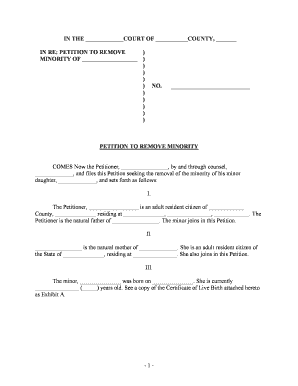
Court caption, case number if known, petitioner and respondent full names and addresses for service.
Statement of facts

Chronological narrative describing independence, living arrangements, education, and conduct supporting emancipation.

Affidavit of support

Sworn statement and exhibits showing income, employment, bank statements, or third-party sponsorship.

Housing proof

Lease, letter from landlord, or utility bills showing stable residence apart from parents.

Notice and service

Declaration of service method and proof that parents/guardians were properly notified per local rules.

Proposed order

Draft order for the judge to sign that specifies rights granted and any limitations.

Practical tips for accurate and efficient completion

Adopt a consistent checklist approach so filings are complete, verifiable, and compliant with local court rules.

Verify local court rules
Confirm filing format, required exhibits, and hearing scheduling procedures with the clerk—rules vary widely and omissions lead to rejections.
Use sworn affidavits
Support statements with notarized affidavits and documentary attachments such as pay stubs and rental agreements to strengthen credibility.
Keep originals
Retain original documents and maintain a secure copy of the signed petition and exhibits for at least seven years or per local retention rules.
Plan for service
Arrange proper service on parents/guardians early; failure to serve can indefinitely delay proceedings and may require re-filing.

Comparing eSignature vendor pricing and basic capabilities

Costs and capabilities vary by vendor and plan; the table below summarizes starting price, trial availability, bulk send, audit trail, HIPAA support, and envelope limits.

signNow DocuSign Adobe Sign PandaDoc HelloSign
Starting Price $8/user/mo $15/user/mo $14/user/mo $19/user/mo $15/user/mo
Free Trial 7-day free trial Varies Varies Varies Varies
Bulk Send Yes Yes Yes Yes No
Audit Trail Yes Yes Yes Yes Yes
HIPAA Compliant Yes Yes Yes No No
Envelope Cap No cap 100 envelopes/user/year Varies Varies Varies

Frequently asked questions about preparing and filing emancipation documents

Answers to common questions about eligibility, evidence, signatures, and filing help reduce delays and improve completeness before submission.


Need help? Contact support

be ready to get more
Join over 28 million airSlate SignNow users