Establishing secure connection…Loading editor…Preparing document…

Competition Racing and Training Release of Liability Waiver

This template is fully customizable. Edit the text, fill out the fields, and send it for signature. Give it a try!
Competition Racing and Training Release of Liability Waiver

What the Competition Racing and Training Release of Liability Waiver Is

The Competition Racing and Training Release of Liability Waiver is a legal agreement used by event organizers, training facilities, and coaches to document a participant's assumption of risk and to limit organizer liability for injuries or property damage arising from racing or training activities. The form typically identifies the participant, event details, voluntary acceptance of hazards, acknowledgment of rules, and a signature block for the participant or the participant's legal guardian when required. It is intended to clarify responsibilities and evidence informed consent before participation.

Why this Waiver Matters for Organizers and Participants

A clear, well-drafted waiver reduces ambiguity about risk allocation, documents participant consent, and supports defense against liability claims. It also standardizes registration, informs emergency response decisions, and helps insurers evaluate exposure.

Why this Waiver Matters for Organizers and Participants

Who Typically Completes This Waiver

Signed waivers form part of the participant record and are often required before permitting on-course participation.

  • Event Organizers and Promoters who manage participant registration, safety briefings, and sanctions.
  • Training Facilities and Coaches responsible for supervised practice sessions and equipment oversight.
  • Parents or Legal Guardians signing on behalf of minors participating in youth racing or training.

Typical Signers and Their Roles

Participant

An adult participant signs to acknowledge risks, follow rules, and accept responsibility. The signature documents informed consent and can affect insurance and dispute resolution outcomes.

Guardian

A parent or legal guardian must sign for minors, confirming authority to consent on the minor's behalf and acknowledging the child's assumed risks and medical authorization provisions.

Core Elements to Include in a Professional Racing and Training Waiver

A complete waiver balances clarity for participants with enforceable legal language; include distinct sections for each essential element.

Assumption of Risk

Describe inherent and activity-specific hazards clearly so the participant understands what risks they are accepting and why those risks are foreseeable.
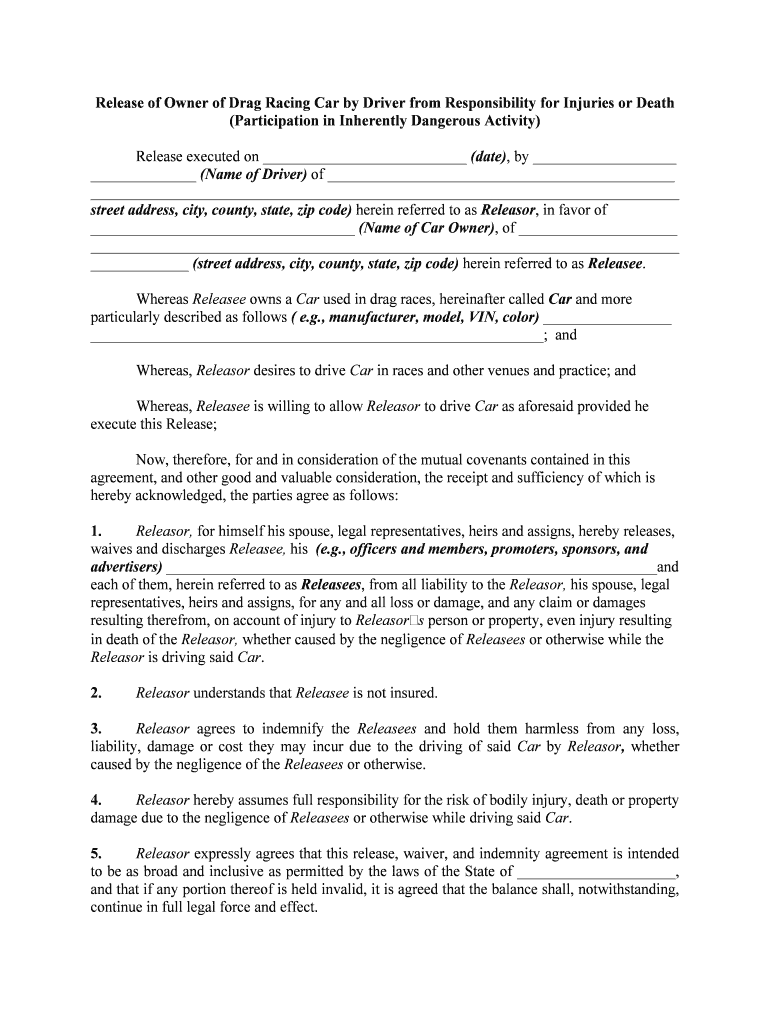
Release of Liability

State which parties (organizers, sponsors, volunteers) are released from claims and specify the scope—bodily injury, property damage, and related losses—using precise language.

Indemnification Clause

Require the signer to indemnify and hold harmless covered parties for claims arising from the participant's negligent actions or rule violations.

Medical Authorization

Include consent for emergency medical treatment, a space for known medical conditions and medications, and an emergency contact to facilitate care.

Acknowledgment and Affirmations

Require affirmations that the signer is physically fit, has reviewed event rules, will follow instructions, and understands cancellation and refund policies.

Governing Law and Severability

Specify the governing state law for disputes and include a severability clause so that invalid provisions do not void the remainder of the agreement.

Step-by-Step: How to Complete and Collect the Waiver

Follow these steps to ensure a valid, complete waiver before participation.

  • 01
    Prepare the Template: Customize event details, dates, and organizer names before distribution.
  • 02
    Verify Signer Identity: Confirm name and DOB; use photo ID or digital authentication where available.
  • 03
    Collect Signatures: Obtain participant or guardian signature and date prior to race entry.
  • 04
    Store a Copy: Provide signer with a copy and retain the original in your records.

Suggested Digital Workflow Settings for Online Waiver Collection

Configure these settings to reduce friction and keep an auditable record of each signed waiver.

Field Configuration
Authentication Email link or SMS code; use stronger MFA for high-risk events
Signing Order Participant signs first, then guardian if required
Conditional Fields Show medical fields only when 'medical condition' checked
Attachments Allow upload of medical clearance or insurance card

How Electronic Waiver Collection Works in Practice

A streamlined online flow reduces delays and captures an audit trail for each completed waiver.

  • Upload Template: Organizer uploads the standardized waiver form to the signing platform.
  • Place Fields: Add name, date, initials, signature, and conditional medical fields.
  • Send to Signer: Generate an email or SMS link for the participant to open and sign.
  • Capture Audit Trail: System records timestamps, IP, and any authentication events for proof.

Technical Considerations for eSigning and Storage

Ensure the selected system retains the signed record and audit trail in a tamper-evident way and meets any applicable compliance requirements.

  • Supported Formats: PDF, DOCX compatible with audit trail metadata
  • Authentication Options: Email link, SMS code, or KBA for higher assurance
  • Integration Points: Connectors to CRM, registration, and cloud storage

Comparison: eSignature Vendor Pricing and Key Features

Basic pricing and feature availability across common eSignature vendors. signNow is listed first per platform comparison conventions.

signNow DocuSign Adobe Sign PandaDoc HelloSign
Starting Price $8/user/mo $15/user/mo $14/user/mo $19/user/mo $15/user/mo
Free Trial 7-day free trial, no card Varies by vendor Varies by vendor Varies by vendor Varies by vendor
Bulk Send Yes Yes Yes Yes No
Audit Trail Yes Yes Yes Yes Yes
HIPAA Compliant Yes Yes Yes No No

Security and Compliance Checklist for Electronic Waiver Tools

Encryption: TLS 1.2/1.3; AES-256 at rest
Certifications: SOC 2 Type II available
HIPAA Support: BAA required
Audit Trail: Timestamps, IP, actions logged
Access Controls: Role-based permissions
Accessibility: WCAG 2.0 Level AA

Risks of Incomplete or Incorrect Waivers

Enforceability Risk: Ambiguous language can reduce enforceability
Minor Signature Error: Missing guardian signature may void waiver
Privacy Exposure: Improper PHI handling risks HIPAA noncompliance
Authentication Gaps: Weak signer verification can undermine attribution
Retention Failures: Insufficient records hinder claims defense
Procedural Lapses: Late collection may breach policy or insurer terms

Common Pitfalls to Avoid When Preparing Waivers

  • Using overly broad legalese that participants cannot reasonably understand increases the chance a court will find the waiver ambiguous.
  • Failing to tailor the waiver to the specific activity or environment may leave gaps in risk allocation and insurer coverage.
  • Collecting unsigned or backdated waivers undermines defensibility and may be rejected by insurers or in litigation.
  • Storing waivers without an audit trail or secure backup exposes organizations to evidence spoliation concerns during claims.

Real-World Examples of Waiver Use

These examples illustrate typical organizational uses of racing and training waivers.

Optica Ventures — Event Registration

Optica Ventures incorporated a standardized waiver into online registration to document participant consent and medical info.

  • The waiver included emergency authorization and insurance details.
  • The result provided consistent participant records for events and simplified incident reporting to insurers and medical personnel.

Fertility Centers of Illinois — Clinic Training

A medical training provider used waivers to capture participant health disclosures before hands-on simulation sessions.

  • Medical authorization fields were optional and HIPAA-protected.
  • Retaining signed records with access controls supported compliance and improved readiness for emergency response.

Best Practices for Accurate, Efficient Waiver Management

Adopt consistent processes and controls to improve validity and reduce administrative burden.

Use Clear, Plain Language
Draft the waiver in straightforward terms that a reasonable participant can understand; avoid ambiguous legal phrases that courts may construe against the drafter.
Require Signed Consent Before Participation
Ensure the waiver is completed and signed before permitting participation; consider digital check-in to block access without a signed form.
Protect Sensitive Health Data
Limit PHI collection to essentials, store PHI under HIPAA controls when required, and restrict access to authorized staff only.
Maintain an Audit Trail
Use a signing platform that records timestamps, IP addresses, and authentication events so you can demonstrate when and how the waiver was executed.

Timing Guidelines and Deadlines for Waiver Collection

Plan collection timelines to ensure waivers are valid and integrated with event operations.

Before Participation:

Obtain the signed waiver before the participant accesses the training or race course.

Minor Consent Deadline:

Require guardian signature at registration for minors; do not accept post-event guardian signatures.

Notarization Timing:

If notarization is required, complete it prior to the event start date.

Distribution to Participant:

Provide a copy to the signer immediately after signing, digitally or in print.

Incident Reporting:

Preserve the signed waiver when reporting incidents to insurers or authorities; act promptly to document events.

Key Processing Milestones for Waiver Lifecycle

Follow these milestones to process waivers reliably across registration and event phases.

01

Template Finalization

Finalize language and event-specific details before opening registration.

02

Pre-Event Collection

Collect signed waivers at or before check-in to validate participation eligibility.

03

Storage and Backup

Store signed records securely and back them up with audit metadata preserved.

04

Post-Event Retention

Apply retention policy and archive records in accordance with legal and insurer requirements.

FAQs and Troubleshooting for Waiver Validity and Electronic Signing

Answers to common questions about enforceability, minors, notarization, and electronic execution of waivers.


Need help? Contact support

be ready to get more
Join over 28 million airSlate SignNow users