Establishing secure connection…Loading editor…Preparing document…

End User License Agreement

This template is fully customizable. Edit the text, fill out the fields, and send it for signature. Give it a try!
End User License Agreement

What an End User License Agreement Covers

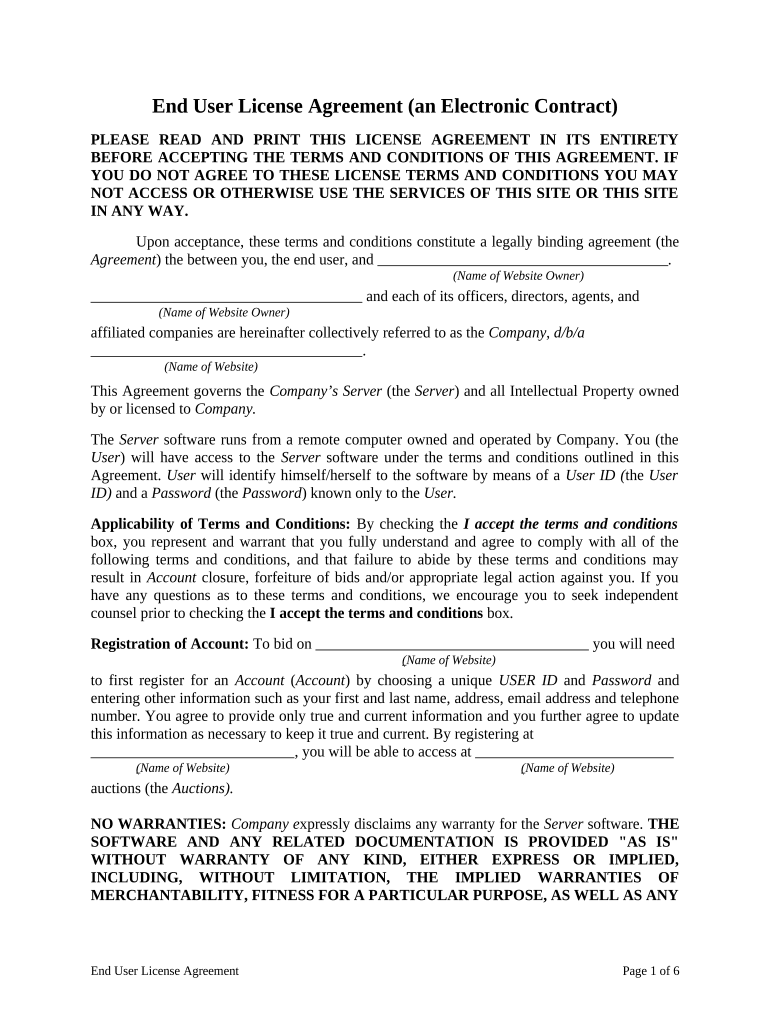
An End User License Agreement (EULA) is a contract that grants an end user limited rights to use software, applications, or cloud services while preserving the publisher’s intellectual property and setting limits on liability, warranties, permitted use, updates, and termination. In the United States a EULA operates as a standard contract: it defines license scope, permitted devices, transfer restrictions, end-of-license obligations, and dispute resolution. Electronic acceptance and records for a EULA are generally enforceable under the federal ESIGN Act and applicable state electronic transaction laws when intent, consent, attribution, and retention requirements are satisfied.

Why a Clear EULA Matters for Providers and Users

A clear EULA reduces legal uncertainty by assigning rights, setting acceptable uses, limiting liability, and establishing procedures for updates and termination. Well-drafted terms protect intellectual property, streamline enforcement, and clarify remedies and notice mechanics for both commercial vendors and end users.

Why a Clear EULA Matters for Providers and Users

Who Prepares and Who Signs an EULA

Typical creators and recipients of EULAs include software vendors, platform operators, corporate purchasers, and individual consumers; each role has different validation and negotiation expectations.

  • Software vendors and licensors: Draft and enforce license terms, often via legal or product teams.
  • Corporate procurement and legal teams: Negotiate commercial terms, service levels, and indemnities on behalf of an organization.
  • Individual consumers and end users: Typically accept standard-form EULAs online; require clear disclosures for consumer-facing clauses.

Who Signs and Who Can Bind the Company

General Counsel

The company’s General Counsel or an authorized attorney typically reviews and approves EULA language and may execute the agreement on behalf of the legal entity when signature authority is delegated in writing.

Authorized Officer

Senior officers (CEO, CFO, CTO) or employees with written delegations may sign for their organization; confirm corporate authority in company bylaws or an internal delegation of authority before accepting terms.

Essential Data Fields for an Enforceable EULA

Parties: Full legal names
Effective Date: MM/DD/YYYY
License Grant: Permitted use
Restrictions: Prohibited actions
Term and Termination: Duration details
Signature Block: Signer name & date

Primary Legal Risks to Watch

Invalid Assent: Challenge to enforceability
Unenforceable Clauses: Excessive liability limits
IP Disputes: Unclear ownership
Privacy Violations: Regulatory fines
Consumer Statutes: State consumer protection risk
Data Breach Exposure: Security obligations

Common Preparation Mistakes to Avoid

  • Relying on implied consent instead of explicit acceptance creates enforceability gaps, especially for consumer-facing agreements.
  • Using inconsistent definitions or vague license scope increases litigation risk and complicates enforcement of restrictions.
  • Failing to provide required consumer disclosures (paper-rights, withdrawal procedures) can violate ESIGN Act consumer rules.
  • Neglecting to specify governing law and venue for disputes leads to uncertainty when cross-jurisdictional issues arise.

Step-by-Step: How to Prepare and Execute a EULA

Follow these sequential steps to draft, review, and obtain valid acceptance of a EULA for software or services.

  • 01
    Draft Core Terms: Define license scope, restrictions, and IP ownership.
  • 02
    Add Compliance Clauses: Include privacy, export control, and warranty disclaimers.
  • 03
    Set Acceptance Method: Choose clickwrap, signed PDF, or negotiated signature flow.
  • 04
    Capture Evidence: Record timestamps, IP, and audit trail for assent.

Where to Send, Store, and Archive Signed EULAs

Routing and retention depend on whether the EULA is consumer-facing or enterprise-negotiated; maintain copies in contract repositories and provide signed copies to counterparties.

  • Signing Portal: Present EULA via a signing platform or web acceptance flow.
  • Counterparty Copy: Deliver signed copy to the licensee for records.
  • Contract Repository: Store master executed agreement in central system.
  • Audit Archive: Retain execution evidence and change history.

Core Clauses Every Professional EULA Should Include

A robust EULA balances enforceability with clarity. These clauses reduce ambiguity and protect both licensors and licensees when disputes arise.

License Grant

Specify permitted uses, device limits, and whether the license is exclusive, nontransferable, or revocable; clarity prevents scope disputes and unlicensed distribution.
Intellectual Property

Declare ownership of software, trademarks, and derivative works, and include assignment language when third-party contributions or open-source components are involved.

Restrictions

List forbidden activities such as reverse engineering, redistribution, and removal of notices; clearly defined prohibitions are easier to enforce.

Warranties and Disclaimers

Limit warranty scope, state disclaimers of implied warranties, and specify remedies such as repair or termination to control liability exposure.

Limitation of Liability

Set reasonable caps and exclusions for consequential damages while ensuring clauses comply with consumer protection laws in applicable jurisdictions.

Updates and Termination

Explain update procedures, notice periods, automatic updates, and termination rights for breach or end of support to manage lifecycle expectations.

How to Configure an Online EULA Acceptance Flow

Configure the acceptance workflow to capture clear assent and an auditable trail across platforms and devices.

Field Configuration
Acceptance Method Clickwrap checkbox with timestamp capture
Authentication Email or SMS verification; add KBA for higher assurance
Recordkeeping Store PDF copy plus audit log and metadata
Versioning Attach effective date and changelog for updates

Technical Requirements for Electronic Execution

Choose a signing platform and integrations that preserve tamper-evident records, timestamps, and a detailed audit trail.

  • File Formats: PDF and DOCX supported
  • Integrations: Salesforce, NetSuite, Microsoft 365
  • Security: AES-256 at rest, TLS 1.2/1.3

Key Timing and Notice Periods to Define

Include clear dates and cure periods in the EULA so parties know when rights, obligations, and update notices take effect.

Effective Date:

When the license rights begin

Renewal Terms:

Automatic renewal or fixed-term renewal periods

Update Notice:

Advance notice period (commonly 30 days)

Breach Cure Period:

Opportunity to cure (commonly 30 days)

Termination Notice:

Procedure for termination and post-termination obligations

Price and Feature Snapshot for E-signature Vendors

Compare typical starting prices and core capabilities for popular e-signature vendors when selecting an execution platform for EULAs.

signNow DocuSign Adobe Sign PandaDoc HelloSign
Starting Price $8/user/mo $15/user/mo $14/user/mo $19/user/mo $15/user/mo
Free Trial 7-day free trial Varies Varies Varies Varies
Bulk Send Yes Yes Yes Yes No
Audit Trail Yes Yes Yes Yes Yes
HIPAA Compliant Yes Yes Yes No No
Envelope Cap No cap 100 envelopes/user/year Varies Varies Varies

Real-World Examples of Electronic Execution and EULA Use

These concise examples show how organizations handle contract execution and compliance when using electronic workflows.

Optica Ventures LLC

The interface is simple and easy-to-use for our team; more importantly, it is just as easy for our customers.

  • Focus on user experience and speed.
  • Optica streamlined license acceptance and centralized executed EULAs to reduce manual processing and improve traceability across deals.

Fertility Centers of Illinois

airSlate SignNow team was exceptional, responsive, and the API supported systems integration.

  • Integration with back-end systems.
  • The organization automated signature collection, preserved audit trails, and maintained HIPAA-aligned workflows for patient-facing forms and consents.

Practical Tips for Accurate, Enforceable EULAs

Apply these practical drafting and execution practices to reduce disputes and ensure consistent implementation.

Use Clear Language
Prefer concise, unambiguous terms over boilerplate to reduce interpretation disputes and improve enforceability.
Capture Electronic Assent
Record timestamps, IP, and acceptance method to support ESIGN and UETA requirements for intent and attribution.
Version Control
Maintain a changelog and effective dates so parties know which version governs their relationship.
Review for Local Law
Check consumer protection and privacy statutes in jurisdictions where your users reside.

Frequently Asked Questions about EULAs and Electronic Execution

Answers to common legal and execution questions about End User License Agreements and their electronic handling.


Need help? Contact support

be ready to get more
Join over 28 million airSlate SignNow users