Establishing secure connection…Loading editor…Preparing document…

Minnesota Ex Parte Order Waiving Service Requirements

This template is fully customizable. Edit the text, fill out the fields, and send it for signature. Give it a try!
Minnesota Ex Parte Order Waiving Service Requirements

What the Minnesota Ex Parte Order Waiving Service Requirements Is

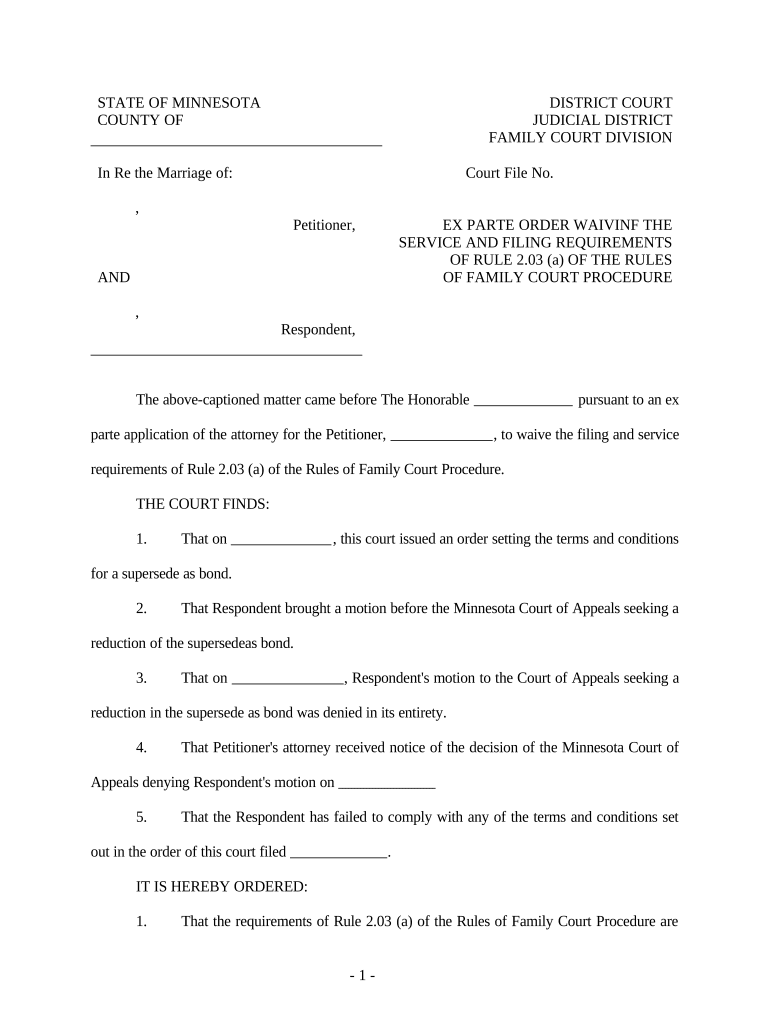
A Minnesota Ex Parte Order Waiving Service Requirements is a court-issued, time-limited directive entered without the opposing party present that suspends or modifies the ordinary rules for serving process under state civil procedure. Typically requested when immediate relief is needed and traditional service would frustrate prompt judicial action, the order must state facts justifying ex parte treatment, comply with governing court rules, and specify any alternative notice or method of service approved by the judge. Drafting should be concise, fact-focused, and supported by affidavit or declaration establishing urgency and good cause.

When this order matters and what it accomplishes

An ex parte waiver of service allows a party to obtain urgent relief or preserve rights when immediate, in-person notice is impracticable or would defeat the purpose of the relief sought. Courts grant such orders narrowly: the requester must show necessity, honest factual basis, and proposed safeguards for due process when full notice is not possible.

When this order matters and what it accomplishes

Who typically prepares and relies on this order

Lead counsel or a self-represented litigant seeking immediate court action prepares the filing; judges evaluate the request under court rules and case law.

  • Civil litigators and plaintiffs' counsel requiring temporary injunctive or preservative relief when standard service would delay action
  • Survivors or parties in domestic or emergency matters seeking temporary protections before standard process can be completed
  • Government attorneys or law enforcement when statutory notice exceptions or expedited procedures apply

Courts expect a clear affidavit of urgency and proposed alternative notice; lack of supporting facts often leads to denial or limited relief.

Key signatories and their roles

Attorney of Record

The attorney filing the motion signs the supporting affidavit and the proposed order, certifies service efforts, and proposes an alternative notice method. The attorney must be licensed in the state and authorized to appear before the court.

Affiant / Declarant

The party or witness who files the sworn affidavit provides factual basis for ex parte relief, including attempts to serve, immediate harm risk, and reasons why standard service is impracticable.

Essential elements to include in a professional order

A complete ex parte waiver order contains judicial findings, an explicit waiver or alternative service method, a limited effective period, and clear directions for post-order notice. Each element supports due process while allowing urgent court action.

Caption

Complete case caption with court name, case number, and party names for immediate identification.
Motion or Affidavit

A sworn factual statement explaining urgency, prior service attempts, and legal basis for waiving or altering service requirements.

Proposed Order

A drafted order for the judge's signature that specifies the precise waiver, duration, and any alternative notice method.

Alternative Notice

Clear instructions for how notice will be provided (email, posting, publication, substituted service) and when it will occur.

Limitations

Temporal and geographic limits and any steps the requesting party must take to complete formal service promptly after emergency relief.

Certificate

A certificate of service or effort describing attempts to notify opposing parties and how they will be informed after the ex parte order.

Required document details and metadata

Case Number: Exact court case number
Court Name: Full judicial district and county
Party Names: Plaintiff(s) and defendant(s) full legal names
Affiant Identity: Name and relationship of the declarant
Date and Time: Filing date and time of ex parte request
Judge Signature Line: Blank signature and date lines for judicial approval

Risks and legal consequences of improper waiver requests

Denial of Relief: Court may deny the motion for insufficient urgency or factual basis
Sanctions: Potential monetary or procedural sanctions for misleading statements or failure to disclose
Delayed Service: Improperly executed alternative notice can delay the case and prejudice the moving party
Due Process Challenges: Opposing party may move to set aside relief for lack of adequate notice
Contempt Risk: Noncompliance with court-ordered notice conditions can lead to contempt
Appeal Grounds: Aggrieved parties may seek interlocutory relief or expedited review

Common mistakes to avoid

  • Relying on conclusory assertions of urgency without concrete facts or timeline
  • Failing to attach or reference prior service attempts and supporting communications
  • Proposing impracticable alternative notice without measurable steps or evidence
  • Submitting a proposed order that lacks clear duration, scope, or method of alternative notice

Step-by-step: preparing and filing the ex parte waiver request

Follow a focused, court-aware process: prepare affidavit, draft proposed order, gather supporting evidence, and follow local court rules for ex parte filings.

  • 01
    Draft Affidavit: Describe facts, urgency, and prior service attempts
  • 02
    Prepare Order: Specify waiver, alternative notice, and expiration
  • 03
    Attach Evidence: Include communications, photos, or affidavits supporting urgency
  • 04
    File Properly: Submit per court's ex parte filing procedures

Customizing an online workflow for electronic filing and notice

Configure a reproducible digital workflow to draft, sign, and file the motion and proposed order, and to send alternative notice after the judge signs the order.

Drafting Platform Use PDF or DOCX template with fillable fields
Signer Authentication Email + SMS code or platform 2FA
Judge Signature Upload for judicial review or e-file when permitted
Alternative Notice Bulk email, certified mail, or publication setup
Recordkeeping Auto-archive signed order and audit trail

Where to file and how the document moves through the system

Filing paths vary by county and case type: e-file when available, deliver courtesy copies per local rule, and follow the judge's chambers procedures for ex parte matters.

  • E-Filing: Submit motion, affidavit, and proposed order via the court's e-filing portal
  • Chambers Delivery: Provide chambers with a courtesy copy if required by local practice
  • Clerk Review: Clerk assigns a judge and may set a brief review schedule
  • Judge Signature: Judge signs the order if satisfied; clerk enters it into the record

Digital signing and distribution considerations

Ensure the chosen eSignature and filing platforms meet court and privacy requirements before submitting ex parte materials.

  • Document Formats: PDF or DOCX accepted by most e-filing systems
  • Authentication: Email plus SMS or stronger signer verification
  • Audit Trail: Retain IP, timestamp, and action logs for the court record

Preserve original signed copies and the platform audit trail; for sensitive matters, choose systems that support HIPAA, ESIGN, and UETA compliance where applicable.

Typical timing and procedural deadlines to monitor

Ex parte proceedings are time-sensitive; track hearing dates, the order's expiration, and any required prompt post-order service to avoid due-process issues.

Hearing Date:

File to obtain same-day or next-business-day review

Order Expiration:

Specify a short duration (days to weeks) in the order

Post-Order Service:

Complete alternative service within days as directed

Response Window:

Allow the opposing party a reasonable time to respond after notice

Record Retention:

Retain filings for the case lifecycle and applicable retention period

Key milestones from filing to final service completion

Track these sequential milestones carefully to preserve emergency relief and conform to due process requirements.

01

File Ex Parte Motion

Prepare and electronically file the motion and supporting affidavit

02

Judicial Review

Judge examines materials and may request supplemental information

03

Order Entry

Judge signs order with defined waiver and notice method

04

Execute Notice

Provide alternative notice according to the order's instructions

Supporting documents to attach with the ex parte request

Attach concise evidence that supports urgency and substantiates prior service attempts; well-organized exhibits help the judge evaluate necessity quickly.

Affidavit/Declaration

A sworn statement detailing facts, dates, attempts at service, and the harm that will occur without immediate relief; attach contact attempts and communications as exhibits.

Proof of Attempts

Screenshots, delivery receipts, email logs, or certified mail tracking demonstrating prior efforts to locate or serve the opposing party.

Proposed Order

A clean, clear order the judge can sign that states the waiver, alternative service method, precise limitations, and when formal service must be completed.

Supporting Exhibits

Photos, affidavits from third parties, or safety reports that corroborate claims of imminent harm or impracticability of standard service.

Practical tips for accurate and efficient preparation

Small drafting choices reduce risk: be specific, attach corroborating evidence, propose reasonable notice, and preserve a clear audit trail for filing and distribution.

Be Specific
State precise facts, timelines, and the nature of immediate harm to support ex parte treatment and ease judicial review.
Limit Scope
Ask only for the minimal waiver or alternative notice necessary to address the emergency.
Provide Safeguards
Propose steps to notify the other party promptly and allow a fair response opportunity after the order is entered.
Preserve Evidence
Retain delivery receipts, platform logs, and certified mail records to demonstrate compliance with the order.

Practical examples of common scenarios

Real-world scenarios illustrate typical uses and judicial expectations when requesting an ex parte waiver of service requirements.

Domestic Protection Example

A petitioner alleges immediate threat to safety and cannot safely serve the respondent in person

  • The court grants a short-term waiver and orders service by email plus posting
  • The order limits relief to 14 days and requires certified mail and a return receipt for full service thereafter.

Asset Preservation Example

A creditor believes assets will be concealed before standard notice can be effected

  • The court authorizes substituted service with a seizure notice posted and sent to a last-known address
  • The order requires the moving party to attempt personal service within five business days.

eSignature provider comparison for managing filings and alternative notice

Comparison of common features and starting prices for eSignature vendors often used to prepare, sign, and distribute court filings; signNow appears first for clarity.

signNow DocuSign Adobe Sign PandaDoc HelloSign
Starting Price $8/user/mo $15/user/mo $14/user/mo $19/user/mo $15/user/mo
Free Trial 7-day free trial No No Yes, limited Yes, limited
Bulk Send Yes Yes Yes Yes No
Audit Trail Yes Yes Yes Yes Yes
HIPAA Compliant Yes Yes Yes No No

Frequently asked questions about Minnesota Ex Parte Order Waiving Service Requirements

Answers to common procedural and practical questions to help avoid drafting errors, comply with court expectations, and preserve emergency relief.


Need help? Contact support

be ready to get more
Join over 28 million airSlate SignNow users