Establishing secure connection…Loading editor…Preparing document…

Louisiana Exception of Prescription

This template is fully customizable. Edit the text, fill out the fields, and send it for signature. Give it a try!
Louisiana Exception of Prescription

What the Louisiana Exception of Prescription Is and When It Applies

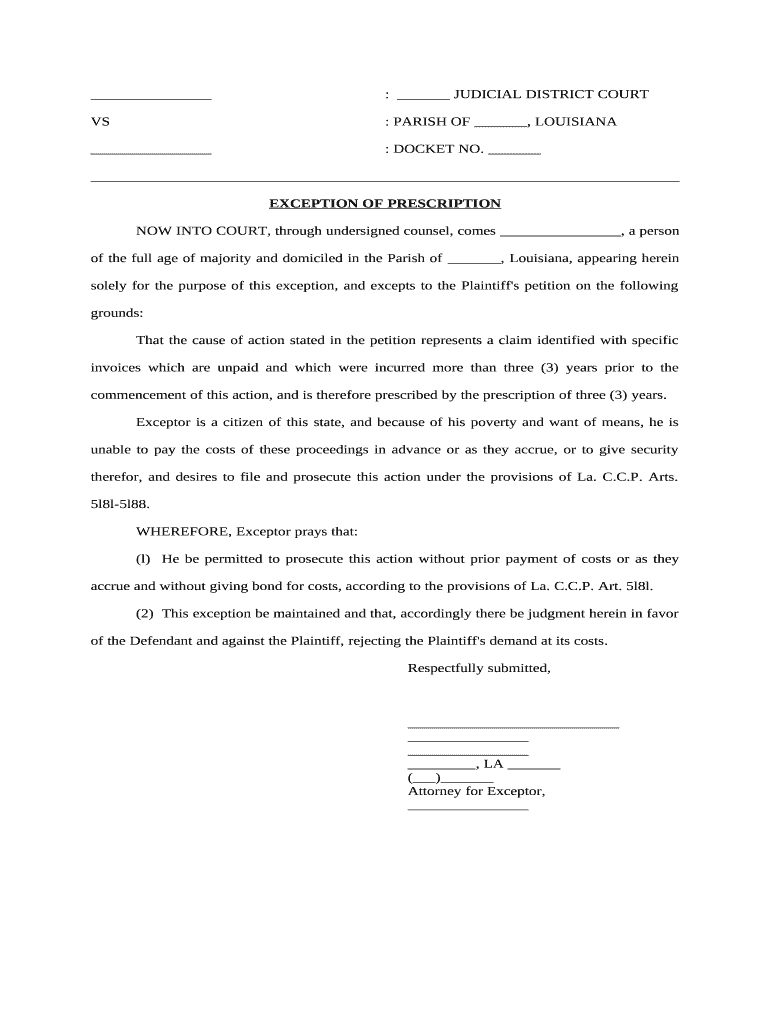
The Louisiana Exception of Prescription is a civil-law pleading used to assert that a plaintiff's claim is barred by the applicable statute of limitations under Louisiana law. Unlike common-law jurisdictions that use the term statute of limitations, Louisiana uses prescription and liberative prescription rules to measure when a right extinguishes. This pleading typically appears as an exception, usually raised by motion or answer, and asks the court to dismiss or limit relief because the claim accrued outside the prescribed period. Timing, cause of action, and accrual rules determine whether prescription is a viable defense in any given case.

Why a Proper Exception of Prescription Matters for Case Outcomes

A correctly drafted Exception of Prescription can terminate an untimely claim early, conserve judicial and party resources, and avoid unnecessary discovery. It preserves the defendant’s substantive and procedural rights while ensuring courts decide cases on timely legal grounds.

Why a Proper Exception of Prescription Matters for Case Outcomes

Who Typically Prepares and Files This Exception

Defense counsel, in-house legal teams, and self-represented defendants commonly prepare the Exception of Prescription when a plaintiff’s pleading appears time-barred under Louisiana law.

  • Private defense attorneys who handle civil litigation and need to preserve procedural defenses promptly.
  • Corporate legal departments responding to claims against the entity, often coordinating with outside counsel.
  • Pro se defendants seeking dismissal of suits filed after statutory time limits expire.

Early evaluation and filing are critical because failing to raise prescription at the appropriate stage can waive the defense; Louisiana procedural rules and case law set strict conditions for preservation.

Core Elements Every Professional Exception of Prescription Should Include

A complete pleading combines legal grounds, factual support, and precise relief requested. The drafting must reference the triggering event, the prescriptive period, and any applicable tolling or interruption doctrines to be effective.

Legal Basis

Identify the prescriptive period (e.g., one, three, or ten years) and cite the controlling Civil Code article or statute applicable to the cause of action.
Triggering Date

Allege the accrual date or last actionable conduct that started prescription; specificity reduces disputes about accrual.

Tolling or Interruption

State any grounds for tolling or interruption (fraud, incapacity, acknowledgment, or contra non valentem) and the supporting facts.

Relief Sought

Request dismissal or exception judgment and include a proposed order for the court to grant the relief requested.

Supporting Evidence

Attach key documents—contracts, invoices, correspondence—that corroborate the accrual or lapse of prescription.

Procedure & Timing

Show compliance with procedural rules for exceptions, including whether it is filed as an exception, dilatory plea, or affirmative defense.

Step-by-Step: Drafting and Filing an Exception of Prescription

Follow a clear sequence to prepare and submit an effective exception that preserves your right to dismissal and meets procedural deadlines.

  • 01
    Review Complaint: Identify claims and alleged accrual facts relevant to prescription.
  • 02
    Research Period: Determine the applicable prescriptive statute in Louisiana and any exceptions.
  • 03
    Draft Pleading: State dates, legal grounds, tolling, and relief requested with supporting exhibits.
  • 04
    File & Serve: File with the clerk and serve opposing counsel per Louisiana procedural rules.

How to Configure an Online Workflow for the Exception

When using e-filing or an eSignature platform for the pleading, set clear fields and signer roles to ensure accurate routing and proper recordkeeping.

Field Configuration
Document Type Pleading / Motion template with editable caption and allegations
Signer Roles Attorney (sign) | Clerk (file) | Opposing counsel (serve)
Authentication Email plus optional SMS code or ID verification for higher assurance
Retention Secure storage with audit trail and exportable PDF for court record

Where to File, Serve, and Record the Exception of Prescription

Understand the typical routing: file with the appropriate parish court clerk, serve opposing counsel according to rules, and ensure the court receives a stamped copy for the record.

  • Filing: Submit to the parish court clerk or electronic filing system where the case is pending.
  • Service: Serve counsel and parties using approved methods (email where allowed or personal service).
  • Proof of Service: File a certificate or affidavit of service to document delivery.
  • Court Ruling: Obtain and preserve the signed order or memorandum of the court's disposition.

Digital Submission and eSignature Considerations

Use platforms that support audit trails, secure storage, and court-compliant PDF output when e-submitting or electronically signing pleadings.

  • File Format: PDF/A or print-ready PDF for clerk acceptance
  • Audit Trail: Timestamps, IP addresses, and signer attribution
  • Authentication: Email verification or multi-factor for attorney signatures

Ensure the platform you select can export a court-ready PDF, preserve a tamper-evident audit trail, and support any required notarization or clerk-specific e-filing standards.

Timing: When to Raise Prescription and Critical Deadlines

Raise the Exception of Prescription as early as possible—usually in the first responsive pleading or by motion—because untimely assertion can be deemed waived under procedural rules.

First Pleading Rule:

Assert prescription in the initial exception or answer to avoid waiver

Motion Timing:

File before judgment and within any court-set deadlines

Service Deadline:

Serve opposing counsel per local rules immediately after filing

Response Period:

Allow standard delay for opposition briefing under civil rules

Court Ruling Window:

Expect variable briefing and hearing schedules depending on docket

Key Milestones from Draft to Court Disposition

A sequential view of major stages helps coordinate drafting, service, and hearing preparation for an Exception of Prescription.

01

Draft & Review

Prepare allegations and gather supporting documents for filing.

02

File & Serve

File with the clerk and serve all parties per procedural rules.

03

Opposition Period

Allow time for plaintiff to respond and for supplemental briefing.

04

Hearing & Ruling

Appear for argument if required and obtain the court's written decision.

Common Drafting and Filing Mistakes to Avoid

  • Failing to allege an accrual date precisely, which invites factual disputes and opposition.
  • Neglecting to identify and allege applicable tolling or interruption facts supporting the defense.
  • Serving the exception incorrectly or omitting proof of service, causing procedural delays.
  • Relying on generic template language without attaching supporting documents that establish timing.

Consequences of an Incorrect or Untimely Exception of Prescription

Waiver Risk: Failing to raise prescription in a timely manner can waive the defense entirely.
Adverse Ruling: A deficient pleading can lead to denial on procedural grounds.
Increased Costs: Defending the merits unnecessarily increases litigation expense and discovery costs.
Missed Evidence: Delays in raising prescription can force disclosure of privileged strategic documents.
Appeal Complexity: Incorrect procedural posture complicates appellate review and remedies.
Sanctions Risk: In rare cases, misrepresentation of dates or facts may trigger sanctions.

Information to Collect and Protect When Preparing the Exception

Docket Data: Case number and filing dates
Accrual Evidence: Contracts, invoices, emails
Tolling Records: Medical records, court orders
Attorney Info: Bar number and contact details
Service Proof: Affidavits or certificates
Audit Trail: E-sign timestamps and signer attribution

eSignature Vendor Comparison for Preparing and Signing Pleadings

Choose a secure eSignature provider that supports audit trails, court-ready PDFs, and (where required) HIPAA or regulatory compliance. The table compares signNow with common alternatives on core pricing and capabilities.

signNow DocuSign Adobe Sign PandaDoc HelloSign
Starting Price $8/user/mo $15/user/mo $14/user/mo $19/user/mo $15/user/mo
Free Trial 7-day free trial No free trial No free trial Yes, limited Yes, limited
Bulk Send Yes Yes Yes Yes No
Audit Trail Yes Yes Yes Yes Yes

Frequently Asked Questions About the Louisiana Exception of Prescription

Answers to common procedural and drafting questions to help avoid waivers, address timing, and manage electronic filing nuances.


Need help? Contact support

be ready to get more
Join over 28 million airSlate SignNow users