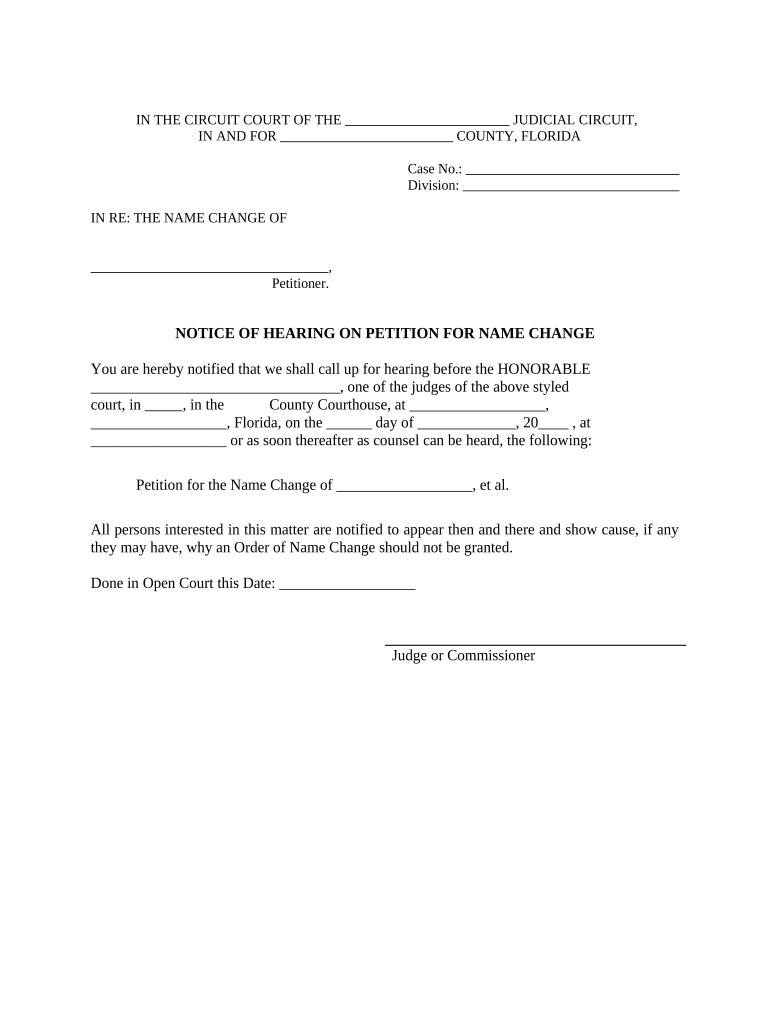
Florida Notice of Hearing
What the Florida Notice of Hearing Is and when it’s used
Why an accurate, timely Notice of Hearing matters
A correct Notice of Hearing preserves procedural rights, gives other parties opportunity to respond, and helps the court manage its calendar effectively.
Who commonly prepares and receives this notice
The Notice of Hearing is prepared by attorneys, pro se litigants, or court staff and is served on all affected parties and counsel prior to the hearing.
- Plaintiff or petitioner counsel — drafts notice, selects hearing type, and arranges service.
- Defendant or respondent counsel — reviews the notice to confirm time, location, and required filings.
- Court clerks and judges — rely on correct notices to set, confirm, or continue hearings.
Quick step-by-step: preparing and filing a Notice of Hearing
-
01Draft the Notice: Populate case number, parties, purpose, date, time, and location.
-
02Confirm Availability: Check the court calendar and opposing counsel availability if required.
-
03Serve Parties: Serve via permitted methods and retain proof of service.
-
04File with Clerk: File the notice and any supporting motion or affidavit timely.
How to set up a digital workflow for the notice
| Field | Configuration |
|---|---|
| Upload Document | PDF or DOCX, optimized for form fields and court formatting. |
| Add Fields | Place case number, date, signature fields, and checkboxes for service methods. |
| Authentication | Choose signer verification: email, SMS code, or stronger methods for counsel. |
| Save Template | Store as reusable template with conditional fields for different hearing types. |
Typical eSubmission and service flow for a Notice of Hearing
-
Upload: User uploads the prepared notice to the e-filing or document platform.
-
Add Signers: Assign signature fields to counsel or parties of record.
-
Serve: Initiate service using listed methods and capture proof.
-
File: File the notice and attach proof of service to the court record.
Technical considerations for eFiling and eService
Confirm the court’s accepted file formats, size limits, and e-filing portal requirements before preparing the notice.
- File formats: Use PDF/A or PDF; DOCX accepted by some portals.
- Authentication: Email or SMS codes commonly accepted for counsel.
- Integrations: Connect with document storage and case management systems.
Common eSignature pricing and feature snapshot for Notice of Hearing workflows
| signNow | DocuSign | Adobe Sign | PandaDoc | HelloSign | |
|---|---|---|---|---|---|
| Starting Price | $8/user/mo | $15/user/mo | $14/user/mo | $19/user/mo | $15/user/mo |
| Free Trial | 7-day trial | Varies by plan | Varies by plan | Varies by plan | Varies by plan |
| Bulk Send | Yes (premium) | Yes | Yes | Yes | Limited |
| Audit Trail | Yes | Yes | Yes | Yes | Yes |
| HIPAA Compliant | Yes | Yes | Yes | No | No |
| Envelope Cap | No cap | 100 envelopes/user/year | Varies by plan | Varies by plan | Varies by plan |
Timing considerations and typical deadlines
Routine Civil Hearings:
Often scheduled weeks ahead; local rules commonly require notice 14–21 days, but check local practice.
Emergency or Ex Parte:
May require immediate filing and shortened notice; emergency protocols vary by court.
Family Law Matters:
Local family court rules often specify shorter notice windows for temporary relief hearings.
Administrative Hearings:
Agency rules govern timing; some permit electronic service and accelerated scheduling.
Proof of Service Filing:
File proof of service promptly after serving parties, per local clerk requirements.
Key milestones from draft to hearing
Notice Drafted
Complete draft with case details and requested relief.
Calendar Confirmed
Obtain court date and confirm parties’ availability as required.
Service Completed
Serve all parties using allowed methods and record proof.
Proof Filed
File proof of service and any supporting materials with the clerk.
Common mistakes to avoid when preparing a Notice of Hearing
- Wrong case number — leads to misfiling and delays in court processing.
- Incomplete location details — parties may miss or arrive at wrong courtroom.
- Insufficient notice period — court may continue or deny relief without a hearing.
- Missing proof of service — hearing may be postponed or judgment entered by default.
Risks and consequences of incorrect or untimely notices
Practical tips for accurate, efficient notice preparation
Illustrative scenarios for using a Notice of Hearing
Civil Motion Hearing
A plaintiff schedules a hearing to resolve a discovery dispute and serves counsel
- Clerk assigns a hearing date two weeks out
- Parties file briefs and proof of service; the court rules based on submissions and oral argument.
Family Temporary Relief
A petitioner seeks temporary custody and files an expedited notice of hearing
- Emergency calendar sets a sooner date with abbreviated notice requirements
- Parties attend, the court issues temporary orders and schedules a full hearing later.
Frequently asked questions about Florida Notices of Hearing
-
What if I entered the wrong case number?
If a wrong case number is used, the clerk may return or misfile the notice. File a corrected notice promptly and provide an explanation to the clerk; confirm the corrected filing is reflected on the court docket.
-
Can a Notice of Hearing be served electronically?
Electronic service is allowed only when permitted by local rules or the parties’ agreement. Check the Florida Rules and local administrative orders; retain delivery receipts or server logs to prove service.
-
How do I prove service to the court?
File a sworn proof of service or certificate of service stating method, date, and recipient. Attach any delivery confirmations, email headers, or affidavits from a process server as supporting evidence.
-
What if the opposing party objects to notice timing?
Objections to timing may lead the court to continue the hearing. Be prepared to show compliance with local notice periods or explain emergency circumstances supporting shorter notice.
-
Can I change the hearing date once noticed?
Rescheduling typically requires agreement of parties or a motion to continue. Notify the clerk and opposing counsel promptly and file an amended notice once a new date is secured.
-
Is e-signature valid on a Notice of Hearing?
Electronic signatures are generally valid under the ESIGN Act (15 U.S.C. ch. 96) and UETA where adopted, but verify court acceptance and any required notarization or original-signature rules locally.