Parties
Full legal names and roles for lender, borrower, guarantor, and servicer; include business entity type and state of formation for corporate parties.
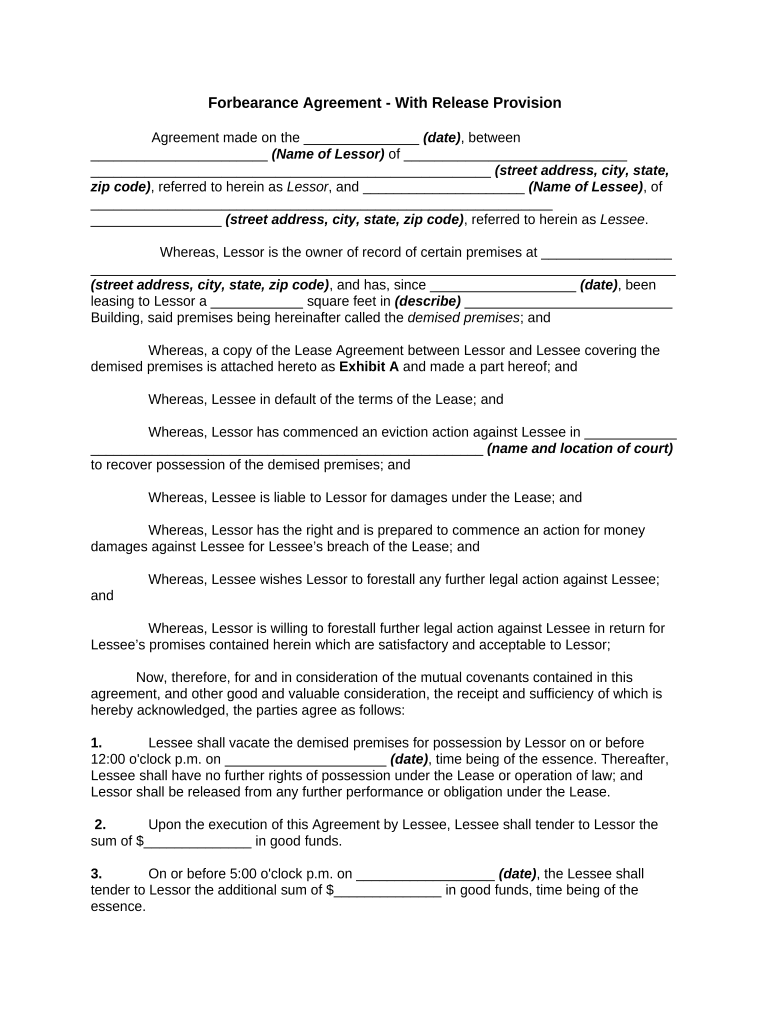
Forbearance agreements preserve borrower-lender relationships by providing short-term relief while protecting lender remedies. They reduce litigation and foreclosure risk, allow structured catch-up plans, and document mutual expectations so both parties understand duration, reinstatement conditions, and repayment mechanics.

Lenders, loan servicers, borrowers, guarantors, and legal counsel commonly prepare and sign forbearance agreements; companies may use in-house teams or external counsel depending on complexity.
Accurate parties, signed dates, and clear repayment terms limit disputes and support enforceability if collection or court review becomes necessary.
Full legal names and roles for lender, borrower, guarantor, and servicer; include business entity type and state of formation for corporate parties.
Precise start and end dates using MM/DD/YYYY format and any extension conditions or review triggers.
Describe whether payments are reduced, suspended, deferred, or capitalized and how deferred amounts will be repaid or collected.
List borrower obligations (documentation, insurance, escrow payments) and lender rights if conditions are unmet.
Describe cure periods, reinstatement terms, acceleration clauses, and how prior default is treated after forbearance.
Signature blocks for all signers, date lines, and any notary, witness, or advanced authentication requirements for enforceability.
| Field | Configuration |
|---|---|
| Signature Order | Set role-based routing for lender, borrower, and guarantor. |
| Authentication | Use email + SMS or stronger methods for higher-value loans. |
| Conditional Fields | Show repayment plan fields only when deferment selected. |
| Retention Policy | Attach document retention settings per legal requirements. |
Choose a platform that provides audit trails, secure storage, and configurable authentication consistent with your risk profile.
Integrations with loan servicing systems, CRM, and secure cloud storage reduce manual rekeying and preserve a single source of truth.
Within 5–10 business days of request receipt.
Typically 10–30 business days depending on documentation.
Signatures generally required within 7–30 days of offer.
Forbearance usually begins on an agreed date, not retroactively.
Servicer reviews compliance throughout the forbearance term.
Borrower submits hardship documentation and request details for review.
Lender or servicer communicates approved terms or denial in writing.
All parties execute the forbearance agreement with required authentication.
Repayment plan commences, account updates applied, and compliance monitored.
A property manager negotiated temporary rent reductions during market disruption to avoid evictions.
A healthcare provider arranged payment deferral for a corporate client during a cash-flow interruption.
| signNow | DocuSign | Adobe Sign | PandaDoc | HelloSign | |
|---|---|---|---|---|---|
| Starting Price | $8/user/mo | $15/user/mo | $14/user/mo | $19/user/mo | $15/user/mo |
| Free Trial | 7-day free trial | Varies | Varies | Varies | Varies |
| Bulk Send | Yes | Varies | Varies | Varies | Varies |
| Audit Trail | Yes | Yes | Yes | Yes | Yes |
| HIPAA Compliant | Yes | Varies by plan | Varies by plan | Varies | Varies |
| Envelope Cap | No cap | 100 envelopes/user/year | Varies | Varies | Varies |