Establishing secure connection…Loading editor…Preparing document…

Credit Agreement

This template is fully customizable. Edit the text, fill out the fields, and send it for signature. Give it a try!
Credit Agreement

What a Credit Agreement Is and when it applies

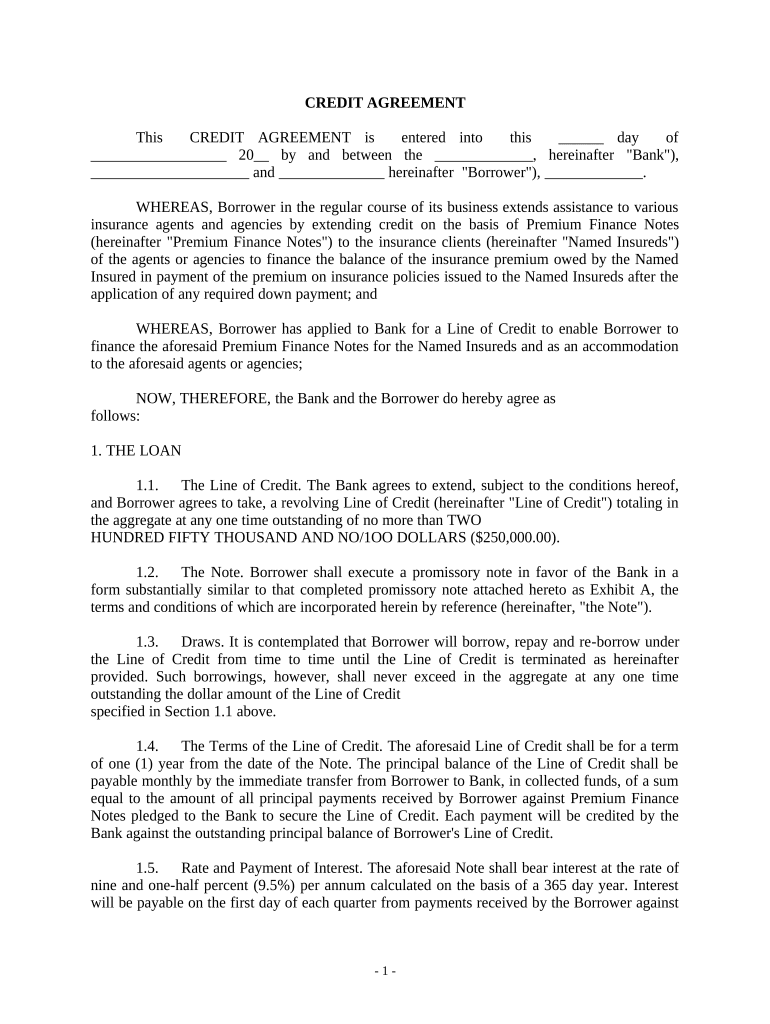
A Credit Agreement is a binding contract that documents the lending relationship between a borrower and a lender, defining loan amount, interest, repayment schedule, fees, collateral, covenants, events of default, remedies, and governing law. It governs secured and unsecured loans, may trigger UCC Article 9 filings for security interests, and often includes provisions for assignment, notice, and dispute resolution. When executed electronically, the agreement is generally enforceable under federal ESIGN (15 U.S.C. ch. 96) and state UETA frameworks, though certain security instruments may require notarization or recording.

Why a clear Credit Agreement matters for both parties

A well-drafted Credit Agreement reduces ambiguity about payment obligations, protects collateral rights, allocates risk, and creates steps for cure and remediation. Clear terms support enforcement, speed funding, and lower dispute costs while documenting lender protections and borrower obligations under applicable law.

Why a clear Credit Agreement matters for both parties

Who commonly prepares and signs Credit Agreements

Credit Agreements are used across sectors when one party extends credit to another; use depends on loan size, security, and regulatory context.

  • Real estate lenders and brokers facilitating mortgages and construction financing.
  • Financial institutions and credit unions documenting commercial or consumer loans.
  • Small and mid-size business owners securing working capital or equipment financing.

Typical signatories and their roles

Lender — Counsel

Bank or institutional counsel who prepares or reviews loan covenants, perfection steps, and closing conditions. They ensure security descriptions match UCC filing requirements and confirm notice and waiver language to minimize future litigation risk.

Borrower — Executive

Authorized corporate officer or sole proprietor who signs on behalf of the borrower entity. They must confirm authority, full legal entity name, and accuracy of financial covenants before executing to avoid personal liability or invalidation.

Core elements every professional Credit Agreement should include

A complete Credit Agreement organizes commercial terms, protections, and processes so parties and third parties can rely on enforceable obligations and clear remedies.

Parties

Full legal names and organizational details for lender(s) and borrower(s), including state of formation and authority to bind the entity.
Loan Terms

Principal amount, interest rate (fixed or variable), calculation method, payment schedule, prepayment terms, fees, and default interest if applicable.

Security

Collateral description, perfection steps, and reference to UCC Article 9 filings or mortgage documents required to secure the lender’s interest.

Covenants

Affirmative and negative covenants describing borrower obligations, reporting requirements, financial covenants, and restrictions on transfers or additional liens.

Events of Default

Defined default events, grace and cure periods, acceleration rights, remedies, and any cross-default triggers with other agreements.

Governing Law

Choice of law, dispute resolution, venue, and whether arbitration applies; includes notice procedures and address for delivery.

Step-by-step: completing and executing a Credit Agreement

Follow these practical steps from draft to execution to reduce errors and ensure enforceability.

  • 01
    Prepare Information: Gather legal names, financial schedules, and collateral details.
  • 02
    Draft Terms: Set amounts, rates, covenants, and default remedies clearly.
  • 03
    Legal Review: Have counsel verify UCC, recording, and state-specific requirements.
  • 04
    Execute and Distribute: Sign, notarize if required, file UCC or record mortgage, and circulate copies.

Configuring an online signing workflow for a Credit Agreement

Set up a secure template and signer sequence to reduce manual steps and preserve a complete audit trail.

Field Configuration
Template Create reusable template with conditional fields for secured vs unsecured loans
Signer Order Specify lender then borrower or simultaneous signing as required
Authentication Use email plus optional SMS code or KBA for higher assurance
Reminders & Expiry Enable automated reminders and set link expiry to enforce timelines

Digital signing and technical compatibility considerations

Choose a platform that supports PDF/DOCX, audit trails, and integrations to preserve evidentiary records.

  • Integrations: Salesforce, NetSuite, Google Workspace and others supported
  • File Formats: PDF and DOCX output with embedded audit trail
  • Authentication: Email, SMS, KBA, or advanced signer verification

Where to send and who receives executed copies

Routing executed Credit Agreements promptly ensures funding, filing, and compliance; distribution depends on role and recording needs.

  • Lender Records: Store signed originals in lender’s secured document management.
  • Borrower Copy: Provide borrower a complete executed set for their records.
  • UCC Filing: File UCC-1 with the Secretary of State if security exists.
  • Recording Office: Record mortgages or deeds at county recorder where required.

Key milestones from negotiation through post-closing

Track milestone stages to coordinate funding, perfection, and post-closing obligations efficiently.

01

Negotiation

Parties exchange and agree on substantive loan terms and covenants.

02

Execution

All authorized signatories execute the final agreement and any security documents.

03

Funding

Lender disburses funds after satisfaction of closing conditions and documentation.

04

Post-Closing

File UCC, record mortgage, deliver possession or notice as required.

Typical timing expectations and contractual deadlines

Although contract terms control, these are common timing points lenders and borrowers include in a Credit Agreement.

Funding Date:

Funds disbursed on the contract-specified date or upon satisfaction of conditions.

Interest Accrual Start:

Interest generally begins on the funding date unless stated otherwise.

Reporting Frequency:

Quarterly or monthly financial reporting obligations often required by covenants.

Default Notice Period:

Commonly 10–30 days to cure payment defaults per contract terms.

Cure Period:

Specified cure periods for breaches appear in the events-of-default section.

Common preparation mistakes that compromise enforceability

  • Ambiguous repayment schedule or unclear rounding rules lead to disputes and calculation errors.
  • Using trade names or abbreviations instead of the borrower’s legal entity name can void perfection or create identity issues.
  • Vague security descriptions that omit serial numbers, locations, or legal real property description impede UCC perfection or recording.
  • Skipping counsel review for cross-defaults, intercreditor provisions, or regulatory implications leaves lenders exposed to unintended risk.

Legal and commercial risks from incorrect agreements

Unenforceable Terms: Ambiguity may render remedies unenforceable.
Unperfected Security: Missed UCC filing risks unsecured priority.
Recording Failure: Delayed recording may impair title or priority.
Signature Issues: Improper signer authority can void obligations.
Regulatory Breach: Consumer lending rules may impose penalties.
Fraud Exposure: Misrepresentations can lead to rescission or damages.

Security, compliance, and data protections for executed agreements

Encryption: TLS 1.2/1.3 in transit; AES-256 at rest
Certifications: SOC 2 Type II and ISO 27001 certified
HIPAA: BAA available for protected health information
21 CFR: Supports 21 CFR Part 11 compliance features
ESIGN/UETA: Compliant with ESIGN and UETA standards
Audit Trail: Timestamps, IP, and action history retained

Real-world examples of electronic Credit Agreement use

Organizations use digital workflows to accelerate closings and maintain compliance across devices and integrations.

Optica Ventures (COO)

Optica streamlined lender-borrower signature flows for portfolio investments.

  • The platform reduced turnaround time by days.
  • Post-implementation, they reported simpler client interactions and consistent documentation across investments, with fewer manual follow-ups at closing and reliable audit trails for compliance.

Martin Properties (Founder)

Martin Properties moved property loan documents online to close remotely.

  • Mobile signing enabled onsite execution.
  • The firm processed and executed secured loan packages remotely with compliance controls, improving speed to funding and reducing time spent coordinating in-person signatures.

eSignature pricing and capability comparison relevant to Credit Agreement workflows

Compare typical starting prices and key capabilities that affect high-volume credit document workflows; signNow appears first as a baseline for comparison.

signNow DocuSign Adobe Sign PandaDoc HelloSign
Starting Price $8/user/mo $15/user/mo $14/user/mo $19/user/mo $15/user/mo
Free Trial 7-day free trial Varies by vendor Varies by vendor Varies by vendor Varies by vendor
Bulk Send Yes Yes Yes Yes No
Audit Trail Yes Yes Yes Yes Yes
HIPAA Compliant Yes Yes Yes No No
Envelope Cap No cap 100 envelopes/user/year Varies by plan Varies by plan Varies by plan

Frequently asked questions about Credit Agreements and eSigning

Answers to common questions on e-signing, notarization, UCC filing, and amendments for Credit Agreements executed in the United States.


Need help? Contact support

be ready to get more
Join over 28 million airSlate SignNow users