Establishing secure connection…Loading editor…Preparing document…

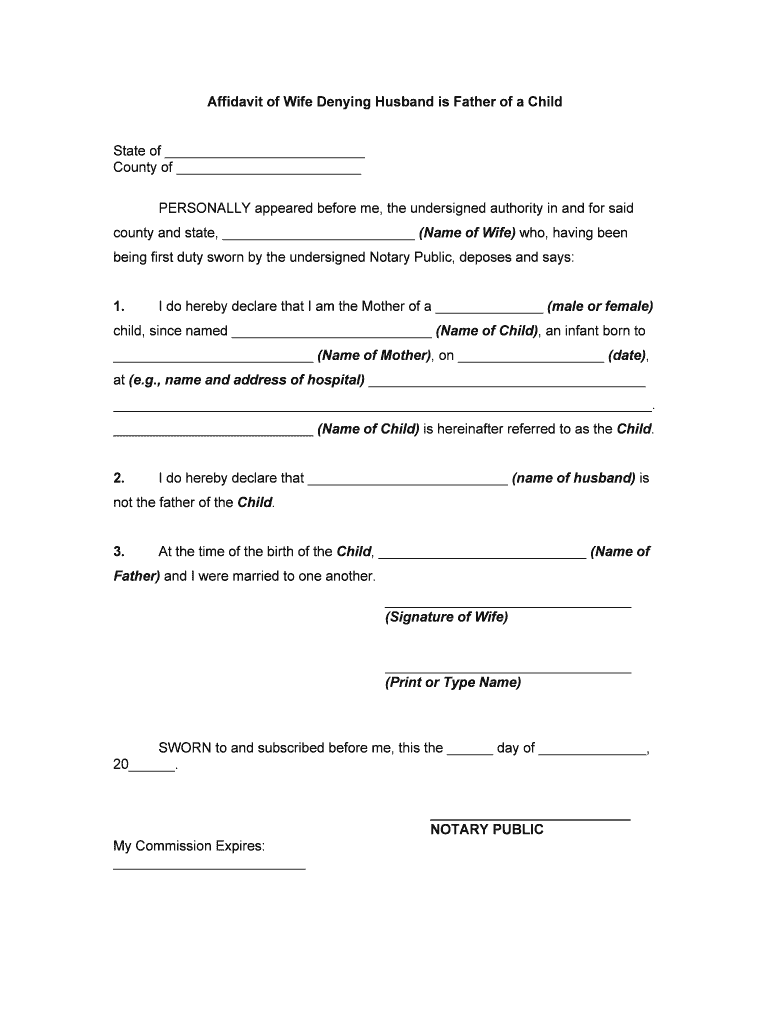
Affidavit of Wife Denying Husband is Father of Child

This template is fully customizable. Edit the text, fill out the fields, and send it for signature. Give it a try!
Affidavit of Wife Denying Husband is Father of Child

What this Affidavit Is and when it’s used

The Affidavit of Wife Denying Husband is Father of Child is a sworn written statement in which a spouse (the affiant) formally declares that her husband is not the biological father of a specified child. It is typically executed under oath and often notarized before being submitted to a family court, child support agency, or used alongside paternity or custody filings. This affidavit sets out the affiant’s factual basis for denial, cites relevant dates and relationships, and may trigger requests for genetic testing, administrative review, or court proceedings depending on the jurisdiction and case circumstances.

Why an accurate affidavit matters

A clear sworn denial records the affiant’s position, creates a contemporaneous written record, and helps courts and agencies determine next steps such as DNA testing or paternity challenges under family law.

Why an accurate affidavit matters

Who commonly prepares or receives this affidavit

Typical users range from private individuals to legal professionals who handle family law, child support, or paternity matters.

  • Spouse or affiant drafting a sworn denial for family court or agency review
  • Family law attorneys preparing pleadings, responses, or evidence packages
  • Child support or family court clerks assessing whether genetic testing should be ordered

Core parts of a professionally drafted affidavit

A complete affidavit follows a predictable structure so courts and agencies can evaluate it quickly. Each element should be complete, factual, and consistent with supporting evidence.

Caption

Case title or identifying heading that links the affidavit to a court docket or administrative matter, including county and case number where applicable.
Affiant Identification

Full legal name, date of birth, address, and relationship to the child. Include any previous names to avoid identity confusion.

Statement of Denial

A concise sworn sentence denying paternity, specifying the child by name and date of birth, and stating the affiant’s belief about parentage.

Factual Basis

Detailed factual paragraph(s) describing dates, relationships, witnesses, or circumstances that support the denial and any relevant timeline.

Attachments

List and attach corroborating documents such as medical records, communication logs, or prior agreements that substantiate the factual basis.

Acknowledgment/Notary

Signature line, printed name, date, and notary acknowledgement or witness signature block as required by state law.

Essential information fields to include

Affiant Name: Full legal name
Respondent Name: Husband’s full legal name
Child Details: Child’s full name and DOB
Statement Date: MM/DD/YYYY
Supporting Docs: List attachments
Notary/Signature: Notary block or witness

Step-by-step: completing and filing the affidavit

Follow these steps in order to prepare a usable affidavit for court or agency review.

  • 01
    Prepare facts: Collect dates, names, and supporting documents.
  • 02
    Draft affidavit: Write a clear sworn statement with factual basis.
  • 03
    Sign and notarize: Sign before a notary or required witness.
  • 04
    File or serve: Submit to court or agency per local process.

Configure an online completion workflow

Set up a digital workflow that preserves the affidavit’s legal integrity and captures signer identity and timestamps.

Field Configuration
Platform Use an ESIGN/UETA-compliant eSignature provider
Authentication Require email plus optional SMS or ID verification
Notarization Enable RON where allowed or require in-person notary
Storage Retain signed PDF with audit trail and attachments

Where the signed affidavit goes next

After you sign, route the affidavit to the appropriate recipients and preserve a tamper-evident record.

  • Send to court: File with clerk or upload to e-file system
  • Serve parties: Provide copies to opposing counsel or parent
  • Attach evidence: Include documents referenced in the affidavit
  • Store securely: Keep PDF and audit trail for retention period

Digital signing and eSubmission considerations

Choose a platform that supports ESIGN/UETA compliance, secure storage, and notarization workflows required by your jurisdiction.

  • Authentication: Email, SMS, or ID verification
  • Audit Trail: Timestamps, IP, and action log
  • Integrations: Salesforce, Google Workspace, NetSuite

Common preparation errors to avoid

  • Incomplete identification: omitting prior names or mismatched IDs causes verification delays and may require affidavit amendment.
  • Undated or unsigned pages: unsigned affidavits or missing signature dates are typically rejected by courts and agencies.
  • Missing attachments: failing to reference or attach corroborating documents weakens the affidavit’s evidentiary value.
  • Improper notarization: using an out-of-jurisdiction notary or missing notarization when required can invalidate the affidavit.

Legal risks and potential penalties

Perjury Risk: False sworn statements may trigger perjury charges
Civil Liability: Court may impose contempt or sanctions
Custody Impact: Credibility issues may affect custody outcomes
Evidence Exclusion: Improperly executed affidavit can be excluded
Notary Fraud: Fraudulent notarization carries criminal penalties
Filing Delays: Errors cause process delays and possible fee increases

How this affidavit differs from related documents

Compare similar filings to ensure you select the correct form: a denial affidavit serves a different function than a paternity affidavit or genetic consent form.

Document Type Affidavit Denial Paternity Affidavit
Primary Purpose record denial record claimed paternity
Typical Use dispute initiation establish parentage
Evidence Needed corroboration likely birth and id documents
Court Effect may trigger testing may establish legal rights

Timing considerations and typical deadlines

There is no single federal deadline for an affidavit denying paternity; timing depends on court rules, administrative deadlines, and whether child support has been established.

File Promptly:

Submit the affidavit as soon as factual basis is established

Agency Deadlines:

Agencies may have short windows for contesting paternity

Court Scheduling:

Expect local docket delays; check county clerk timelines

Testing Orders:

DNA testing may be ordered quickly after filing

Statute Issues:

Statute of limitations varies; consult local counsel

eSignature solutions: pricing and core features compared

When choosing an eSignature provider for affidavits, consider starting price, trial availability, bulk send capability, audit trails, and HIPAA compliance for health-related records.

signNow DocuSign Adobe Sign PandaDoc HelloSign
Starting Price $8/user/mo $15/user/mo $14/user/mo $19/user/mo $15/user/mo
Free Trial 7-day free trial, no credit card Varies by plan Varies by plan Varies by plan Varies by plan
Bulk Send Yes (paid tier) Varies by plan Varies by plan Varies by plan Varies by plan
Audit Trail Yes Yes Yes Yes Yes
HIPAA Compliant Yes Yes Yes No No
Envelope Cap No cap 100 envelopes/user/year Varies by plan Varies by plan Varies by plan

Frequently asked questions and troubleshooting

Answers address common execution, validity, and procedural questions about affidavits denying paternity.


Need help? Contact support

be ready to get more
Join over 28 million airSlate SignNow users