Establishing secure connection…Loading editor…Preparing document…

Forma Pauperis Form

This template is fully customizable. Edit the text, fill out the fields, and send it for signature. Give it a try!
Forma Pauperis Form

What the Forma Pauperis Form Is and When it Applies

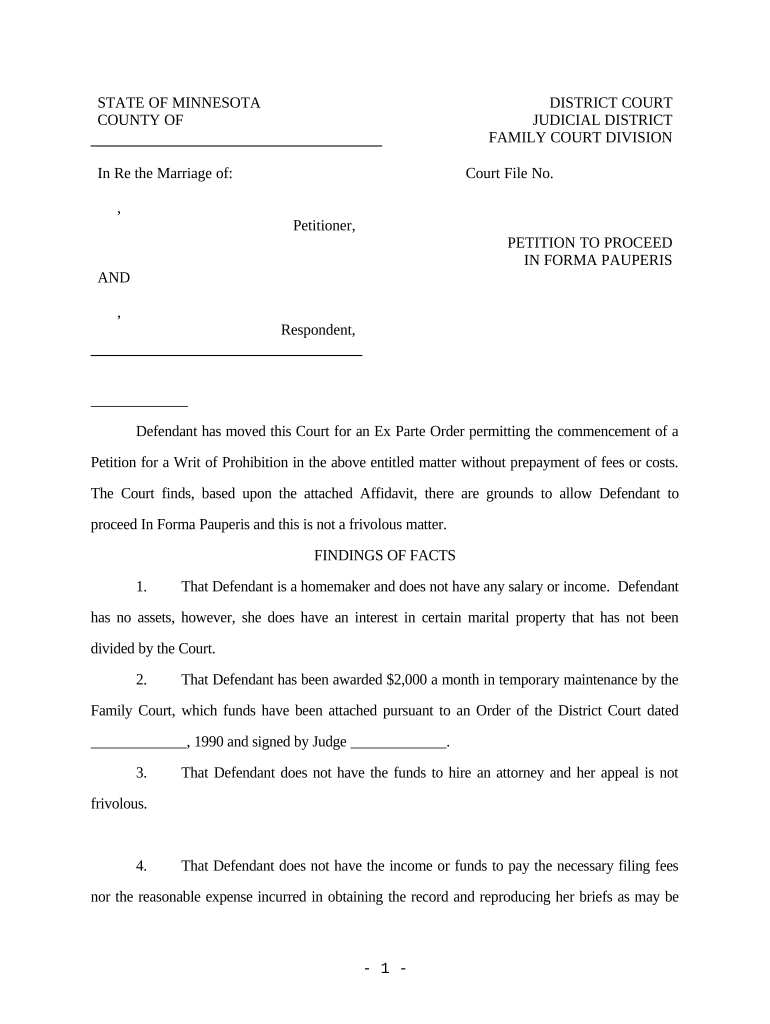
The Forma Pauperis Form is a sworn written request submitted to a court asking permission to proceed without paying filing fees or other court costs because the filer cannot afford them. Courts use the form to evaluate financial eligibility and assess whether the claim has sufficient legal basis to proceed. The filer typically provides income, asset, employment, and household information, and signs under penalty of perjury. Federal and state courts maintain local rules that govern how and when the form is filed, what supporting documents are required, and whether electronic submission or eSignature is permitted.

Why a Properly Completed Form Matters

A correctly prepared Forma Pauperis Form can remove financial barriers to court access, avoid dismissal for nonpayment, and streamline case intake. Accurate statements reduce the risk of sanctions or criminal exposure for false statements.

Why a Properly Completed Form Matters

Who Typically Completes a Forma Pauperis Request

Individuals and organizations file fee-waiver requests when inability to pay could prevent litigation, appeals, or other court proceedings.

  • Pro se litigants who lack legal representation and cannot afford court fees.
  • Public defenders, nonprofit legal clinics, or social service agencies assisting eligible clients.
  • Incarcerated persons requesting litigation or appeal filing without funds.

Core Parts of a Professional Forma Pauperis Form

A thorough form combines factual financial disclosures, a case-specific narrative, and supporting documents so the judge can evaluate indigence and the merits. Each component should be complete, consistent, and signed under penalty of perjury.

Affidavit

A signed sworn statement describing inability to pay, explaining fixed budget items, and asserting facts under penalty of perjury. Judges rely on this as the primary narrative.
Income Worksheet

Detailed monthly and annual income lines for all household members, including wages, benefits, pensions, and other regular receipts. List gross and net amounts where requested.

Assets & Debts

Itemize bank balances, vehicles, property, loans, and outstanding debts. Courts evaluate liquid assets first when deciding eligibility for a fee waiver.

Case Information

Case caption, court name, case number (if any), party names, and the specific filing or appeal for which the waiver is sought. Accuracy avoids processing delays.

Supporting Documents

Attach pay stubs, benefit award letters, bank statements, or a prison trust ledger as proof. Redact unrelated personal identifiers where permitted.

Signature & Verification

Date and sign the form. Many courts require a declaration under penalty of perjury; some permit notarization or electronic verification instead.

Step-by-Step: Preparing and Submitting a Fee Waiver Request

Follow these practical steps to prepare a complete and defensible Forma Pauperis submission that aligns with court rules and reduces processing friction.

  • 01
    Gather Documents: Collect pay stubs, benefit letters, bank records, and identification.
  • 02
    Complete Form: Fill every required field; explain material budget items.
  • 03
    Attach Exhibits: Label and bundle supporting evidence chronologically.
  • 04
    File with Clerk: Submit to the clerk per local procedures, in person or electronically.

Customizing an Online Workflow for the Forma Pauperis Form

Configure a digital template that enforces required fields, captures attachments, and preserves an audit trail for court review.

Template Upload Upload court-approved PDF or DOCX form to the platform.
Required Fields Mark name, signature, and income fields as mandatory to prevent omissions.
Conditional Logic Show additional fields only when specific income sources or assets are reported.
Attachment Rules Restrict file types (PDF, JPG) and require at least one supporting document.
Signer Verification Choose signer authentication level consistent with court rules.

Where to File and How the Court Processes It

Filing location and process depend on the case type: federal district, state trial court, or appellate court. Follow the clerk's local rules for submission format and timing.

  • Initial Filings: File with the clerk when submitting a complaint or notice of appeal.
  • In-Court Requests: Some courts accept oral requests at calendar call; confirm local practice.
  • Appeals: Waiver requests for appeals often follow appellate filing rules and deadlines.
  • Clerk Review: The clerk screens and routes the request according to court procedures.

Digital Submission and eSignature Considerations

Many courts permit electronic filing and may accept eSigned fee-waiver requests if local rules allow.

  • File Formats: PDF and DOCX accepted in most eFiling systems.
  • Authentication: Email, SMS code, or stronger ID verification may be required.
  • Audit Trail: Retain timestamps and signer evidence for court review.

Consequences of False or Incomplete Statements

Perjury Exposure: Criminal liability for knowingly false statements
Case Dismissal: Court may dismiss the filing for material misstatements
Fee Assessment: Court can require payment of previously waived fees
Sanctions: Monetary or procedural sanctions for abuse
Loss of Credibility: Weakened position across current and future cases
Administrative Delays: Incomplete forms cause returns and processing delays

Common Mistakes to Avoid When Preparing a Fee Waiver

  • Omitting required attachments such as pay stubs or benefit letters often triggers rejection or requests for additional proof.
  • Providing inconsistent income or asset figures between the form and supporting documents undermines credibility and invites further scrutiny.
  • Failing to sign or date the verification statement, or using initials where a full signature is required, commonly causes processing delays.
  • Attempting to hide assets or income can lead to criminal perjury charges and loss of any fee-waiver privileges.

Essential Information Typically Requested

Name: Full legal name
Address: Current residence
Income: Monthly/annual earnings
Assets: Bank balances, property
Debts: Loans, judgments, obligations
Signature: Signed verification under penalty

Realistic Use Scenarios for Fee Waiver Requests

These examples illustrate typical situations where a court may consider a fee waiver and the supporting evidence that strengthens the request.

Public Defender Intake

A public defender files a waiver on behalf of an indigent client

  • Documents include a prison trust ledger and benefit statements
  • The court grants the waiver after verifying the client’s inability to pay and the case proceeds without prepayment of fees.

Pro Se Civil Plaintiff

A litigant files a complaint with a fee waiver request

  • Point-in-time pay stubs and a bank statement are provided
  • The clerk conditionally accepts the filing and forwards the request for judicial review, avoiding immediate dismissal.

Timing Considerations and Typical Deadlines

Timing for filing a Forma Pauperis Form depends on the procedure: initial complaint, motion, or appeal. Local rules set specific windows; verify with the clerk before proceeding.

Initial Complaint Filing:

Submit the waiver with the complaint unless local rules allow later filing

Appeal Filings:

File the waiver as part of the appeal or per appellate clerk instructions

Emergency Filings:

Courts may accept immediate oral requests followed by formal filing

Clerk Requests:

Respond to clerk requests for additional info promptly to avoid denial

Local Rule Variations:

Deadlines vary by jurisdiction; consult the court clerk

Common eSignature Vendor Comparison for Filing and Signing

When choosing an eSignature provider for preparing and filing court forms, consider pricing, HIPAA support where relevant, bulk-send needs, and envelope or session limits. signNow is listed first per vendor comparison conventions.

signNow DocuSign Adobe Sign PandaDoc HelloSign
Starting Price $8/user/mo $15/user/mo $14/user/mo $19/user/mo $15/user/mo
Free Trial 7-day free trial No No Yes, limited Yes, limited
Bulk Send Yes Yes Yes Yes No
Audit Trail Yes Yes Yes Yes Yes
HIPAA Compliant Yes Yes Yes No No
Envelope Cap No cap 100 envelopes/user/year Varies Varies Varies

Frequently Asked Questions and Troubleshooting

Answers to common questions about form completion, supporting documents, and electronic filing to reduce processing delays and avoid common errors.


Need help? Contact support

be ready to get more
Join over 28 million airSlate SignNow users