Establishing secure connection…Loading editor…Preparing document…

Garnishee Answer Form

This template is fully customizable. Edit the text, fill out the fields, and send it for signature. Give it a try!
Garnishee Answer Form

What the Garnishee Answer Form Is and When It Applies

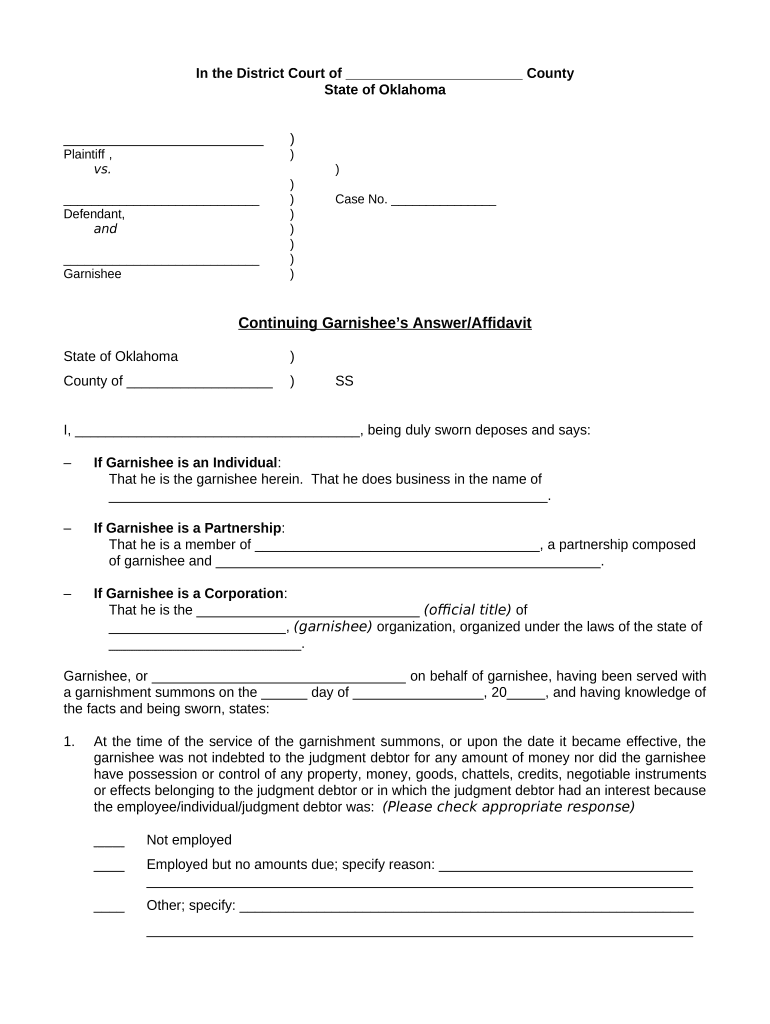
A Garnishee Answer Form is a formal response filed by a third party (often a bank, employer, or custodian) after receiving a garnishment or writ directing that party to withhold or turn over a debtor's property or funds. The answer identifies whether the garnishee holds assets subject to the garnishment, states any exemptions or defenses, and provides supporting details required by the issuing court. Courts use the form to determine whether funds should be released, held, or returned and to set further proceedings or hearings in the underlying enforcement action.

Why a Clear, Accurate Garnishee Answer Matters

Completing the Garnishee Answer accurately protects the garnishee from liability for wrongful release or failure to withhold, preserves the garnishee's defenses and exemptions, and keeps the court record accurate. It also gives the debtor and creditor the information needed to advance the case.

Why a Clear, Accurate Garnishee Answer Matters

Who Typically Completes a Garnishee Answer

The Garnishee Answer is completed by the party who holds the debtor's property or income and who has been served with the garnishment or writ.

  • Employers and payroll departments that receive wage garnishment orders and must report earnings and withholding status.
  • Banks, credit unions, and custodians that hold accounts or securities subject to seizure.
  • In-house counsel or third-party agents who act on behalf of businesses responding to the court's writ.

If you are unsure whether you must answer, consult your local court rules or legal counsel; failure to respond or incorrect responses can create exposure.

Step-by-step: Filling Out a Garnishee Answer

Follow these sequential steps to complete and submit a compliant Garnishee Answer.

  • 01
    Review the Writ: Confirm the court, case number, and service date before answering.
  • 02
    Identify Holdings: List accounts, payroll, or property subject to the garnishment.
  • 03
    Claim Exemptions: State statutory or court-ordered exemptions clearly on the form.
  • 04
    Sign and File: Sign by authorized person and file with the issuing court.

Core Components of a Professional Garnishee Answer

A well-prepared Garnishee Answer is organized, fact-based, and supported by clear citations to records or statutes where appropriate.

Caption

Court caption with parties and case number placed exactly as on the writ to ensure correct docketing and processing by the clerk.
Statement of Response

Concise statement admitting or denying possession of the specified property and identifying the exact items or amounts held.

Exemptions and Defenses

Itemized claims of exemption (statutory or constitutional), including citation to the controlling law if available.

Supporting Schedules

Attachment of account ledgers, payroll records, or bank statements as required or helpful to substantiate the answer.

Verification

A signed verification or affidavit, if local rules require, attesting to the truthfulness of the answer under penalty of perjury.

Service Information

Proof of service details: who was served, method, and date should be included or filed separately as required.

Configuring an Electronic Workflow for the Answer

Set up fields and routing so the form collects evidence, obtains an authorized signature, and reaches the court by the required method.

Field Configuration
Mandatory Fields Make caption, case number, debtor identity, and signature required.
Attachments Allow PDF uploads for supporting bank or payroll records.
Signer Authentication Require an authorized signer with email plus optional SMS code.
Routing Route completed answers to legal team and court filing email or e-filing portal.

Typical Filing Path for a Garnishee Answer

Follow the court-directed filing path to avoid defects: prepare, sign, serve, and file in the order required by local rules.

  • Prepare Document: Complete the answer and gather attachments.
  • Obtain Signature: Authorized person signs the answer.
  • Serve Parties: Serve creditor, debtor, and any required parties.
  • File with Court: File the signed answer at the clerk or via e-filing portal.

Digital Signing and eSubmission Considerations

Electronic completion speeds response and preserves a tamper-evident record, but must meet court and statutory standards for authenticity.

  • File Formats: PDF and PDF/A are preferred for court filings and archival quality.
  • Authentication: Use signer authentication (email, SMS, or advanced methods) where local rules require identity proofing.
  • Audit Trail: Capture timestamp, IP, and signer actions to support validity in court.

Comparing eSignature Costs and Key Features for Garnishee Answers

Basic cost and capability differences can affect whether an eSignature provider meets court and compliance needs for legal responses and attachments.

signNow DocuSign Adobe Sign PandaDoc HelloSign
Starting Price $8/user/mo $15/user/mo $14/user/mo $19/user/mo $15/user/mo
Free Trial 7-day free trial Varies by vendor Varies by vendor Varies by vendor Varies by vendor
Bulk Send Yes Yes Yes Yes No
Audit Trail Yes Yes Yes Yes Yes
HIPAA Compliant Yes Yes Yes No No

Typical Deadlines and Timing Expectations

Deadlines for answers and filings vary by jurisdiction; use service dates and local rules to calculate response windows.

Response Window:

Often 20–30 days from service; check local court rules for exact deadlines

Service Proof:

Proof of service should be filed promptly after serving parties

Court Processing:

Clerk processing times vary from same day to several weeks

Hearing Dates:

A hearing may be scheduled within 30–90 days after filing the answer

Appeal Rights:

Appeal or motion deadlines follow local civil procedure and vary by court

Potential Consequences of an Incorrect or Late Answer

Default Liability: Subject to court-ordered turnover or judgment
Contempt Risk: Possible contempt or sanctions for noncompliance
Monetary Fines: Fines or statutory penalties may apply
Criminal Exposure: Intentional false statements can trigger criminal charges
Reputational Harm: Business relationships may be damaged
Increased Costs: Attorney and court costs increase with delays

Common Preparation Errors to Avoid

  • Using an incorrect court caption or case number can cause misfiling and delays; always copy the caption exactly from the writ.
  • Failing to attach supporting account statements or payroll records undermines the answer and invites expedited motions or contempt claims.
  • Signing by someone without proper authorization exposes the organization to liability for an invalid or misleading answer.
  • Assuming a uniform deadline; different courts use different service rules and forms — always confirm the local rule.

Essential Data Elements to Include on the Form

Debtor Name: Full legal name
Garnishee Name: Legal entity name
Account Details: Account numbers/locations
Amounts Held: Current balances
Service Date: MM/DD/YYYY
Authorized Signer: Printed name and title

Who May Legally Sign a Garnishee Answer

Corporate Officer

A corporate officer or other person with delegated authority signs for the garnishee. The signer should be listed on corporate records, hold a title that demonstrates authority, and be prepared to verify the facts under penalty of perjury if required.

Authorized Agent

An authorized agent or attorney-in-fact may sign when a valid power of attorney or written authorization is on file. The authorization should be produced if requested by the court or opposing parties.

Illustrative Use Cases

Two concise examples show how a Garnishee Answer resolves asset questions and protects the responding party.

Case Study: Bank Response

A regional bank received a writ for a depositor's account and confirmed a partial balance subject to garnishment

  • The bank attached a dated account ledger showing available funds and unavailable holds
  • The court accepted the detailed answer, instructed turnover of the permitted amount, and closed the matter without further action against the bank.

Case Study: Employer Response

An employer was served with a wage garnishment and calculated disposable earnings across pay periods

  • The payroll director documented deductions, filed the answer, and set up withholding per order
  • The debtor received notice, the creditor received payment as ordered, and payroll had contemporaneous records for audit.

Practical Tips for Accurate, Efficient Completion

Follow these best practices to reduce risk and speed processing of garnishee responses.

Keep Records Organized
Maintain a dedicated folder (electronic and/or physical) for garnishment notices, answers, proofs of service, and supporting account ledgers to expedite responses and support audits.
Use Standard Templates
Create standardized answer templates that map to local court forms and include required verifications, which reduces omissions and speeds review by legal teams.
Verify Signer Authority
Confirm the signer’s authority in advance and keep a written delegation of signing power to prevent invalid signatures and downstream disputes.
Confirm Filing Method
Check whether the court accepts electronic filing, email, or requires in-person submission; adapt your workflow to the court’s prescribed method to avoid rejection.

Frequently Asked Questions About Garnishee Answers

Answers to common procedural and legal questions to help garnishees avoid missteps and meet court requirements.


Need help? Contact support

be ready to get more
Join over 28 million airSlate SignNow users