Establishing secure connection…Loading editor…Preparing document…

Charging Lien Form

This template is fully customizable. Edit the text, fill out the fields, and send it for signature. Give it a try!
Charging Lien Form

What the Charging Lien Form Is and when it applies

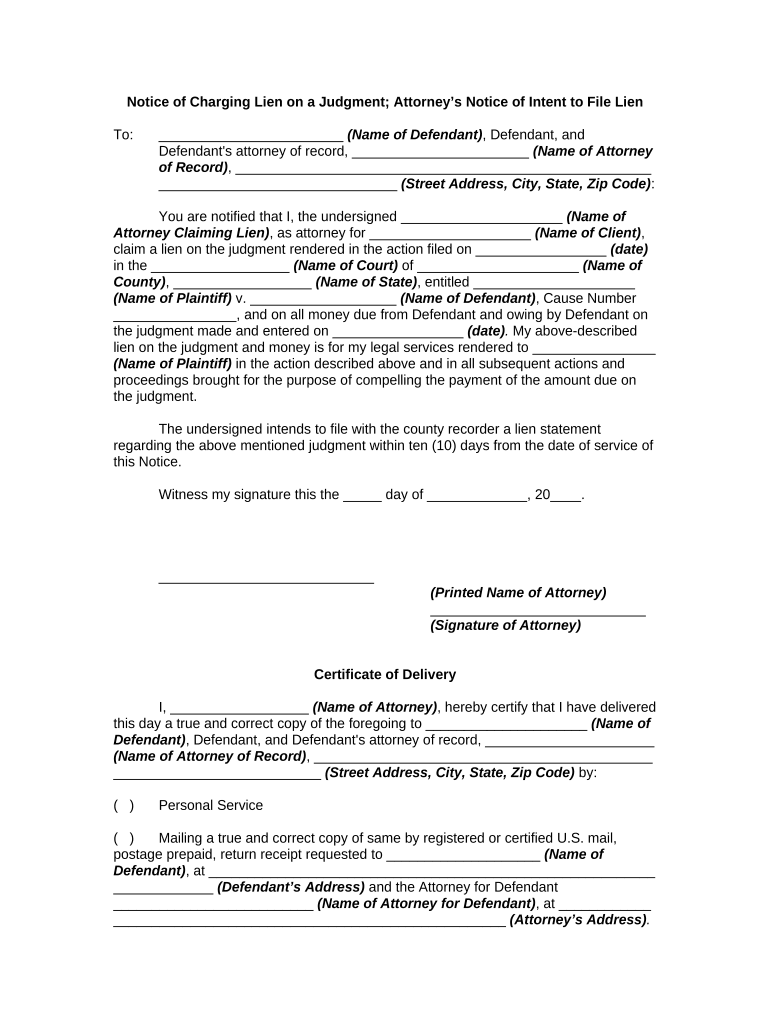
A Charging Lien Form is a formal written instrument used by a professional—commonly an attorney or other service provider—to assert a secured claim against a client’s judgment, settlement, or property for unpaid fees or costs. The form identifies the claimant, the underlying matter, the amount claimed or fee basis, and the legal basis for the lien. Charging liens are governed by state statute and court rule when attached to judgments, or by contract when created as part of fee arrangements; proper completion and filing preserve priority and enforceability in subsequent proceedings.

Why using a clear Charging Lien Form matters

A well-prepared Charging Lien Form preserves fee recovery rights, creates a clear record for courts and third parties, and helps establish priority over subsequent claims. It reduces disputes over chargeable services and supports collection or enforcement actions when a judgment or settlement is obtained.

Why using a clear Charging Lien Form matters

Who typically completes a Charging Lien Form

Several practitioner and business profiles routinely prepare charging liens when fees are unpaid or when fee priority must be secured.

  • Small law firms and solo practitioners asserting attorney charging liens after judgment or settlement.
  • Construction contractors and subcontractors asserting liens related to mechanics’ or payment rights tied to projects.
  • Collections professionals and creditors documenting fee claims tied to judgments or assigned receivables.

Parties preparing the form should confirm authority to file and consult rules for the relevant jurisdiction before recording or submitting to a court or recorder.

Core elements included in a professional Charging Lien Form

A complete form groups identification, basis for the lien, claim amount, supporting references, and execution details so courts and recorders can accept and process the claim without delay.

Claimant

Full legal name and contact information for the person or firm asserting the lien, including bar number when applicable and mailing address for service.
Debtor / Client

Full legal name and identifying details for the client or property owner against whom the lien is asserted, plus case or property identifiers.

Legal Basis

Concise statement of authority (statute, contract clause, or court rule) supporting the charging lien and citation to the controlling law or rule.

Amount Claimed

Specific fee amount or formula (hourly totals, retainer applied, contingency percentage) with dates and brief explanation of how the figure was calculated.

Supporting Records

Reference to invoices, engagement letters, judgment or settlement documents, and any court docket numbers or recording instrument identifiers.

Execution Details

Signature block, signer title or capacity, date, and any notary acknowledgement or witness lines required by local filing rules.

Essential fields to include on the form

Claimant Name: Exact legal name
Client Name: Exact legal name
Case Identifier: Court docket or contract ID
Claim Amount: Dollar amount or formula
Legal Citation: Statute or rule reference
Signature: Signer name and date

Step-by-step: completing and filing a Charging Lien Form

Follow a clear sequence—prepare, verify, sign, and then file or record—so the lien is timely and admissible.

  • 01
    Draft the Form: Complete all identification and claim fields accurately.
  • 02
    Attach Support: Include invoices, engagement letter, judgment references.
  • 03
    Authenticate: Sign, notarize, or obtain witnesses as required.
  • 04
    File or Record: Submit to court clerk or county recorder per rules.

Where to send or file the Charging Lien Form

Destination depends on whether the lien attaches to a judgment, a recorded encumbrance, or is asserted in a pending case; local rules determine the correct venue.

  • Court Filing: File with the clerk if lien attaches to a pending or resolved court judgment.
  • County Recorder: Record with county recorder when asserting against property as an encumbrance.
  • Serve Parties: Serve opposing parties with the filed lien per court service rules.
  • Docket Reference: Ensure docket number or recording reference appears on all copies.

Digital signing, notarization, and e‑submission considerations

Electronic execution and e‑submission are often permitted, but authentication and retention requirements vary by jurisdiction and document type.

  • eSignature Law: ESIGN and UETA permit electronic signatures for most transactions.
  • Notarization: Remote notarization (RON) rules differ by state; confirm acceptance.
  • Record Format: File PDFs compatible with court or recorder requirements.

When using digital signing or RON, retain audit trails, signer authentication evidence, and any recorded audio‑video per the notarization rule set; courts and recorders increasingly accept e‑submitted documents when these requirements are met.

How to configure an online workflow for the Charging Lien Form

A structured digital workflow minimizes errors: prepare a template, require key fields, and capture an audit trail for enforcement and recordkeeping.

Field Configuration
Claimant Name Required text field, auto-validate name format
Amount Claimed Numeric field with currency format and validation
Supporting Docs Attach PDFs; require at least one document
Signature Require signer, date, and optional notary block

Risks and legal consequences of incorrect forms

Invalid Claim: Lien may be voided
Priority Loss: Later claims may supersede
Filing Rejection: Recorder or clerk may refuse
Statute Limits: Missed deadlines can bar relief
Fee Exposure: Costs and sanctions possible
Ethics Risk: Attorney malpractice exposure

Common mistakes to avoid when preparing the form

  • Using approximate or vague fee descriptions such as 'reasonable fees' instead of a precise calculation or stated method for computing fees.
  • Failing to include a docket number, contract identifier, or property legal description, which can lead to misrecording or rejection by the recorder.
  • Skipping jurisdiction checks for notarization, witness requirements, or RON acceptance; rules differ by county and state and can invalidate filings.
  • Not maintaining a signed, timestamped audit trail or failing to attach supporting invoices and engagement letters that substantiate the claimed amount.

Practical tips for accurate and efficient completion

Adopt checks and templates to reduce errors, maintain documentation, and comply with authentication rules before filing or recording.

Use a standardized template
Create a jurisdiction‑specific template that includes required fields, statutory citations, and a checklist for notarization or witness steps to avoid omissions.
Attach supporting documents
Include engagement letters, itemized invoices, and court dockets; supporting evidence reduces challenges and accelerates clerk acceptance.
Verify identity and authority
Confirm the signer has authority to file the lien and use reliable authentication methods if signing electronically to support attribution under ESIGN/UETA.
Maintain audit trails
Retain timestamped signatures, IP addresses, and notarization recordings (if RON used) to preserve evidentiary weight in enforcement actions.

Illustrative scenarios showing common Charging Lien uses

These concise examples show how charging liens are applied in practice and the documentation that typically accompanies them.

Case Study 1

A small law firm files a charging lien after securing a settlement

  • The lien cites the engagement agreement and itemized invoices
  • The recorded lien referenced the court docket and permitted negotiation, enabling collection against the distributed settlement proceeds without extended litigation over fees.

Case Study 2

A subcontractor asserts a lien on a project payment judgment

  • The claim attaches invoices and change‑order records
  • Properly recorded documentation at the county level preserved the subcontractor’s priority and supported recovery when the general contractor’s funds were distributed.

eSignature vendor pricing and feature snapshot for Charging Lien workflows

Selected vendor starting prices and common capabilities relevant to preparing, signing, and submitting legal charging lien documents.

signNow DocuSign Adobe Sign PandaDoc HelloSign
Starting Price $8/user/mo $15/user/mo $14/user/mo $19/user/mo $15/user/mo
Free Trial 7-day free trial Varies by plan Varies by plan Varies by plan Varies by plan
Bulk Send Yes Yes Yes Yes No
Audit Trail Yes Yes Yes Yes Yes
HIPAA Compliant Yes Yes Yes No No

FAQs — common questions about Charging Lien Forms

Answers to frequent questions about electronic signing, notarization, filing venues, and what to do when a lien is challenged.


Need help? Contact support

be ready to get more
Join over 28 million airSlate SignNow users