Court Caption
Full caption with court name, county, case number, and party designations; accurate caption ensures the clerk files the motion in the correct matter and prevents administrative rejection.
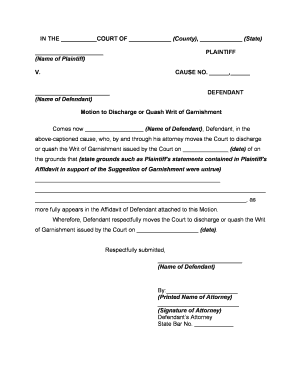
The motion provides a formal route to recover exempt funds, correct procedural errors, avoid continued withholding, and establish a court record that the garnishment was improper or satisfied.

This motion is commonly filed by affected debtors, their attorneys, or third parties claiming exemption from garnishment.
Parties should check local rules for filing procedures and service requirements before submitting the motion.
A person whose property or wages are subject to garnishment. The debtor provides factual declarations about exempt income, account ownership, or payments already made and signs the motion or affidavit to seek discharge or quashment.
Attorney for the judgment creditor responds to the motion, defends the garnishment, and may file counteraffidavits or propose an alternative order. Counsel manages service logistics and any negotiated release.
| Field | Configuration |
|---|---|
| Authentication | Email link or SMS code for signer verification |
| Signature Type | Typed or drawn signature with audit trail |
| Service Notifications | Automatic delivery to creditor and garnishee emails |
| Court Copy Retention | Save stamped PDF and certificate of service |
Confirm court e-filing formats, local service rules, and signer authentication before e-submitting the motion.
Keep an archived signed PDF and certificate of service in your case file for proof of filing and delivery.
Full caption with court name, county, case number, and party designations; accurate caption ensures the clerk files the motion in the correct matter and prevents administrative rejection.
Concise, dated factual summary describing the garnishment, amounts withheld, account ownership, and actions taken; link each factual assertion to an attached exhibit to strengthen credibility.
Cite controlling state statute or rule and explain how facts meet each element for discharge or quashment; present case law or statutory exemptions when available.
Sworn factual declaration from the debtor or records custodian verifying account ownership, exemption status, or lack of service; include notarization when local rules require it.
Attach a clean, judge-ready proposed order granting the requested relief, directing the garnishee to return funds, and specifying any deadlines for compliance.
Detail how, when, and to whom the motion was served; attach proof of service to satisfy procedural requirements and avoid service disputes.
File as soon as exemption or defect is identified to limit further withholding.
Local rules commonly allow 7–30 days for opposing briefs or responses.
Courts typically set hearings within 14–60 days depending on caseload.
Allow several business days for clerk review and docketing.
Post-judgment appeals follow state civil procedure timelines.
A debtor's bank account contained exempt Social Security benefits
An employer received a garnishment for the wrong employee due to a name match error
| signNow | DocuSign | Adobe Sign | PandaDoc | HelloSign | |
|---|---|---|---|---|---|
| Starting Price | $8/user/mo | $15/user/mo | $14/user/mo | $19/user/mo | $15/user/mo |
| Free Trial | Yes, 7-day free trial, no card | Varies by plan | Varies by plan | Varies by plan | Varies by plan |
| Bulk Send | Yes | Yes | Yes | Yes | Yes |
| Audit Trail | Yes | Yes | Yes | Yes | Yes |
| HIPAA Compliant | Yes | Yes | Yes | No | No |