Establishing secure connection…Loading editor…Preparing document…

Mississippi Writ of Garnishment

This template is fully customizable. Edit the text, fill out the fields, and send it for signature. Give it a try!
Mississippi Writ of Garnishment

What the Mississippi Writ of Garnishment Is and when it applies

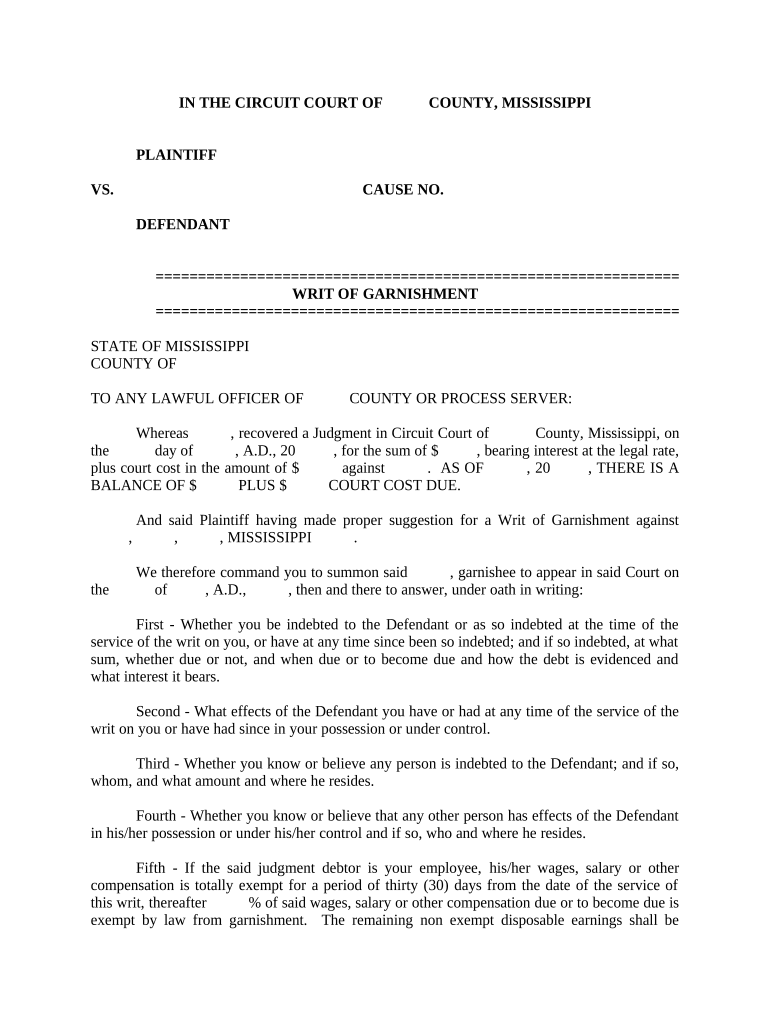
A Mississippi Writ of Garnishment is a court-issued order used to collect a judgment by directing a third party (commonly an employer or bank) to remit funds or property held for a judgment debtor. It is a post-judgment enforcement tool that typically follows an established judgment and any required post-judgment notices. In Mississippi, the writ starts the garnishment process and notifies the garnishee of legal obligations and timelines. Proper completion ensures the garnishee knows what to hold, what to remit, and what defenses or exemptions the debtor may assert.

Why a correctly drafted Mississippi Writ of Garnishment matters

A clear, legally compliant writ protects the judgment creditor’s right to collect while reducing the risk of procedural dismissal, garnishee liability, and debtor dispute. Accurate forms and timely service preserve remedies and limit exposure for all parties.

Why a correctly drafted Mississippi Writ of Garnishment matters

Who commonly prepares and receives a Mississippi Writ of Garnishment

Parties must follow Mississippi procedural rules for service, notice, and any debtor claims of exemption to avoid challenges or sanctions.

  • Judgment Creditors: Individuals or businesses enforcing a court judgment to recover money owed.
  • Attorneys and Law Firms: Prepare pleadings, ensure compliance with procedural rules, and represent creditors in garnishment responses or hearings.
  • Garnishees (Employers/Banks): Third parties ordered to hold or remit funds in their custody for the judgment creditor.

Step-by-step: filing and serving a Mississippi Writ of Garnishment

Follow a standard sequence to preserve enforcement rights and comply with Mississippi procedure when seeking garnishment against a debtor’s assets.

  • 01
    Obtain Judgment: Confirm a final money judgment exists and is entered in the appropriate court.
  • 02
    Prepare Writ: Complete the writ with case caption, judgment amount, garnishee details, and issuance date.
  • 03
    File with Court: Submit the writ and required filing fee to the issuing court clerk for endorsement.
  • 04
    Serve Garnishee: Serve the garnishee following Mississippi service rules and file the proof of service.

How garnishment works in practical terms

A garnishment moves funds or property from the garnishee to the creditor under court authority. The sequence below outlines the core mechanics.

  • Issue Writ: Court issues writ directing garnishee to hold or turn over specified funds or property.
  • Garnishee Response: Garnishee answers under oath regarding any funds or property held belonging to the debtor.
  • Debtor Claims: Debtor may file a claim of exemption or contest the garnishment in court.
  • Court Order to Pay: After resolution, the court orders the garnishee to remit allowable amounts to the creditor.

Core elements every professional Mississippi Writ of Garnishment includes

A complete writ clearly directs the garnishee, attaches the judgment record, and frames deadlines and exemptions. Omissions risk delay or dismissal.

Case Caption

Identifies the issuing court, parties, and case number to tie the writ to the underlying judgment.
Garnishee Details

Full legal name, address, and identifying account or employment information for efficient service.

Judgment Amounts

Breaks down principal, interest, costs, and any post-judgment fees the creditor seeks.

Specific Directions

Clear order about withholding or turning over funds and any time frames for compliance.

Service Instructions

How and when to serve the writ plus where to return proofs of service for court records.

Debtor Rights Notice

Advises the debtor of exemption procedures and timelines to contest the garnishment.

Information and compliance data to include on the writ

Case Number: Unique court docket identifier
Issuing Court: Full court name and county
Creditor Identity: Full legal name and contact
Debtor Identity: Full legal name and last known address
Garnishee Info: Name, address, and account or employer details
Monetary Totals: Principal, interest, and costs

Common preparation errors that undermine garnishment

  • Incorrect case number or court name causes clerks to reject the writ or delay enforcement.
  • Mismatched debtor name or insufficient garnishee details permits garnishee to deny possession.
  • Omitting post-judgment interest or fees underestimates total due and leads to reconciliation disputes.
  • Improper service timing or proof of service can invalidate the garnishment and require reissuance.

Legal and financial risks of an incorrect or incomplete writ

Writ Rejection: Court may refuse filing for procedural defects
Garnishee Liability: Garnishee incorrectly remitting funds can face claims from debtor
Creditor Delay: Errors postpone collection and increase carrying costs
Contempt Risk: Improper service or coercive instructions risk sanctions
Exemption Claims: Debtor exemptions can reduce or eliminate garnishment amounts
Additional Costs: Refiling and attorney fees escalate collection expenses

Key deadlines and timing expectations for garnishment actions

Mississippi procedure imposes distinct timing steps: issuance, service, garnishee answer, and return. Observe court-set deadlines and statutory response periods to prevent delays.

Issuance Date:

Date the court clerk signs or issues the writ

Service Deadline:

Serve the garnishee promptly per local rule; timelines vary by county

Garnishee Answer:

Garnishee typically answers under oath within statutorily prescribed days

Debtor Exemption Period:

Debtor may assert exemptions within the timeframe allowed by statute or court order

Return to Court:

File proof of service and garnishee answer as required by the issuing clerk

Milestones: from judgment to collection

A sequential timeline helps coordinate filings, service, and enforcement; follow the steps in order to maintain priority and compliance.

01

Judgment Entry

Final judgment is entered on the court docket; enforcement rights begin.

02

Writ Preparation

Complete writ details and supporting judgment documentation before filing.

03

Court Issuance

Clerk signs and issues the writ for service on the garnishee.

04

Collection Order

After answers and exemptions resolve, court orders garnishee to remit funds.

How to configure an e-filing and signing workflow

Set up a consistent digital process to prepare, sign, and serve the writ while preserving an audit trail and record copies.

Field Configuration
Template Create a reusable writ template with merge fields
Signer Sequence Assign creditor or counsel to sign first, clerk or court where applicable
Authentication Use email + SMS or advanced ID checks for garnishee verification
Record Retention Store signed writs with audit trail and service proofs

Digital signing and distribution considerations

Ensure the selected solution complies with ESIGN and UETA and can supply downloadable, tamper-evident signed records for court submission.

  • File Formats: PDF/A and PDF compatible
  • Audit Trail: Timestamp, IP, and signer attribution
  • Integrations: Connectors for case management and cloud storage

Real-world examples of garnishment use and outcomes

These concise examples show how parties use garnishments to enforce money judgments in different contexts.

Commercial Debt Recovery

A small supplier obtains a default judgment against a buyer

  • The supplier files a writ naming the buyer’s bank as garnishee
  • The bank reports account balances, the court orders turnover of non-exempt funds, and the supplier recovers a substantial portion of the judgment after fees and exemptions are applied.

Wage Garnishment

An individual creditor secures a judgment for unpaid services

  • Employer served as garnishee with wage details
  • The employer withholds amounts within federal and state limits and remits payments to the clerk for creditor distribution after required notices.

Practical tips to improve accuracy and speed of garnishment processing

Adopting consistent procedures reduces rework and exposure when enforcing judgments across counties and different garnishees.

Verify Party Names
Cross-check names against judgment paperwork and account records to prevent garnishee objections or improper service.
Attach Judgment Proof
Include certified or stamped judgment copies to expedite garnishee recognition and compliance.
Use Clear Amount Breakdowns
Specify principal, interest, and costs separately so garnishees can calculate remittable sums without court interpretation.
Preserve Audit Trails
Keep signed PDFs, timestamps, and proof of service digitally to substantiate compliance and defend challenges.

Typical signatories and filers for the writ

Creditor or Counsel

The creditor or an attorney signs and certifies the writ before filing. Counsel often signs to attest to the accuracy of supporting documents and to accept service or responsibility for subsequent notices and any fee obligations.

Court Clerk

The clerk issues or endorses the writ upon filing and payment of applicable fees, which authorizes service on the garnishee and starts the statutory timelines for answers and returns.

Comparing eSignature options for completing and distributing writs

Select an eSignature provider that supports secure PDF output, audit trails, and integration with your case management tools. The table compares common vendor starting prices and core features.

signNow DocuSign Adobe Sign PandaDoc HelloSign
Starting Price $8/user/mo $15/user/mo $14/user/mo $19/user/mo $15/user/mo
Free Trial 7-day free trial Varies by plan Varies by plan Varies by plan Varies by plan
Bulk Send Yes Yes Yes Yes No
Audit Trail Yes Yes Yes Yes Yes
HIPAA Compliant Yes Yes Yes No No

Frequently asked questions about Mississippi Writs of Garnishment

Answers to common questions on preparation, service, and enforcement of writs in Mississippi to help avoid delays and errors.


Need help? Contact support

be ready to get more
Join over 28 million airSlate SignNow users