Establishing secure connection…Loading editor…Preparing document…

Habeas Corpus

This template is fully customizable. Edit the text, fill out the fields, and send it for signature. Give it a try!
Habeas Corpus

What a Habeas Corpus Petition Is and When It Applies

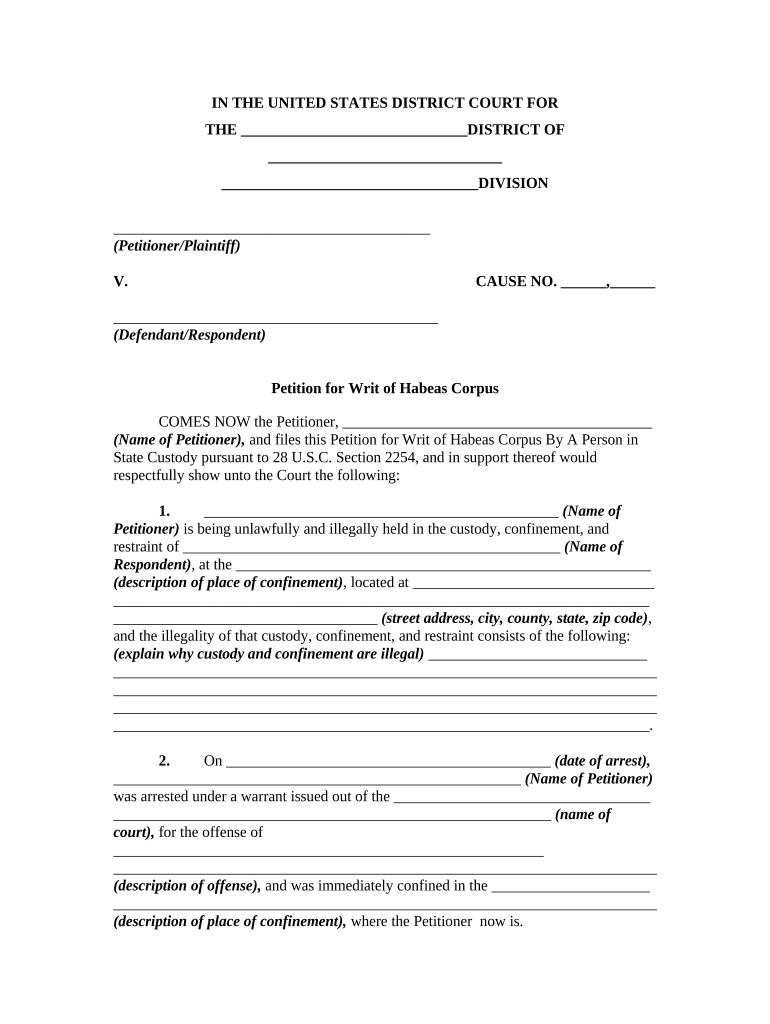
A Habeas Corpus petition is a written request to a court asking for relief from unlawful detention or imprisonment. It challenges the lawfulness of confinement, the procedure used to obtain the conviction, or the legality of continued custody. Habeas petitions may be filed in state courts under state procedure or in federal court under statutes such as 28 U.S.C. §2241 and §2254 when federal constitutional issues are implicated. Relief can include release, a new trial, or other remedies. Procedures, time limits, and available remedies vary by jurisdiction and by whether the petition is filed in state or federal court.

Why Habeas Corpus Matters for Custodial Rights

Habeas Corpus provides a formal mechanism to test whether detention complies with constitutional and statutory protections. It can correct trial errors, address ineffective assistance of counsel, and remedy due process violations. For detainees, counsel, and advocates, understanding habeas procedures preserves liberty and avoids procedural forfeiture.

Why Habeas Corpus Matters for Custodial Rights

Who Typically Prepares or Files a Habeas Petition

Common participants include the detained person, retained or appointed counsel, public defenders, and post-conviction relief attorneys.

  • Public defenders and appointed counsel represent indigent petitioners in state or federal collateral review.
  • Private criminal appeals attorneys prepare complex federal claims or capital post-conviction petitions.
  • Prisoner pro se filers submit petitions without counsel and must follow strict procedural rules.

Proper representation and timely filing are essential: procedural defaults and statute-of-limitations issues frequently determine whether a court will review the merits.

Core Components of a Professional Habeas Corpus Petition

A well-organized petition focuses on jurisdiction, grounds for relief, supporting facts, and a clear request for remedy. Include identification, statement of prior proceedings, and citations to controlling law.

Caption

Court name, case number (if assigned), and caption identifying petitioner and respondent; ensures correct filing and routing to the presiding judge.
Jurisdiction

Statement of the court's jurisdictional basis (e.g., 28 U.S.C. §2241 or §2254) and any relevant exhaustion of state remedies or statutory exemptions.

Grounds for Relief

Concise numbered grounds (constitutional or statutory) with supporting factual allegations and legal citations linked to each ground.

Factual Statement

Chronological summary of relevant facts, trial record references, and citations to exhibits or transcripts that corroborate the claim.

Request for Relief

Specific remedy sought (e.g., release, evidentiary hearing, new trial), including alternative relief if primary request is denied.

Verification and Signature

Signed declaration under penalty of perjury by petitioner or counsel with date and contact information for service and communications.

Essential Information to Include

Petitioner Name: Full legal name
Custody Location: Facility name
Case Number: Previous case ID
Grounds Listed: Numbered claims
Supporting Exhibits: Transcript refs
Signature Date: MM/DD/YYYY

Step-by-Step: Preparing and Filing the Petition

Follow these steps in order to build a complete petition and avoid common procedural defects.

  • 01
    Review Record: Gather trial transcripts, orders, and prior appeals.
  • 02
    Identify Claims: Select constitutional or statutory grounds with supporting facts.
  • 03
    Draft Petition: Prepare caption, jurisdictional statement, and numbered grounds.
  • 04
    File and Serve: Submit to clerk, pay fee or request IFP, and serve respondent per rules.

Filing Pathways and Typical Workflow

A habeas petition may proceed through state post-conviction channels before federal review; understand exhaustion and procedural default concepts.

  • State Remedies: Exhaust state remedies before federal habeas when applicable.
  • Federal Filing: File in U.S. District Court under 28 U.S.C. §2254 or §2241 as appropriate.
  • Response and Briefing: Respondent files answer; court may order briefing or evidentiary hearing.
  • Relief Determination: Court grants, denies, or holds hearing on factual disputes.

How to Configure an Online Submission Workflow

When using a document platform, set roles, attachments, and authentication to meet court and service rules.

Field Configuration
Submitter Role Counsel or pro se selects as primary uploader
Attachment Handling Attach PDF exhibits and transcripts; combine into single packet where required
Signer Authentication Use typed signature for counsel; consider two-factor for remote verifications
Delivery Configure service emails and download copies for local filing

Digital Filing and eSubmission Practical Requirements

Electronic filing or eSubmission requires attention to signer attribution, document integrity, and court-specific formatting.

  • File Format: PDF/A is preferred
  • Audit Trail: Capture timestamp and signer identity
  • Authentication: Use two-factor for higher assurance

Confirm local court e-filing rules and service requirements; eSubmission may supplement but not replace required paper filings in some jurisdictions.

Key Deadlines and Time Considerations

Timing affects whether a court will consider habeas claims; know statute of limitations and relevant trigger dates in your case.

AEDPA Statute of Limitations:

One year for federal petitions under 28 U.S.C. §2244(d)

State Post‑Conviction Deadlines:

Varies by state; many provide short windows for collateral relief

Exhaustion Requirement:

Complete state remedies before federal filing where required

Filing Fee / IFP:

Fee due on filing unless in forma pauperis granted

Service Deadline:

Serve respondent per local rules after filing

Common Risks and Consequences of Deficient Petitions

Procedural Dismissal: Court rejects petition for untimely filing
Failure to Exhaust: Claims barred from federal review
Sanctions Risk: Frivolous filings can trigger sanctions
Service Defects: Improper service may void proceedings
Lost Remedies: Waived claims cannot be relitigated easily
Evidentiary Limits: Untimely evidence may be excluded

Representative eSignature Vendor Comparison for Legal Filings

Compare core pricing and compliance features relevant to legal filings and secure submissions; signNow is listed first per standard vendor comparison.

signNow DocuSign Adobe Sign PandaDoc HelloSign
Starting Price $8/user/mo $15/user/mo $14/user/mo $19/user/mo $15/user/mo
Free Trial 7-day free trial No No No No
Bulk Send Yes Yes Yes Yes No
Audit Trail Yes Yes Yes Yes Yes
HIPAA Compliant Yes Yes Yes No No

Real-World Examples of Habeas-Related Workflows

These concise examples show how counsel and agencies interact with petitions and support materials.

Public Defender Workflow

Counsel compiles trial record and files timely petition in state court

  • Uses state exhaustion steps
  • Result: petitioner preserved federal review rights while reducing procedural risk through timely record citations and verified service.

Corrections Records Request

Attorney requests detention logs and incident reports from the facility

  • Facility provides certified copies per policy
  • Outcome: exhibits submitted with petition supported the factual allegations and shortened the court's evidentiary inquiry.

Common Questions About Preparing and Filing a Habeas Petition

Answers to frequent procedural and filing questions to help avoid preventable delays or rejections.


Need help? Contact support

be ready to get more
Join over 28 million airSlate SignNow users