Header
Include your full name, unit number, current address, phone number, and email so the landlord can identify the tenancy and reply directly.
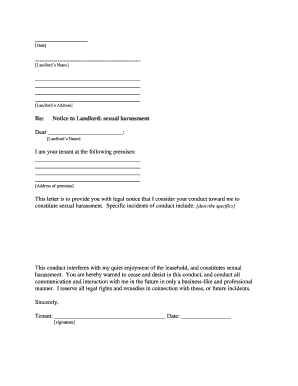
A formal notice creates a dated record that preserves facts and triggers landlord responsibilities under lease terms and local housing or anti-discrimination rules; it may also support later administrative or legal remedies while protecting the tenant’s right to a timely response.

Tenants, tenant advocates, and property managers commonly use this notice to document incidents and request landlord action.
The notice can be adapted for single incidents, repeated patterns, or requests for immediate measures such as relocation, repairs, or changes to building access controls.
A tenant preparing the notice should state their name, unit, contact information, and a factual account of incidents. The tenant may attach photos, messages, or witness names to support the claim and to document the timeline for later review or complaint filings.
A property manager who receives the notice should log receipt, begin an investigation consistent with company protocols and local law, and communicate planned steps and expected timelines back to the tenant while preserving confidentiality where required.
Include your full name, unit number, current address, phone number, and email so the landlord can identify the tenancy and reply directly.
Open with a one- or two-sentence summary naming the conduct (sexual harassment) and the dates or range when it occurred to frame the detailed chronology that follows.
List events in date order with times, locations, involved parties, and factual descriptions of actions or words rather than conclusions about motive.
Attach copies of photos, messages, audio timestamps, or witness statements and label each attachment so investigators can match items to events.
State specific, reasonable remedies sought such as an investigation, security adjustments, temporary relocation, or enforcement of no-contact lease terms.
Note how you submitted the notice and keep receipts or email headers to show the date and method of delivery.
| Field | Configuration |
|---|---|
| Tenant Contact | Required field; validate email |
| Incident Date | MM/DD/YYYY format |
| Attachments | Allow PDF, JPG, PNG |
| Delivery Method | Record certified mail or e-delivery |
Choose delivery channels that provide proof of receipt and preserve timestamps for legal use.
Use platforms and methods that maintain tamper-evident records and allow you to export signed copies in standard formats for retention and potential review.
Preserve evidence and log events as soon as possible after each incident.
Many landlords respond within 5–30 business days under policy; local law may impose shorter or specific timeframes.
Some agencies impose filing limits; consult local housing or fair housing guidance for deadlines.
For imminent safety risks, request immediate security or police assistance regardless of formal notice timelines.
Keep copies of all communications until any dispute or claim is fully resolved.
| signNow | DocuSign | Adobe Sign | PandaDoc | HelloSign | |
|---|---|---|---|---|---|
| Starting Price | $8/user/mo | $15/user/mo | $14/user/mo | $19/user/mo | $15/user/mo |
| Free Trial | 7-day free trial | Varies by vendor | Varies by vendor | Varies by vendor | Varies by vendor |
| Bulk Send | Yes | Yes | Yes | Yes | Yes |
| Audit Trail | Yes | Yes | Yes | Yes | Yes |
| Envelope Cap | No cap | 100 envelopes/user/year | Varies | Varies | Varies |