Establishing secure connection…Loading editor…Preparing document…

Indiana Notice of Hearing for Change of Name of Minor

This template is fully customizable. Edit the text, fill out the fields, and send it for signature. Give it a try!
Indiana Notice of Hearing for Change of Name of Minor

What the Indiana Notice of Hearing for Change of Name of Minor Is

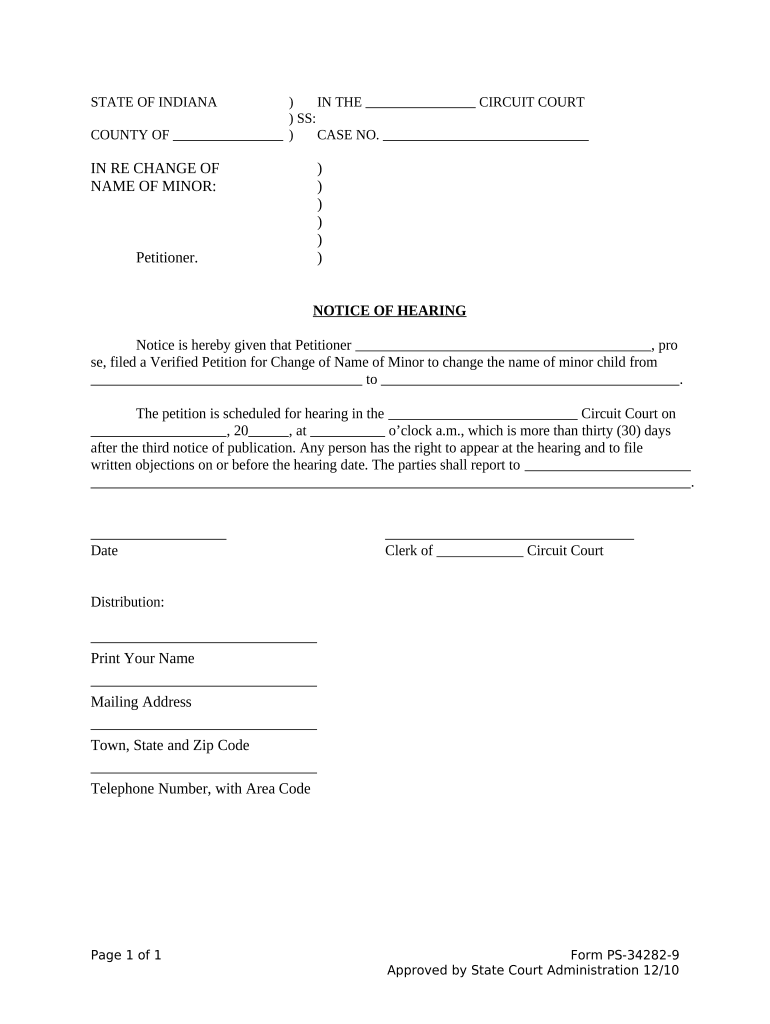
The Indiana Notice of Hearing for Change of Name of Minor is a court document filed to notify interested parties that a hearing has been scheduled on a petition to change a minor's legal name. The notice identifies the petitioner and minor, states the hearing date, time, and location, and explains who must be served or otherwise notified. It preserves due process by giving affected parties an opportunity to appear and object, and it creates the official record the judge uses to decide the petition. Follow local court rules when preparing and serving the notice.

Why a Proper Notice Matters

A correct notice ensures the court has jurisdiction, protects the minor's legal interests, and gives recipients a fair opportunity to respond. Accurate notices reduce the risk of continuances, procedural dismissal, or re-service and support timely entry of a final order that allows downstream record changes.

Why a Proper Notice Matters

Who Typically Prepares and Receives This Notice

Typical filers include parents, legal guardians, and attorneys who seek a court-ordered name change for a minor; clerks and judges rely on the notice to schedule hearings and manage dockets.

  • Petitioning parent or guardian — files the petition and arranges service on required parties prior to hearing.
  • Nonfiling parent or legal guardian — receives notice and may consent or file an objection.
  • Court clerk and judge — use the notice to set the hearing and verify proof of service.

Primary Parties and Their Roles

Primary Petitioner

Usually a parent or legal guardian who files the petition on behalf of the minor. The petitioner provides relationship details, contact information, and any custody or consent statements; missing information can delay the hearing or require corrective filings with the clerk.

Other Parent

The nonfiling parent often must be served unless parental rights have been terminated. Their consent or objection may influence the court's disposition; improper service can result in continuance or the need for re-service.

Essential Notice Elements at a Glance

Document Type: Court notice for name change
Key Parties: Petitioner, minor, notified parents
Required Identity: Names, DOB, and relationship
Service Method: Personal service or certified mail
Hearing Details: Date, time, location included
Retention: Maintain original court-stamped copy

Common Consequences of Mistakes

Hearing Delay: Insufficient service
Dismissal Risk: Procedural defects
Default Order: Unopposed objections possible
Custody Implications: Court may review custody
Privacy Exposure: Public record consequences
Financial Costs: Additional fees and counsel

Frequent Preparation Errors to Avoid

  • Failing to serve a noncustodial or legally entitled parent typically produces a continuance and extra court costs.
  • Submitting inconsistent names, dates of birth, or addresses may prompt clerk rejection or the need for amended filings.
  • Ignoring local rules on publication or juvenile procedure can invalidate service and delay the hearing date significantly.
  • Omitting required attachments such as the petition, proposed order, or custody affidavits increases the chance of a continuance or denial.

Step-by-Step: Prepare and File the Notice

Follow these steps to prepare, serve, and file a compliant Indiana Notice of Hearing for a minor name-change petition.

  • 01
    Prepare Petition: Complete the accompanying Petition to Change Name for Minor.
  • 02
    Draft Notice: Include hearing date, parties, minor's details, and service instructions.
  • 03
    Serve Parties: Serve required persons per local rules and file proof of service.
  • 04
    File with Court: Submit notice, petition, and required filing fee to the clerk.

Configure an Electronic Workflow for the Notice

Set up a digital workflow to prepare the notice, collect signatures, track service, and archive proof of service in compliance with court rules.

Document template and field mapping Create a reusable template with required fields and validation rules.
Specify recipient roles and signing order Define who signs, who is served, and the sequence of actions.
Set signer authentication strength (email/SMS/KBA) Choose authentication appropriate to the court and parties.
Enable service tracking and proof collection Capture delivery receipts, timestamps, and return-of-service affidavits.
Configure retention, export PDF/A, and audit log Store court-stamped PDFs and a complete audit trail for records.

Technical Requirements and Integrations

Digital delivery and integration options affect how notices are signed, how proof of service is captured, and whether filings meet local e-filing rules.

  • File Formats: PDF and DOCX formats supported
  • Integrations: Works with court e-filing or cloud storage
  • Accessibility: Ensure WCAG-compliant viewing and signing

How Filing, Service, and Hearing Interact

This flow shows the typical progression from filing the petition and notice to serving parties, proving service, and proceeding at the hearing.

  • File Clerk: Clerk assigns docket number and schedules hearing.
  • Service: Petitioner serves the notice on entitled parties.
  • Return of Service: File proof that parties received notice before hearing.
  • Hearing: Judge hears petition, considers objections, issues order.

Typical Timelines and Deadlines

Timelines for service and hearing vary by county; verify local rules with the clerk before filing to avoid missed deadlines and continuances.

File Petition:

File petition and notice with the clerk to initiate proceedings.

Service Deadline:

Serve required parties, typically several weeks before the scheduled hearing.

Publication Window:

If publication is used, follow the court's specified notice period and proof requirements.

Objection Cutoff:

Objections must be filed or presented by the hearing per the court's timetable.

Judgment Entry:

Court issues order after hearing and clerk enters the final judgment.

Key Case Milestones from Filing to Order

Sequential milestones that typically occur in a minor name-change proceeding, from filing through entry of the final order.

01

Petition Filed

Clerk assigns case number and sets initial hearing.

02

Notice Served

Serve all entitled parties and file proof of service.

03

Hearing Held

Judge considers evidence, hears objections, and decides the petition.

04

Order Entered

Court signs order; clerk files judgment and provides certified copies.

Practical Tips to Speed Processing and Reduce Risk

Use these best practices to minimize rework, ensure proper service, and support prompt entry of the final order.

Confirm county court rules and forms
Review the specific county clerk's instructions, required forms, and fee schedule before filing. Local practice often governs acceptable service methods, publication rules, and e-filing availability.
Attach certified vital records and supporting documents
Provide certified birth certificates, custody orders, and consent affidavits when required. Certified documents reduce follow-up requests and help the court make prompt findings.
File clear proof of service promptly after serving parties
Use signed return receipts, sheriff affidavits, or sworn return-of-service forms and upload or file them so the court can verify notice before the hearing.
Use electronic forms and e-signatures where accepted
When courts and parties accept digital processes, maintain auditable e-signature trails and ensure ESIGN/UETA consent and retention practices are followed.

Basic eSignature Pricing and Feature Comparison

Overview of starting prices and select capabilities among common eSignature vendors to help compare basic costs and features relevant to document signing and proof collection.

signNow DocuSign Adobe Sign PandaDoc HelloSign
Starting Price $8/user/mo $15/user/mo $14/user/mo $19/user/mo $15/user/mo
Free Trial 7-day free trial Varies by plan Varies by plan Varies by plan Varies by plan
Bulk Send Yes Yes Yes Yes No
Audit Trail Yes Yes Yes Yes Yes
HIPAA Compliant Yes Yes Yes No No

Representative Use Cases

Practical examples showing how corrected notices, attorney preparation, and verified proof of service affect hearing outcomes and post-order updates.

County Clerk Example

A clerk returned a filing due to an address mismatch for the nonfiling parent; correcting the notice preserved the hearing date

  • Service error identified early and corrected
  • The petitioner re-served the corrected notice, filed proof of service, and the court rescheduled the hearing. Documenting the correction and filing an amended notice minimized attorney time and allowed the minor's matter to proceed without substantive delay.

Attorney Representation Example

An attorney assembled a full packet with consent affidavits and a proposed order to reduce hearing time

  • Complete packet shortened the hearing time
  • Because certified copies and parental consent were included, the court granted the name change at the initial hearing and the clerk issued the certified order promptly, enabling the family to update vital records and school documentation quickly.

Frequently Asked Questions

Answers to common questions about service, filing, evidence, and next steps for an Indiana Notice of Hearing in a minor name-change case.


Need help? Contact support

be ready to get more
Join over 28 million airSlate SignNow users