Establishing secure connection…Loading editor…Preparing document…

Initial Disclosures

This template is fully customizable. Edit the text, fill out the fields, and send it for signature. Give it a try!
Initial Disclosures

What Initial Disclosures Are and where they fit in litigation

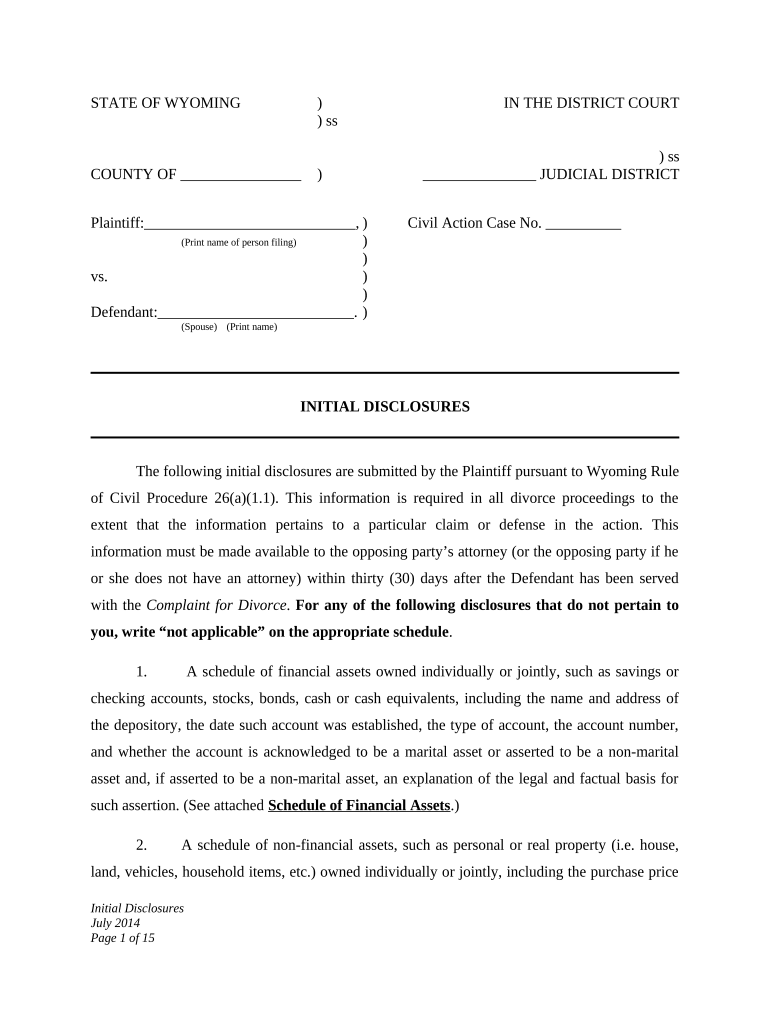
Initial Disclosures are the early exchange of basic case information required by procedural rules so parties can identify witnesses, documents, and damages without formal discovery motions. Under the Federal Rules of Civil Procedure (Rule 26(a)(1)), parties ordinarily must disclose witness names, relevant documents or categories of documents, a computation of damages, and insurance agreements, typically within a short period after the Rule 26(f) conference. Electronic delivery and storage of these disclosures are consistent with ESIGN and state UETA statutes when parties consent and records are retained in a reproducible form.

Why timely and complete initial disclosures matter

Providing accurate initial disclosures reduces disputed discovery, narrows issues early, and preserves evidence admissibility under court rules; late or inadequate disclosures risk exclusion of evidence, sanctions, and extended litigation costs.

Why timely and complete initial disclosures matter

Who typically prepares and receives these disclosures

Initial disclosures are prepared by parties' counsel or self-represented litigants and served on opposing parties to satisfy court scheduling orders.

  • Plaintiff counsel preparing a plaintiff's witness list and document inventory for the opposing party.
  • Defense counsel assembling responsive document categories, witnesses, and damage computations.
  • In-house legal teams coordinating disclosures with outside counsel and corporate custodians.

Courts, mediators, and opposing counsel use these disclosures to plan depositions, motions, and scheduling; accuracy at this stage lowers the risk of sanctions or evidentiary exclusion.

Core elements that appear in professional initial disclosures

A compliant initial disclosure package groups required items clearly so the receiving party can locate witnesses, documents, and contact information without additional requests. Organize content into labeled sections and include contact details and certification of service.

Witnesses

List individual names, addresses, and subject matter of testimony so opposing counsel can plan depositions and follow-up discovery.
Document Categories

Provide concise categories or attachments of relevant documents, with custodial notes if documents are voluminous or stored electronically.

Damage Computation

Supply a clear computation of damages with supporting calculations, sources, and any pending adjustments or contingent claims.

Insurance Information

Identify insurance carriers, policy numbers, and coverage limits that might cover claims or defense obligations.

Custodial Sources

Describe likely custodians, locations, and systems where responsive ESI is maintained to facilitate targeted preservation and collection.

Certificate of Service

Include a dated service statement describing the method of delivery (mail, e‑service, CM/ECF) and recipients.

Step-by-step: preparing and serving initial disclosures

Follow a concise sequence to assemble disclosures, confirm completeness, and serve according to court rules and scheduling orders.

  • 01
    Gather Records: Collect witness lists, ESI custodians, and responsive documents.
  • 02
    Draft Disclosures: Populate caption, sections, and an accurate computation of damages.
  • 03
    Review & Certify: Have counsel verify accuracy and compliance before signing.
  • 04
    Serve and File: Serve opposing parties and file with court if required by local rules.

Configuring an online workflow for electronic initial disclosures

An online workflow standardizes collection, signature capture, and secure delivery while preserving an audit trail required for admissibility and compliance.

Field Configuration
Document Upload Accept PDF/DOCX; preserve native ESI metadata when practical
Signature Fields Add signature/date blocks and required initials using conditional logic
Authentication Enable email or SMS codes; use stronger ID verification if ordered
Retention Policy Set immutable retention and export in ISO PDF/A or native formats

Where and how to send initial disclosures

Deliver disclosures per the court and local rules: many jurisdictions accept e-service, CM/ECF filing, or direct counsel email when permitted by order.

  • Counsel Service: Email or e-service to opposing counsel per agreement or local rule
  • Court Filing: File via CM/ECF when the court requires filing of disclosures
  • Registered E‑Service: Use registered electronic service systems where local rules permit
  • Certified Mail: Use for parties refusing electronic service or when ordered by court

Technical considerations for e-signature and e-submission

Ensure the platform captures an audit trail, supports common document formats, and meets any court-prescribed authentication requirements.

  • File Formats: PDF, DOCX, and native ESI
  • Integrations: Salesforce, Microsoft 365, NetSuite, Box, Procore
  • Security: TLS in transit; AES‑256 at rest

Choose a platform that provides tamper-evident signed PDFs, exportable audit reports, and access controls so the court and parties can reproduce the record when required.

Typical timing and deadlines to track

Observe the timing set by procedural rules and local orders; missing a disclosure deadline can trigger motions and sanctions.

FRCP Initial Deadline:

Rule 26(a)(1): generally 14 days after the Rule 26(f) conference

Supplementation Duty:

Ongoing duty to supplement under Rule 26(e)

Expert Disclosures:

Separate deadlines govern expert reports and disclosures

Local Rule Variances:

Courts frequently modify deadlines by scheduling order

Service Proof:

Retain proof of service and timestamps for compliance

Key milestones from case opening to discovery readiness

Track these milestones to coordinate preservation, collection, and production without late disclosures.

01

Case Initiation

Complaint filed and defendant served; triggers initial timelines

02

Rule 26(f) Conference

Parties meet to discuss discovery and scheduling

03

Initial Disclosures Served

Provide required lists and documents per the schedule

04

Supplementation & Meet

Supplement later disclosures and confer on disputes

Common mistakes that lead to objections or sanctions

  • Omitting custodians or key documents and then producing them late, which can prompt exclusion under discovery rules and erode credibility.
  • Overbroad or vague document descriptions (e.g., 'all emails') that force repeated meet-and-confer sessions and court intervention.
  • Failing to preserve ESI before collection, resulting in spoliation allegations and potential adverse inference instructions.
  • Using informal service without proof or running afoul of local e-service rules, making a disclosure ineffective for compliance purposes.

Consequences of incomplete or untimely disclosures

Evidence Exclusion: Rule 37(c)(1): may exclude undisclosed evidence
Sanctions: Monetary fines or attorney fee awards
Adverse Inference: Court may infer missing evidence harms nonproducing party
Delay Costs: Extended litigation timelines and added expense
Credibility Harm: Judge or jury may view parties less favorably
Case Disruption: Motions to compel and discovery disputes

Practical examples of initial disclosure use

Two short case examples show how disclosures streamline discovery and avoid disputes.

Commercial Contract Dispute

A vendor lists custodians and contract documents to avoid broad ESI requests

  • The parties agree on narrow search terms
  • Early specificity reduced collection costs and limited motion practice.

Personal Injury Case

Plaintiff provides medical provider names and records categories early

  • Defense narrows experts and discovery scope
  • Timely disclosures accelerated mediation and settlement talks.

Practical tips to prepare defensible initial disclosures

Adopt disciplined collection, review, and documentation habits to produce disclosures that withstand scrutiny and minimize disputes.

Document Inventory
Maintain a running inventory of responsive documents, noting custodians, file locations, and search terms used during collection.
ESI Preservation
Issue litigation holds promptly, preserve relevant ESI systems, and document preservation steps taken.
Audit Trail
Use platforms that record signer identity, timestamps, IP addresses, and versioned exports for evidentiary support.
Meet-and-Confer
Engage opposing counsel early to narrow categories and prevent repetitive discovery disputes.

Typical eSignature vendor pricing and feature comparison

Common vendor choices differ by price model, bulk send, and compliance features; signNow appears first for straightforward comparison of starting price and key capabilities.

signNow DocuSign Adobe Sign PandaDoc HelloSign
Starting Price $8/user/mo $15/user/mo $14/user/mo $19/user/mo $15/user/mo
Free Trial 7-day free trial (no card) Varies by plan Varies by plan Varies by plan Varies by plan
Bulk Send Yes Yes Yes Yes No
Audit Trail Yes Yes Yes Yes Yes
HIPAA Compliant Yes Yes Yes No No

Frequently asked questions about Initial Disclosures

Answers to common procedural and technical questions about preparing, serving, and preserving initial disclosures in U.S. litigation.


Need help? Contact support

be ready to get more
Join over 28 million airSlate SignNow users