Establishing secure connection…Loading editor…Preparing document…

Wisconsin Plaintiff's First Set of Interrogatories

This template is fully customizable. Edit the text, fill out the fields, and send it for signature. Give it a try!
Wisconsin Plaintiff's First Set of Interrogatories

What the Wisconsin Plaintiff's First Set of Interrogatories Is

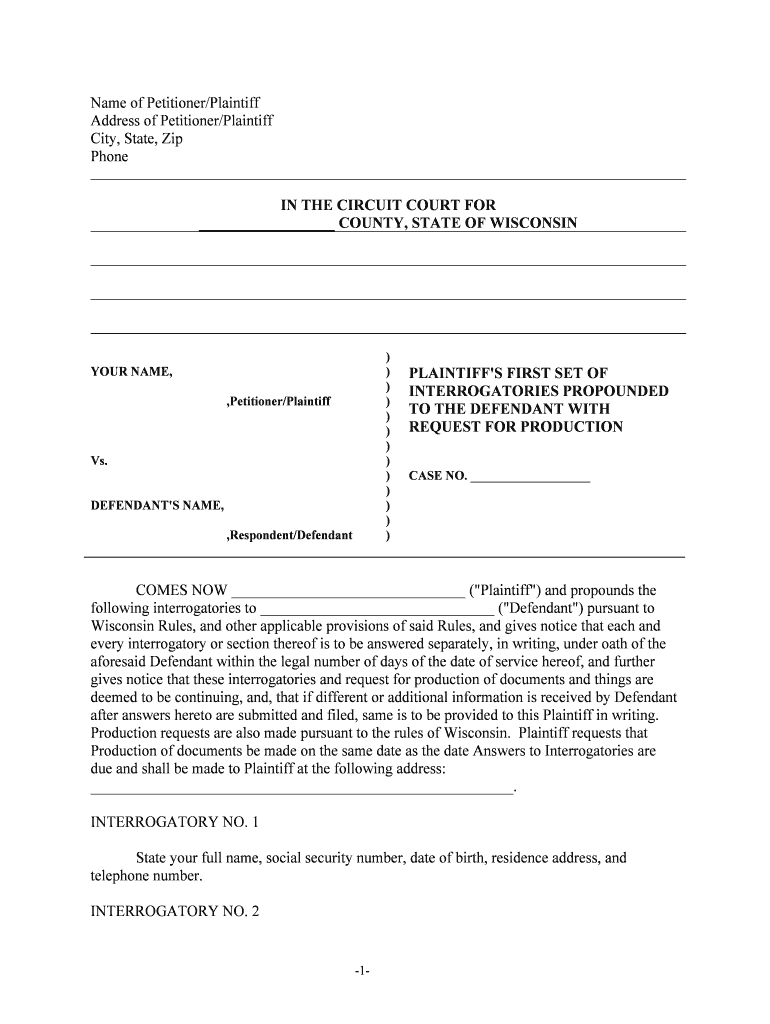
The Wisconsin Plaintiff's First Set of Interrogatories is a formal discovery document used by a plaintiff in civil litigation to request written, sworn answers from an opposing party. Interrogatories ask the recipient to provide factual information, identify witnesses and documents, and state the basis for defenses. Answers are exchanged as part of the discovery process and become part of the case record; they may be used in depositions, motions, or trial. Local court rules and state procedural rules govern format, service, and timing in Wisconsin courts.

Why Use a First Set of Interrogatories in Wisconsin

Interrogatories help narrow disputed facts, lock in the opponent’s positions, and identify documents and witnesses early in the case, improving preparation efficiency and reducing surprise at trial.

Why Use a First Set of Interrogatories in Wisconsin

Who Typically Prepares and Uses These Interrogatories

Plaintiffs and their litigation teams draft and serve interrogatories to gather facts, admissions, and document leads before trial.

  • Plaintiff or lead counsel — Drafts targeted questions to establish liability, damages, and witness identities for trial preparation.
  • Paralegals and litigation support — Format, paginate, and track responses; coordinate service and electronic production of supporting documents.
  • Opposing party representatives — Respond under oath, produce documents, and raise timely objections according to procedural rules.

Responses are integral to depositions and motions; counsel typically coordinates follow-up discovery based on answers received.

Core Components of a Professional Plaintiff's First Set of Interrogatories

A well-drafted set combines clear definitions, concise numbered questions, directions for producing documents, verification language, and a caption consistent with court filings.

Caption

Court name, case number, and full party names must match the complaint and any prior filings to avoid service or filing irregularities.
Definitions

Precise defined terms (e.g., 'document', 'identify', date ranges) reduce ambiguity and limit evasive answers or scope disputes during meet-and-confer.

Instruction Section

State instructions on how to answer, format for dates and redactions, and whether combined document lists or privilege logs are expected.

Interrogatory Items

Numbered questions in logical order: background facts, timeline, witnesses, damages, communications, and document identification requests.

Document Requests

Cross-referenced requests for documents described in answers with production format, date ranges, custodian identification, and Bates-stamping guidance.

Verification Block

Signature and verification language required by court rules indicating answers are true under penalty of perjury or oath.

Step-by-Step: Preparing and Serving the First Set of Interrogatories

Follow a clear sequence from drafting to service and follow-up to reduce objections and avoid missing deadlines.

  • 01
    Draft Questions: Target facts, witnesses, and documents with clear definitions and date ranges.
  • 02
    Review Local Rules: Confirm service method, page limits, and any state-specific verification requirements.
  • 03
    Serve Opposing Party: Serve by agreed electronic method or permitted service; maintain proof of service.
  • 04
    Track Responses: Monitor deadlines, log objections, and schedule meet-and-confer if responses are inadequate.

Configuring an Online Workflow for Interrogatory Delivery and Tracking

Set up a repeatable electronic workflow to send interrogatories, collect responses, and store evidence in a defensible audit trail.

Field Configuration
Document Format PDF/A preferred for long-term preservation and consistent rendering
Signer Authentication Use email + optional SMS code or stronger verification for high-risk cases
Audit Trail Capture Record IP, timestamps, and signer actions for admissibility
Storage Location Secure cloud or case management repository with role-based access

Where to Send, Serve, and File Interrogatory Documents

Understand distinct destinations: opposing counsel (service), court (only if filed), and your case file (recordkeeping).

  • Serve Opponent: Deliver to opposing counsel per rule—email, e-service, or personal service as allowed.
  • File with Court: Only file discovery with court when court requires or when submitting motions to compel.
  • Preserve Originals: Retain signed verifications in your case file and preserve related documents.
  • E-Notification: Record service confirmations and service dates for future motions or sanctions hearings.

Digital Delivery and Technical Requirements

Electronic delivery requires PDF-compatible files, reliable audit trails, and verifiable signer attribution to support admissibility.

  • File Types: PDF, DOCX and native spreadsheets accepted
  • Authentication: Email + optional SMS or KBA for added proof
  • Integrations: CRM, cloud storage, and case management connectors

Choose tools that support audit trails, secure storage, and vendor integrations such as Salesforce, Microsoft 365, NetSuite, Box, or Google Workspace to streamline production and preservation.

Typical Timelines and Deadlines to Expect

Deadlines depend on the governing procedural rules; plan for prompt service, response windows, and follow-up meet-and-confer periods.

Standard Response Window:

30 days is typical under FRCP Rule 33; check state rules for Wisconsin-specific periods

Motion Practice Timing:

Motions to compel follow local calendaring and may add weeks to resolution

Supplementation Duty:

Ongoing duty to supplement responses during litigation per FRCP 26(e)

Privilege Logs:

Provide privilege logs when withholding documents; log timing affects disputes

Preservation Hold:

Issue litigation holds immediately to avoid spoliation claims

Common Drafting and Service Mistakes to Avoid

  • Overbroad or compound questions invite objections and preserve grounds for motion practice, increasing cost and delay in resolving discovery disputes.
  • Failing to define terms or date ranges clearly can result in evasive answers and force time-consuming meet-and-confer sessions.
  • Neglecting signature or verification requirements risks collateral attacks on the sufficiency or admissibility of responses at later stages.
  • Poorly tracked service or missing proof of service undermines enforcement and may lead to contested motion hearings and sanctions.

Potential Risks and Consequences of Improper Discovery Responses

Waiver of Objections: Untimely objections
Sanctions: Court-ordered fines or costs
Evidence Exclusion: Documents or testimony barred
Motion Costs: Adverse cost award
Perjury Exposure: False sworn answers risk criminal penalties
Case Delay: Discovery disputes extend timelines

Required Information to Include on the Form

Case Caption: Court and case number
Party Names: Full legal party names
Interrogatory Numbers: Sequential numbering
Definitions: Key defined terms
Verification: Signature and date
Production Reference: Document request cross-references

eSignature Vendor Comparison for Serving and Managing Interrogatories

Comparing common vendor features and starting prices can help legal teams choose a platform that supports secure service, audit trails, and HIPAA or regulatory compliance.

signNow DocuSign Adobe Sign PandaDoc HelloSign
Starting Price $8/user/mo $15/user/mo $14/user/mo $19/user/mo $15/user/mo
Free Trial 7-day free trial Varies by vendor Varies by vendor Varies by vendor Varies by vendor
Bulk Send Yes Yes Yes Yes No
Audit Trail Yes Yes Yes Yes Yes
HIPAA Compliant Yes Yes Yes No No

FAQs: Common Questions About the Wisconsin Plaintiff's First Set of Interrogatories

Answers to frequent questions on drafting, serving, objecting to, and enforcing interrogatories in Wisconsin litigation.


Need help? Contact support

be ready to get more
Join over 28 million airSlate SignNow users