Establishing secure connection…Loading editor…Preparing document…

Oklahoma Transfer on Death Deed

This template is fully customizable. Edit the text, fill out the fields, and send it for signature. Give it a try!
Oklahoma Transfer on Death Deed

What the Oklahoma Transfer on Death Deed Is and how it works

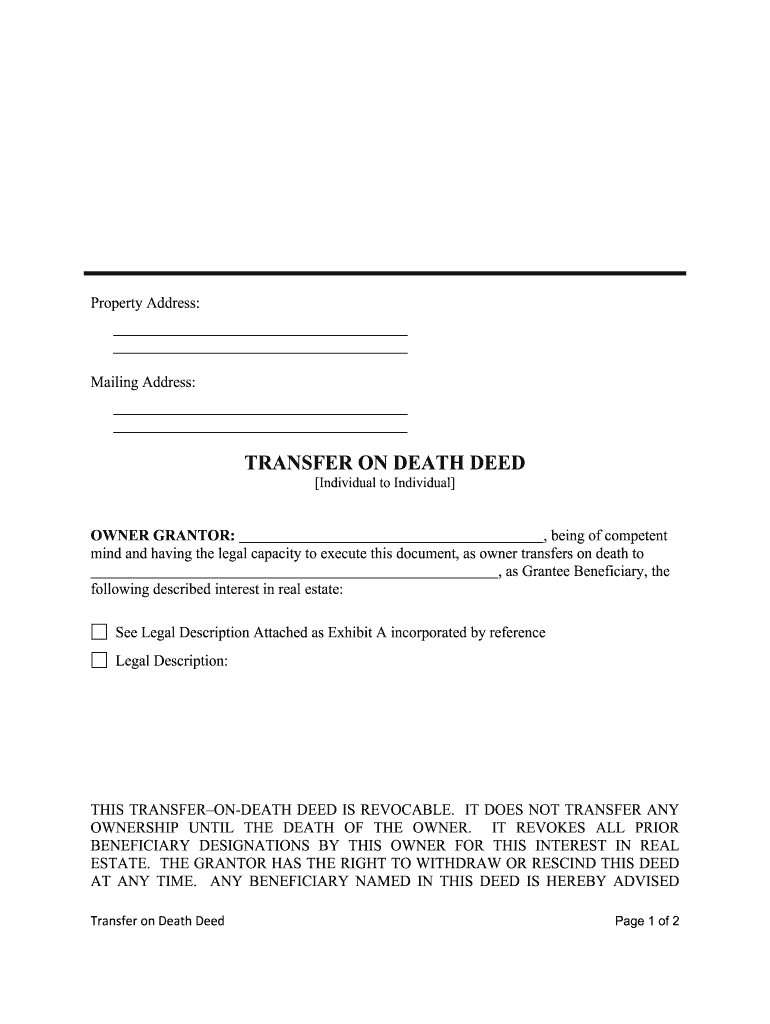
An Oklahoma Transfer on Death Deed is a state-level deed that lets a property owner name one or more beneficiaries to receive real property automatically at the owner’s death. The deed is executed by the owner during life, notarized, and recorded with the county clerk; when validly created and recorded under Oklahoma law it can transfer title outside of probate. It does not change ownership while the grantor lives, is typically revocable by the grantor, and interacts with existing mortgages and liens in specific ways that may require additional steps.

Why property owners choose an Oklahoma Transfer on Death Deed

A Transfer on Death Deed can simplify post‑death title transfer, avoid probate for the covered parcel, and preserve privacy by keeping transfers out of court records. It preserves the owner’s control during life, is generally revocable, and can reduce time and expense for heirs when used alongside comprehensive estate planning.

Why property owners choose an Oklahoma Transfer on Death Deed

Who typically uses an Oklahoma Transfer on Death Deed

Typical users are property owners seeking a simple, revocable way to pass real estate outside probate without altering lifetime ownership.

  • Older homeowners with a single family home who want to avoid probate and simplify transfer for heirs.
  • Owners of vacant lots or residential rental parcels looking to name a successor owner without forming a trust.
  • Individuals with limited assets for probate who prefer a narrow, deed‑based solution rather than broader estate instruments.

Primary roles in completing and executing the deed

Grantor — Property Owner

The grantor is the record owner who signs and executes the Transfer on Death Deed. The grantor must be competent, sign before a notary, and may revoke or amend the deed during life; accurate legal name and title chain are essential for effectiveness.

Beneficiary — Designated Recipient

A beneficiary has no present ownership interest while the grantor lives but acquires title upon the grantor’s death if the deed was validly executed and recorded. Beneficiaries should be identified with full legal names and contact information to prevent confusion at recording.

Key confirmation and security items to verify

Notarization: Notary acknowledgement required
Recording: Record with county clerk
Legal Description: Full parcel legal description
Beneficiary ID: Full legal names required
Revocability: Grantor may revoke before death
Title Search: Confirm liens and mortgages

Top risks and consequences to watch for

Failed recording: Deed ineffective if not recorded
Mortgage conflict: Lender lien remains unpaid
Ambiguous beneficiary: Title disputes among heirs
Revocation errors: Improper revocation may fail
Tax consequences: Capital gains basis issues
Probate overlap: Other assets may still probate

Common preparation mistakes to avoid

  • Using an incomplete legal description that doesn’t match county records, which can lead to rejection at recording and leave the property subject to probate.
  • Failing to notarize properly or using an out‑of‑state notarial form; missing or incorrect notary elements can invalidate the deed.
  • Neglecting to record the deed before the owner’s death or to check vested interest rules; unrecorded deeds generally cannot transfer title at death.
  • Overlooking mortgage, tax, or Medicaid planning interactions; a TOD deed does not remove liens or necessarily protect eligibility for public benefits.

How to complete an Oklahoma Transfer on Death Deed — step by step

Follow these four practical steps to create, execute, and record a Transfer on Death Deed for property located in Oklahoma.

  • 01
    Prepare: Obtain full legal description and beneficiary details.
  • 02
    Execute: Sign in presence of a notary with any required witnesses.
  • 03
    Record: File the deed with the county clerk where the property sits.
  • 04
    Post‑death: Beneficiary submits death certificate and recorded deed to update title.

Typical process for e‑signing and recording a TOD deed

Digital workflows can be used for preparation and signature collection where permitted; notarization and recording steps remain essential.

  • Draft document: Create deed using county‑compatible form and legal description.
  • Place signature fields: Add grantor and notary fields for execution.
  • Authenticate signer: Use identity checks, in‑person notarization or RON where allowed.
  • Record with county: Submit original notarized document per county clerk rules.

Key milestones from creation through title transfer

A clear sequence of actions reduces risk: prepare, execute, record, and update title post‑death.

01

Prepare Deed

Assemble legal description, beneficiary names, and title information.

02

Execute & Notarize

Sign before a notary (and witnesses if required) to complete the acknowledgment.

03

Record Document

File with the county clerk where the property is located to perfect the transfer.

04

Post‑Death Title Update

Beneficiary submits death certificate and recorded deed to update ownership records.

Recording and title update steps after the grantor’s death

After death, beneficiaries and title agents follow a short sequence to establish and record the post‑death title change.

  • Obtain death certificate: Secure certified copy from vital records office.
  • Present recorded TOD deed: Provide county clerk’s recorded copy to title company or recorder.
  • Title company review: Clear outstanding liens or notify beneficiaries of encumbrances.
  • Issue new deed: Record deed or affidavit transferring title to beneficiary.

How a Transfer on Death Deed compares with a Last Will

Compare core attributes so you can choose the tool that matches your goals: avoid probate, revokeability, and recording requirements differ materially.

Criteria TOD Deed Last Will
Probate Avoidance
Revocable During Life
Effective on Death
Recording Required

eSignature vendor pricing and feature snapshot for TOD deed workflows

Compare basic pricing and feature availability that matter when collecting signatures, notarization, and bulk documents for property transfers.

signNow DocuSign Adobe Sign PandaDoc HelloSign
Starting Price $8/user/mo $15/user/mo $14/user/mo $19/user/mo $15/user/mo
Free Trial 7‑day free trial Varies by plan Varies by plan Yes, limited Yes, limited
Bulk Send Yes Yes Yes Yes No
Audit Trail Yes Yes Yes Yes Yes
HIPAA Compliant Yes Yes Yes No No

Practical tips for accurate and efficient completion

Use these habits to minimize recording delays and disputes when preparing a Transfer on Death Deed.

Verify legal description against county records
Compare the parcel description line‑by‑line with the current recorded deed; even small discrepancies can cause rejection at the recorder’s office and delay final transfer.
Use full legal names for all parties
Enter names exactly as they appear on government IDs and title to avoid later challenges; include middle names or suffixes (Jr., Sr., III) consistently.
Record promptly after execution
Record the notarized deed immediately to ensure it is effective at death and to provide notice to third parties, including potential creditors and subsequent purchasers.
Coordinate with lenders and advisors
Confirm whether any mortgage or lien terms require lender notice or payoff; consult an attorney when encumbrances could prevent clear beneficiary title.

Timing considerations and critical deadlines

Understand the timing that makes a Transfer on Death Deed effective and the administrative steps beneficiaries must meet after death.

Recording before death:

Record the deed while the grantor is alive to ensure transfer effectiveness.

No probate delay for recorded deeds:

Recorded TOD deeds commonly avoid probate for the covered parcel.

Post‑death steps:

Beneficiary typically presents death certificate and recorded deed to update title.

Tax reporting windows:

Retain records for IRS timelines; consult tax counsel for basis and reporting.

Revocation timing:

Any revocation must be recorded before death to be effective.

Frequently asked questions about the Oklahoma Transfer on Death Deed

Answers to common questions about validity, recording, revocation, and how TOD deeds interact with mortgages and estate plans.


Need help? Contact support

be ready to get more
Join over 28 million airSlate SignNow users