Establishing secure connection…Loading editor…Preparing document…

Iowa Power of Attorney

This template is fully customizable. Edit the text, fill out the fields, and send it for signature. Give it a try!
Iowa Power of Attorney

What an Iowa Power of Attorney Is

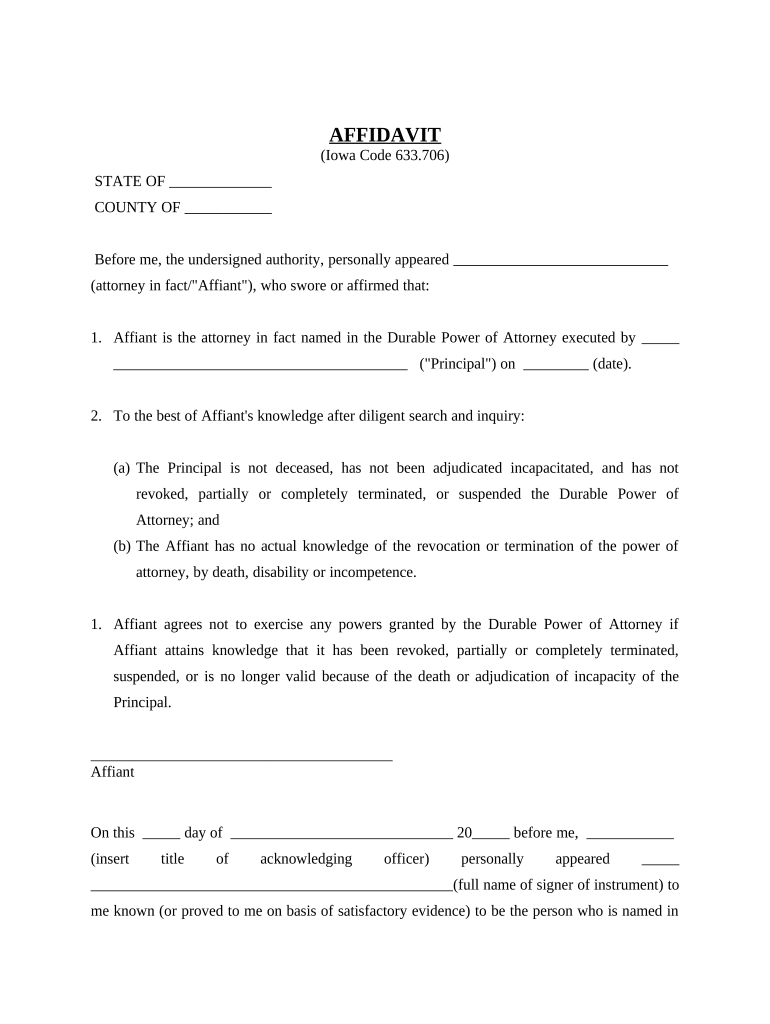
An Iowa Power of Attorney is a legal document that authorizes another person to act on your behalf in personal, financial, or healthcare matters under Iowa law. It can be durable to remain effective after incapacity, limited to specific transactions, or springing based on a triggering event. The principal selects one or more agents, specifies powers granted, and sets effective and termination dates. Proper execution may require signatures, witnesses, and notarization to satisfy state formalities. Use this form to name agents, clarify duties, and reduce later disputes about decision-making authority.

Why a Clear POA Matters

A properly executed Iowa Power of Attorney ensures decision continuity by designating trusted agents, reduces court-appointed guardianship risk, and clarifies authorities for banking, property, and health decisions. It creates a legal record of consent and instructions that courts and institutions recognize under state law.

Why a Clear POA Matters

Who Typically Uses an Iowa Power of Attorney

Individuals and organizations who appoint agents under Iowa Power of Attorney include elderly principals, business owners, caregivers, and corporate signatories.

  • Elderly or disabled people naming an agent for finances and health decisions.
  • Business owners authorizing agents to manage accounts, contracts, and property transactions.
  • Caregivers or family members granted authority for medical or long-term care choices.

Step-by-step: Completing the Iowa Power of Attorney

Follow these steps to complete and validate an Iowa Power of Attorney form accurately for legal and institutional acceptance.

  • 01
    Choose Type: Select durable, limited, or springing based on desired scope.
  • 02
    Name Agent: Enter full legal name and contact details of the agent.
  • 03
    Define Powers: Specify authorities such as banking, real estate, or healthcare decisions.
  • 04
    Execute Document: Sign, date, and notarize or obtain witnesses as Iowa law requires.

Core sections to include in a professional POA

Essential sections of an Iowa Power of Attorney document clarify agent powers, effective period, limitations, successor agents, signature blocks, and notarization details.

Agent Powers

Specify each power granted with concrete examples, such as signing checks, managing investments, buying or selling property, and handling tax matters. Clear listing reduces disputes and institutional resistance.
Effective Date

State whether the authority starts immediately, on a future date, or upon incapacity. For springing POAs, define the medical or legal criteria that trigger effectiveness.

Duration

Indicate if the POA is durable (survives incapacity), limited in time, or revocable. Include explicit termination conditions, such as death, revocation, or a set end date.

Successor Agents

Name alternate agents and the order they act if the primary agent is unable or unwilling. Clarify whether powers transfer automatically or require acceptance.

Recordkeeping

Require agents to keep detailed records and provide accounting on request. Specify whether agents are reimbursed for expenses and whether bonding is required.

Signatures

Include signature and date lines for principal and agent, plus spaces for witness and notary acknowledgments per Iowa formality expectations to improve acceptance by third parties.

Security and compliance at a glance

Encryption: TLS 1.2/1.3 in transit
Data at rest: AES-256 encryption at rest
Certifications: SOC 2 Type II; ISO 27001
HIPAA: BAA available for covered entities
ESIGN/UETA: Compliant with federal and state law
Audit Trail: Comprehensive timestamps and history

Key penalties and legal risks

Institutional Rejection: Banks may refuse transactions
Civil Liability: Agent breach can cause lawsuits
Tax Consequences: Incorrect authority affects filings
Criminal Risk: Fraudulent acts carry criminal charges
Delay in Care: Healthcare actions postponed
Costly Corrections: Attorney fees and re-executions

Common preparation mistakes to avoid

  • Using nicknames or initials that don't match government ID can cause third-party rejection and delays in critical transactions.
  • Failing to specify powers (e.g., tax filings or real estate) leaves ambiguity and can expose agents to dispute or limits on authority.
  • Not including successor agents creates gaps if the primary agent is unavailable, which may necessitate court intervention.
  • Skipping notarization or using incomplete witness acknowledgments increases the chance banks or medical providers will refuse to accept the document.

How electronic execution typically works

Typical workflow for executing an Iowa Power of Attorney electronically, including preparation, signer authentication, notarization, and delivery to institutions.

  • Prepare Document: Complete fields and attach exhibits.
  • Add Signers: Assign agent email and signing order.
  • Authenticate Signer: Use email link, SMS code, or RON KBA.
  • Deliver Copies: Send signed PDF and certificate to institutions.

Recommended digital workflow settings

Configure a digital workflow that enforces fields, authentication, and routing for Iowa POA execution and storage.

Field Configuration
Signature Field Required; signer must check intent
Date Field Enter MM/DD/YYYY; auto-populates on signature
Authentication Email link or SMS OTP; RON optional
Notary Session Remote or in-person per Iowa rules

Platform and integration considerations

Platform and integration considerations for preparing, signing, notarizing, and sharing Iowa Power of Attorney documents electronically.

  • File Formats: PDF, Word DOCX accepted
  • Integrations: Salesforce, NetSuite, Google Workspace
  • Authentication: SMS, email, KBA, SSO support

Timing and processing expectations

Key timing and processing expectations when preparing and submitting an Iowa Power of Attorney to institutions.

Execution Date:

Set effective date and record signing date as MM/DD/YYYY.

Notarization:

Schedule notary or RON before distribution to banks.

Provide Originals:

Deliver original or certified copies to institutions upon request.

Record Filing:

Record with county only if state or institution requires.

Revocation Notice:

Notify agents and institutions immediately upon revocation or change.

Comparing tools: POA, guardianship, and healthcare directives

Quick comparison between Iowa Power of Attorney, court guardianship, and advance healthcare directives to help choose the right tool.

Criteria Iowa POA Guardianship Healthcare Directive
Created by principal court principal
Activation immediate/springing court order upon incapacity
Scope broad financial/health court-limited healthcare only
Revocation by principal court process by principal

Practical tips to improve acceptance and clarity

Practical tips to make an Iowa Power of Attorney clear, accepted, and durable across institutions and situations.

Use clear, specific language
Draft powers with precise actions (for example, 'sell residential property at or above $X' or 'access retirement accounts') to prevent third-party refusal. Avoid ambiguous phrases unless legally intended and explained.
Include successor agents and contingencies
Identify alternate agents with succession order and conditions. Specify whether alternates step in automatically or require acceptance. This prevents gaps in authority and reduces the likelihood of guardianship proceedings.
Keep originals and provide certified copies
Store an original signed and notarized POA securely and distribute certified copies to banks, medical providers, and attorneys. Retain proof of delivery and track where originals are held to avoid disputes.
Verify acceptance before relying on POA
Contact banks, insurers, and healthcare facilities in advance to confirm they accept the POA format and whether they require additional institutional forms, notarization, or witness counts to process agent actions without delay.

Download, export, and supporting documents

Options to download and store the executed Iowa Power of Attorney in multiple formats for sharing with institutions and legal counsel.

Save as PDF

Export a finalized, signed PDF/A copy to preserve layout; include the platform audit trail and signature certificate to support acceptance by banks and courts when requested.

Export DOCX

Keep an editable DOCX master for revisions and create a locked PDF for the executed version to prevent unauthorized changes and to present originals to institutions.

Download Certificate

Save the signature certificate and audit report that show timestamps, signer identity, authentication method, and IP addresses; these documents support legal admissibility and audits.

Cloud Storage

Store encrypted copies in secure cloud or document management systems with role-based access, versioning, and retention policies to satisfy institutional and regulatory requirements.

Who signs and who acts under the POA

Principal — Grantor

The principal is the person who creates and signs the power of attorney. They must have legal capacity at signing and may set the scope and limits of the agent's authority. The principal's signature creates the agent's legal powers under the document.

Agent — Attorney-in-Fact

The agent, also called the attorney-in-fact, acts under powers the principal grants. The agent must act in the principal's best interests, keep records, avoid conflicts, and follow any limitations in the POA; fiduciary obligations may trigger legal liability for misconduct.

Notarization and witness steps for authentication

Typical notarization and witness steps to authenticate an Iowa Power of Attorney for acceptance by banks and courts.

01

Prepare Originals

Ensure completed fields and signatures ready.

02

Arrange Notary

Schedule in-person or RON notary as allowed.

03

Bring ID

Principal brings government-issued photo ID.

04

Witness Signing

Provide witnesses if state requires them.

05

Notary Acknowledgment

Notary signs and stamps document.

06

Record Notary

Notary completes journal or audio record for RON.

07

Return Originals

Deliver original to institutions or retain secure copy.

08

Confirm Acceptance

Verify banks and providers accept the executed document.

How to revoke an Iowa Power of Attorney

Steps to revoke an Iowa Power of Attorney and notify affected parties to terminate an agent's authority effectively.

01

Draft Revocation:

Draft a signed written revocation stating cancellation of prior POA.
02

Sign Revocation:

Principal signs and dates the revocation.
03

Notarize if necessary:

Notarize to match original execution.
04

Notify Agent:

Send notice directly to the agent with proof.
05

Inform Institutions:

Provide revocation copies to banks and providers.
06

Record if applicable:

Record revocation if original was recorded.

Comparing eSignature vendor pricing and capabilities

Cost and feature comparison of eSignature vendors commonly used to execute and manage Iowa Power of Attorney documents.

signNow DocuSign Adobe Sign PandaDoc HelloSign
Starting Price $8/user/mo $15/user/mo $14/user/mo $19/user/mo $15/user/mo
Free Trial 7-day free trial Varies by vendor Varies by vendor Varies by vendor Varies by vendor
Bulk Send Yes (Business Premium) Varies by plan Varies by plan Varies by plan Varies by plan
Audit Trail Yes Yes Yes Yes Yes
HIPAA Compliant Yes Yes Yes No No

Frequently asked questions about the Iowa Power of Attorney

Answers to common questions on validity, notarization, revocation, agent duties, and electronic signing for Iowa Power of Attorney forms.


Need help? Contact support

be ready to get more
Join over 28 million airSlate SignNow users