Caption and Docket
A clear caption with full party names and the original docket number allows clerks to locate the lower-court record and correctly assign the appeal.
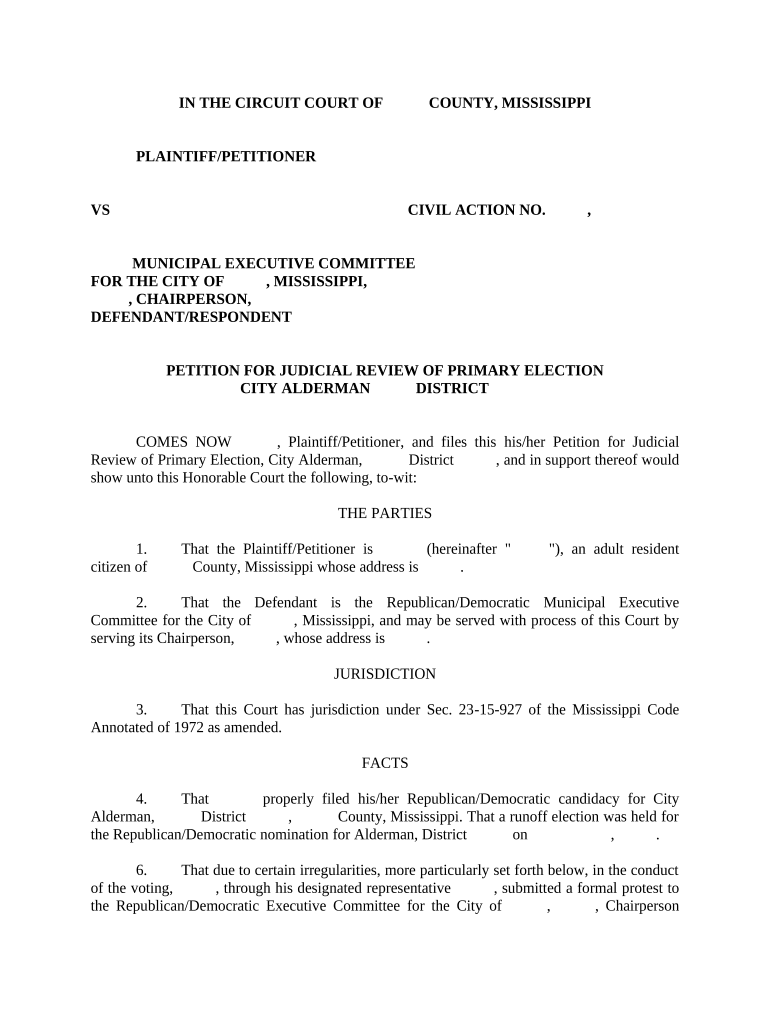
A properly prepared Judicial Review Form preserves appeal rights, clarifies issues for the reviewing body, and reduces administrative rejections that can cause case dismissal or prejudice the filer’s position.

Courts, litigants, attorneys, and agency staff prepare Judicial Review Forms to initiate appellate or administrative review and to ensure proper record routing.
Roles and responsibilities vary by jurisdiction and agency; always confirm who has filing and signature authority under local rules.
A licensed attorney who prepares the form, certifies service, and files within statutory deadlines. The attorney typically includes citations to the record, legal argument summaries, and a certificate of compliance with local filing rules to avoid procedural dismissal.
An individual representing themselves who must follow the same formatting, signature, and service rules as represented parties. Courts may provide limited-form guidance but offer no waiver of procedural requirements for pro se filers.
| Field | Configuration |
|---|---|
| Authentication | Email link, SMS code, or stronger ID check |
| Conditional fields | Show fields only when relevant to streamline completion |
| Templates | Save form as a reusable template for repeat filings |
| Notifications | Automate clerk notices and service confirmations |
Ensure any platform you use supports required file formats, signer authentication, and an audit trail acceptable to the filing authority.
Verify jurisdictional e-filing rules and technical requirements before submitting; preserve the audit trail and a stamped filed copy for the record.
Often 30 days from entry of judgment; check local rule
Commonly 30–60 days from final agency notice
Some jurisdictions permit limited extensions for good cause
Proof of service commonly required at filing
Clerks may take days to weeks to docket and assign
A clear caption with full party names and the original docket number allows clerks to locate the lower-court record and correctly assign the appeal.
Explain the legal basis for review, including statutory citations or rule references demonstrating the reviewing body’s authority to consider the petition.
List the discrete legal or factual issues presented for review in numbered form to guide the court’s or agency’s consideration.
Provide a short summary of why the lower decision was erroneous with record citations to support the assertions and permit efficient review.
Specify the precise remedy sought—reversal, remand, stay, or other relief—so the reviewing body can consider appropriate orders.
Include a certification of service, signatures, and dates. If electronically signed, ensure the audit trail meets ESIGN/UETA requirements for attribution and retention.
Attach the judgment, order being appealed, and relevant written rulings to identify the decision under review and the operative dates.
Provide pinpoint citations or a condensed appendix with the record pages needed to evaluate the stated issues, following local appendix rules.
Include sworn statements when factual disputes affect timeliness or jurisdiction; ensure compliance with notarization or declaration statutes.
Attach evidence that opposing parties and the clerk were served according to the applicable rules and timeframes.
| signNow | DocuSign | Adobe Sign | PandaDoc | HelloSign | |
|---|---|---|---|---|---|
| Starting Price | $8/user/mo | $15/user/mo | $14/user/mo | $19/user/mo | $15/user/mo |
| Free Trial | 7-day free trial | Varies by plan | Varies by plan | Varies by plan | Varies by plan |
| Bulk Send | Yes | Yes | Yes | Yes | No |
| Audit Trail | Yes | Yes | Yes | Yes | Yes |
| HIPAA Compliant | Yes | Yes | Yes | No | No |