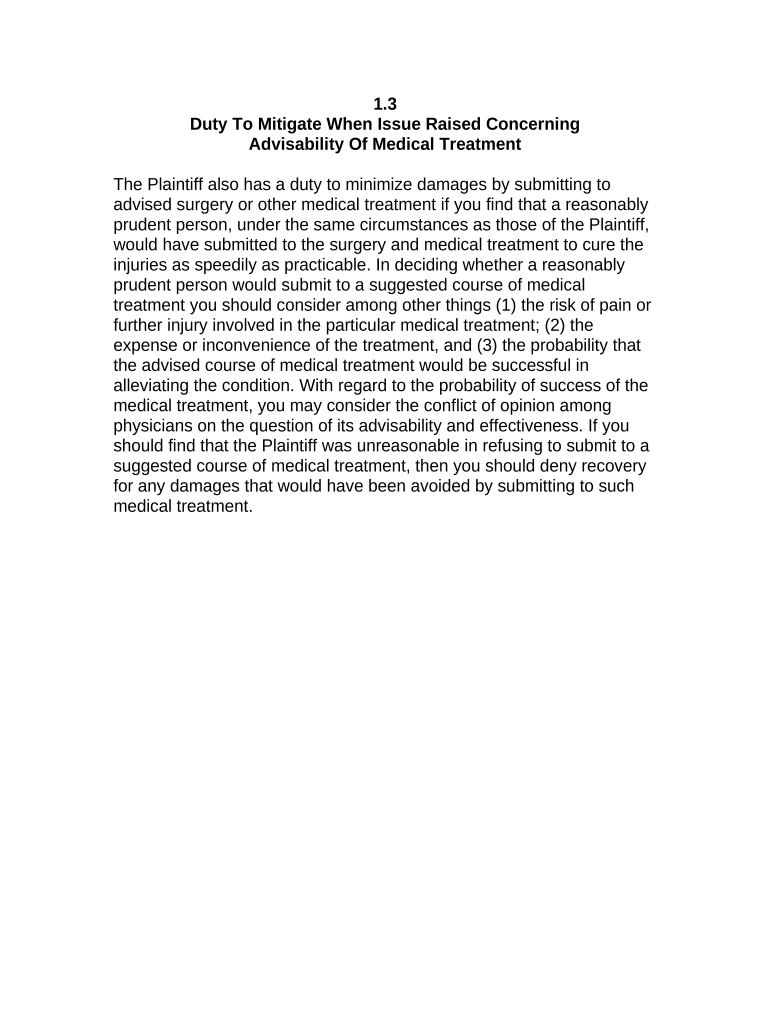
Jury Instruction Duty
What the Jury Instruction Duty Is and When It Applies
Why a Well‑Prepared Jury Instruction Duty Matters
Clear, timely jury instructions reduce the risk of reversible error and help preserve appellate arguments under procedural rules and case law. Drafting precise instructions aligned to substantive law protects parties’ trial and post‑trial rights.
Who Typically Prepares and Uses a Jury Instruction Duty
Accurate preparation and timely service of the Jury Instruction Duty help avoid sanctions, preserve issues, and support efficient court consideration.
- Trial attorneys: Draft instructions tailored to facts and legal claims to guide jury deliberations and protect appellate records.
- Court clerks and judges: Review formatting, docket entries, and whether submissions comply with local rule requirements.
- Pro se litigants: May prepare and submit instructions; courts often apply local-format and service requirements strictly.
Representative Signatories and Preparers
Trial Attorney
A licensed attorney representing a party prepares the instruction text, attaches supporting authorities, and signs the certificate of service; they ensure adherence to local court formatting and serve opposing counsel per rule.
Court Clerk
The clerk accepts filings, applies docketing procedures, and enforces local filing requirements; clerks may reject nonconforming submissions and advise parties on e‑filing or physical submission protocols.
Step-by-Step: Drafting and Submitting a Jury Instruction Duty
-
01Gather Case Data: Collect caption, docket number, party names, and trial date.
-
02Draft Instruction: Write plain, legally accurate instruction text with elements.
-
03Cite Authority: Attach statutory or case law citations supporting the instruction.
-
04Serve and File: Serve opposing counsel and file per local court rules.
Typical Digital Workflow Settings for Online Completion
| Field | Configuration |
|---|---|
| Court Caption Field | Required text field, single line |
| Docket Number Field | Required, validation pattern allowed |
| Instruction Text Field | Multi-line, preserves formatting |
| Signature Block | Signer role required, date auto-fill |
Digital Filing and Format Considerations
Confirm the court clerk’s e‑filing specifications before submission and preserve an unalterable copy for the record.
- File Formats: PDF/A or DOCX preferred
- Integrations: Works with NetSuite, Google Workspace
- Authentication: Email or SMS signer verification
Where to File and How the Filing Process Works
-
Prepare Submission: Finalize instruction text and supporting citations.
-
E‑File or Hand File: Submit via court e‑filing portal or clerk’s office.
-
Serve Opposing Counsel: Serve per local rule: e‑service or hand delivery.
-
File Certificate: File certificate of service with the court docket.
Common Timing Rules and When to Submit Proposed Instructions
Charge Conference Deadline:
Often due before or at jury charge conference.
Advance Service:
Many courts require service several days before trial begins.
Objection Window:
Opposing counsel must lodge objections within judge’s established timeframe.
Last‑Minute Submission:
Late proposals may be accepted only with leave of court.
Local Rule Variation:
Some courts require specific numbering and single‑spaced format.
Notarization and Witness Steps (When Required)
Signature Authentication
Signer prints name and signs; date included.
Notarization (If Needed)
Obtain notary only for sworn affidavits or exhibits.
Witness Signatures
If an exhibit requires witnesses, follow state witness rules.
Remote Notarization
Use RON where state law permits and court accepts.
Retention of Records
Keep audio/video RON record per state rules.
Clerk Acceptance
Clerk may refuse nonconforming notarized exhibits.
Certificate of Service
Include method and recipients of service.
Chamber Copy
Deliver chamber copy if ordered by judge.
Penalties and Risks of an Incorrect or Untimely Submission
Common Mistakes to Avoid When Preparing a Jury Instruction Duty
- Failing to follow the court’s local formatting rules, including margins and numbering, which often results in rejection or requests for correction.
- Submitting instructions without precise legal citations or without distinguishing between burden of proof standards, reducing persuasive force before the judge.
- Omitting a clear certificate of service or using an incorrect service method, which may lead to procedural objections or waiver.
- Attempting last‑minute edits without court leave; rushed submissions can contain drafting errors and weaken appellate preservation.
How Courts and Counsel Use Electronic Workflows in Practice
Brian Fitzgibbons, COO — Optica Ventures LLC
Legal teams consolidated proposed instructions into a single digital package for review
- Streamlined exchange with opposing counsel before trial
- "The interface is simple and easy‑to‑use for our team; more importantly, it is just as easy for our customers."
Kodi‑Marie Evans, Director — Xerox
Integrations allowed auto‑population of case captions from ERP data
- Reduced manual entry and filing errors in high‑volume matters
- airSlate SignNow provided flexible signing and integration with case management systems.
eSignature Vendor Pricing and Capability Snapshot for Court Document Workflows
| signNow | DocuSign | Adobe Sign | PandaDoc | HelloSign | |
|---|---|---|---|---|---|
| Starting Price | $8/user/mo | $15/user/mo | $14/user/mo | $19/user/mo | $15/user/mo |
| Free Trial | 7-day free trial | No | No | No | No |
| Bulk Send | Yes (Business Premium) | Yes | Yes | Yes | No |
| Audit Trail | Yes | Yes | Yes | Yes | Yes |
| HIPAA Compliant | Yes | Yes | Yes | No | No |
| Envelope Cap | No cap | 100 env/yr | Varies by plan | Varies by plan | Varies by plan |
FAQs and Troubleshooting for Jury Instruction Duty Preparation
-
Can I use an electronic signature?
Yes. Electronic signatures are legally valid in interstate commerce under the ESIGN Act (15 U.S.C. §7001) and in most states under UETA, provided the court accepts e‑filed submissions and the signature meets intent, consent, attribution, and retention requirements.
-
What if the court requires paper originals?
If the court requires original ink signatures or paper copies, follow the clerk’s instructions. Electronically signed drafts may still be used for review, but file paper originals when ordered to avoid rejection.
-
Do proposed instructions need case citations?
Yes. Provide supporting statutory and case citations for each legal proposition so the court can evaluate the instruction’s accuracy and preserve the issue for appeal.
-
How do I preserve objections for appeal?
Serve and file your proposed instructions and clearly state any objections on the record during the charge conference; timely objection preserves appellate review on instruction content.
-
Is remote notarization acceptable?
Remote Online Notarization (RON) is permitted in most states but varies; verify the state’s RON status and court acceptance before relying on a RON for sworn exhibits or affidavits.
-
What formats should I keep for the record?
Retain the filed PDF, signed copies, service evidence, and audit trail metadata. These records support authenticity and reproduction in appeals or posttrial motions.