Establishing secure connection…Loading editor…Preparing document…

Order of Protection New York

This template is fully customizable. Edit the text, fill out the fields, and send it for signature. Give it a try!
Order of Protection New York

What the Order of Protection New York is and when it applies

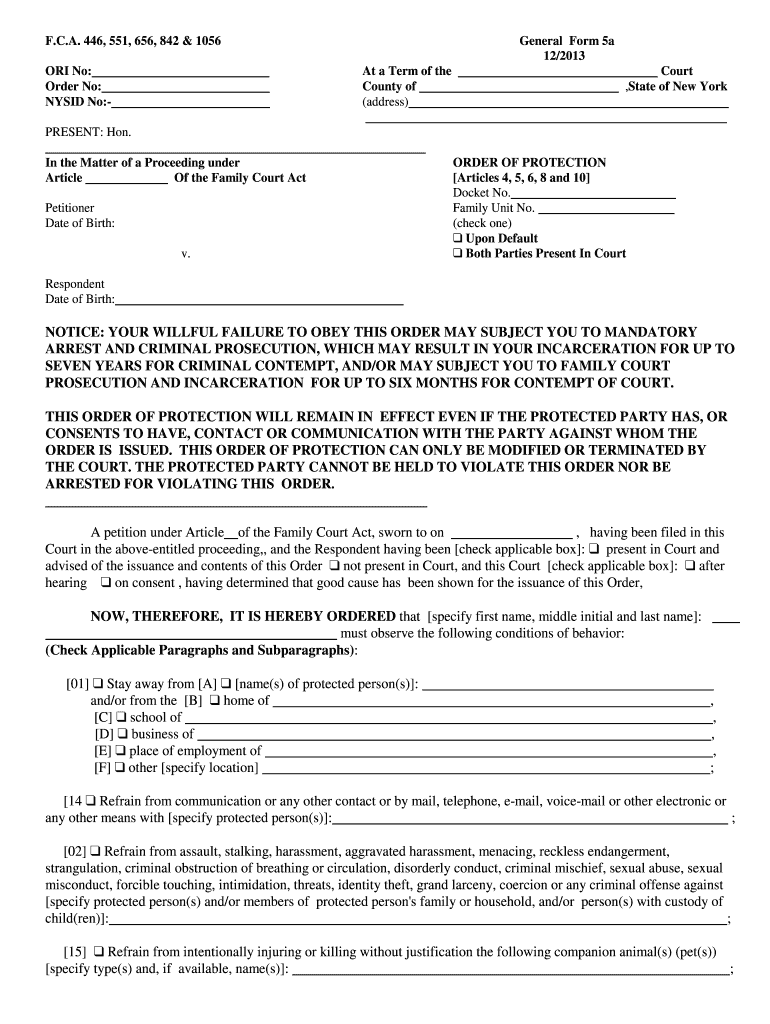
An Order of Protection in New York is a court-issued directive that restricts contact, communication, or proximity between a protected person and a respondent who poses a threat. It can require the respondent to stay away from the protected person, vacate a shared residence, surrender firearms, and follow other specific conditions the court imposes. Orders may be temporary (emergency/temporary orders entered ex parte) or permanent after a hearing. The process, remedies, and enforcement mechanisms are governed by New York statute and family or criminal court rules.

Why an Order of Protection matters

An Order of Protection provides immediate legal restrictions and civil remedies to reduce risk, document threats formally, and create enforceable boundaries enforced by law enforcement. It also creates a permanent court record that supports subsequent enforcement or related civil proceedings.

Why an Order of Protection matters

Who typically files or is named in an Order of Protection New York

People seeking legal protection range from domestic partners and family members to roommates and individuals threatened by a person they know; organizations (schools or employers) may assist victims in identifying options.

  • Domestic violence survivors seeking immediate separation and firearm surrender
  • Victims of stalking or harassment requesting no-contact directives
  • Parents or guardians protecting minors or dependents from a threatening respondent

Courts assess the relationship, immediacy of danger, and evidence presented; an attorney or victim services advocate can explain eligibility and next steps for filing in New York family or criminal court.

Primary components of an Order of Protection form in New York

A complete petition or application and the resulting order include standardized sections that capture parties, factual basis, requested relief, and enforcement instructions.

Parties

Full legal names and contact details for the protected person(s) and respondent; accurate identification supports service and enforcement.
Relationship

Describe the relationship (family, household, dating, other) because relief and filing venue can depend on the nature of the relationship.

Allegations

Clear, chronological factual statements about incidents, dates, locations, injuries, threats, and witnesses to establish the need for protection.

Requested Relief

Specify the relief sought: stay-away distance, custody provisions, no-contact orders, firearm surrender, and temporary possession of shared residence.

Service

Provide information about how the respondent can be located and served; accurate service data is required for the order to be enforceable.

Judicial Findings

Space for the judge’s factual findings, duration of the order, and explicit enforcement language used by law enforcement and other agencies.

Step-by-step: filing an Order of Protection in New York

Follow these practical steps to prepare and submit a petition or application to family or criminal court.

  • 01
    Prepare details: Collect dates, descriptions, photos, and police reports.
  • 02
    Complete petition: Fill all fields clearly and attach supporting documents.
  • 03
    Court filing: File at the appropriate county court or family court clerk’s office.
  • 04
    Hearing & service: Attend the hearing; ensure respondent is served with order copies.

How an Order of Protection moves through the New York court system

This flow outlines the most common pathway from emergency relief to a final court order.

  • Emergency relief: Temporary order may be issued ex parte when immediate danger exists.
  • Service: Respondent must be served with the temporary order before the full hearing.
  • Full hearing: Court holds a hearing where both parties can present evidence and witnesses.
  • Final order: Judge issues final protections, duration, and enforcement instructions.

Digital filing and electronic evidence in Orders of Protection

Courts increasingly accept electronic attachments (photos, messages) but requirements for e-filing and evidence vary by county and court.

  • File Formats: PDF and common image formats are typically accepted for attachments.
  • Authentication: Maintain metadata and chain-of-custody for digital photos and messages to preserve evidentiary weight.
  • E-filing systems: Some New York counties provide e-file portals with specific upload limits and instructions.

Verify county-specific e-filing requirements before submission; when in doubt, bring printed and digital copies to court intake to avoid delays.

Configuring an electronic evidence package for court submission

Use a consistent workflow for assembling digital exhibits so the court and opposing party can review materials easily.

File Preferred format (PDF)
Naming convention YYYYMMDD_Type_Description
Order Chronological with cover index
Redaction Redact unrelated personal data
Backup Store original files in read-only archive

Consequences of incorrect or incomplete Orders of Protection

Dismissal Risk: Incomplete allegations may lead to denial of relief
Enforcement Failure: Poor service details can prevent respondent notification and enforcement
False Allegation Exposure: Knowing false statements may result in contempt or perjury charges
Delay: Missing evidence or clerical errors can extend case timelines
Privacy Breach: Improperly stored electronic evidence can violate privacy rules
Cost Increase: Attorney and re-filing fees increase when documents are rejected

Common preparation mistakes to avoid

  • Vague incident descriptions that lack dates, locations, or witnesses
  • Providing incomplete respondent information that hinders service
  • Failing to attach police reports, medical records, or photos when available
  • Submitting unsigned or improperly dated affidavits

Security and privacy considerations when handling Orders of Protection

Encryption: AES-256 at rest; TLS 1.2/1.3 in transit
Access Controls: Role-based access and SSO recommended
Audit Trail: Preserve timestamps, IP, and user actions for e-submissions
HIPAA: Apply HIPAA rules when records include protected health information
Retention: Apply legally required retention schedules and secure deletion
BAA: Use a Business Associate Agreement for HIPAA-covered workflows

How Orders of Protection are used in practice

Real scenarios show how petitioners, courts, and enforcement agencies interact across stages of protection and enforcement.

Case Study 1

A petitioner obtained an ex parte temporary order after an assault near her home

  • Court scheduled a full hearing within 10 days
  • At the hearing, corroborating police reports and medical records led the judge to issue a one-year order with firearm surrender and stay-away conditions.

Case Study 2

A stalking victim documented repeated unwanted messages with timestamps and screenshots

  • The victim filed a petition attaching the digital exhibits
  • The court admitted the exhibits after authentication and issued a multi-year order including no-contact provisions.

eSignature vendor comparison for preparing and signing an Order of Protection New York

Common vendor features that affect legal workflows for Orders of Protection include starting price, trial availability, bulk send, audit trails, HIPAA support, and envelope or transaction caps.

signNow DocuSign Adobe Sign PandaDoc HelloSign
Starting Price $8/user/mo $15/user/mo $14/user/mo $19/user/mo $15/user/mo
Free Trial 7-day free trial Free trial available Free trial available Free plan available Free plan available
Bulk Send Yes (available) Yes Yes Yes No
Audit Trail Yes Yes Yes Yes Yes
HIPAA Compliant Yes (BAA available) Yes Yes No No

Practical tips for accurate and efficient Orders of Protection in New York

Small preparation steps reduce delays and improve enforceability; use this checklist before filing.

Document chronology
Create a concise incident timeline with dates and locations to present clear facts at the hearing.
Certify attachments
Label and index each exhibit, include metadata where possible, and provide a plain-English exhibit list for the court.
Confirm service
Arrange reliable service and obtain proof of service; incomplete service can delay or void orders.
Preserve originals
Keep originals of medical records, photos, and messages and submit copies to the court as required.

Common questions about Orders of Protection New York

Answers to frequently asked procedural, evidentiary, and enforcement issues that petitioners and practitioners encounter.


Need help? Contact support

be ready to get more
Join over 28 million airSlate SignNow users