Establishing secure connection…Loading editor…Preparing document…

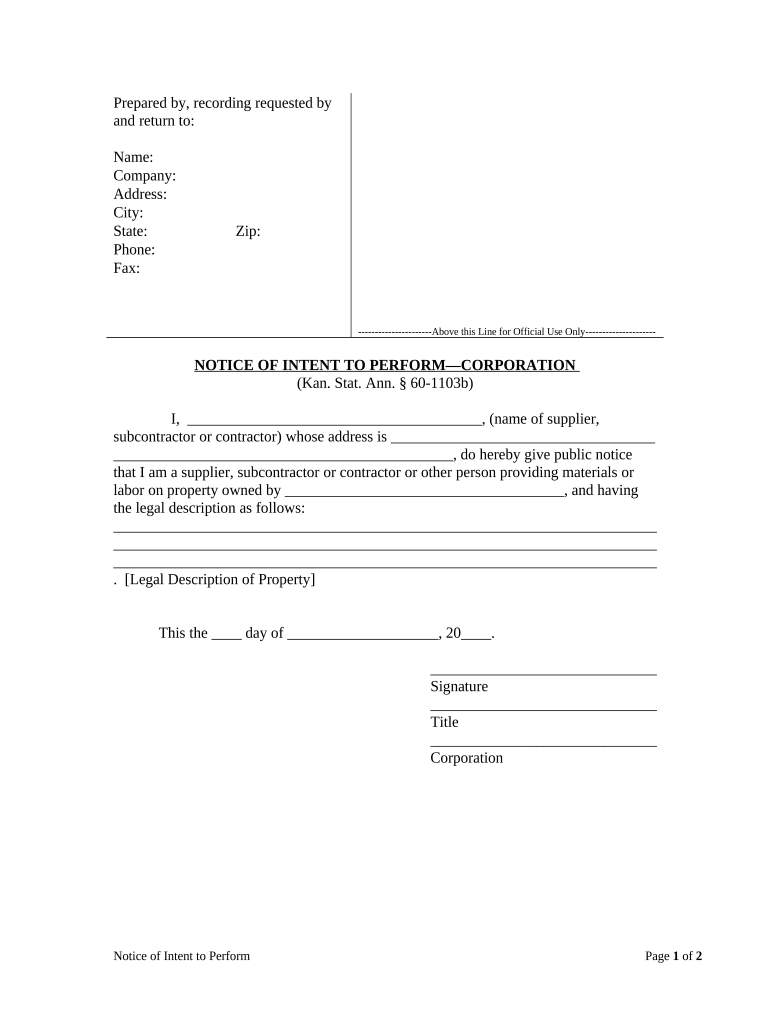
Kansas Notice of Intent to Perform

This template is fully customizable. Edit the text, fill out the fields, and send it for signature. Give it a try!
Kansas Notice of Intent to Perform

What the Kansas Notice of Intent to Perform Is and when it applies

The Kansas Notice of Intent to Perform is a formal written statement used in contracting and procurement contexts to confirm that a contractor, subcontractor, or vendor intends to fulfill specified contract obligations. It documents the party’s commitment to perform work, deliver goods, or meet service milestones and often accompanies bid awards, contract amendments, or requests for performance assurance. The notice helps create an administrative record for project managers, contracting officers, and owners and can trigger schedule updates, payment processing, or compliance checks under the contract terms.

Why issuing a clear Notice of Intent to Perform matters

A clear notice protects contracting parties by establishing intent, timing, and the scope of performance in writing. It reduces ambiguity, supports administrative decisions, and provides documentary evidence if disputes or schedule changes arise.

Why issuing a clear Notice of Intent to Perform matters

Who typically prepares and relies on this notice

Several roles interact with a Notice of Intent to Perform during procurement and project execution.

  • Contractors and subcontractors who confirm readiness to start work or accept contract terms.
  • Contracting officers, project managers, and owners who record commitments and update schedules.
  • Legal or compliance teams that use the document as part of the contract file and dispute records.

Step-by-step: completing your Notice of Intent to Perform

Follow these sequential steps to prepare, approve, and distribute the notice so it becomes part of the official contract record.

  • 01
    Prepare draft: Populate required fields and reference the contract sections.
  • 02
    Internal review: Have project manager and legal review for scope and authority.
  • 03
    Sign and date: Authorized signer signs; include printed name and title.
  • 04
    Distribute: Send to contracting officer and retain a dated copy in the contract file.

How the notice moves through contract administration

Typical routing ensures the notice is reviewed, accepted if appropriate, and archived for future reference.

  • Submission: Contractor submits notice to the contracting officer or project rep.
  • Acknowledgement: Recipient logs notice, confirms receipt, and notes any objections.
  • File update: Project schedule and payment records are updated if necessary.
  • Record retention: Signed notice is stored with contract documentation for retention.

Configuring a digital workflow for this notice

Set up an e‑document workflow to standardize routing, approvals, and retention for Notices of Intent to Perform.

Field Configuration
Signature Order Sequential: contractor -> project manager -> contracting officer
Authentication Email link or SMS code for signer verification
Retention Rule Store PDF + audit trail in contract folder for required period
Notifications Auto‑notify stakeholders on submission and completion

Digital delivery and platform capabilities to consider

Choose a platform that supports secure signing, audit trails, and archive exports for contract records.

  • File formats: PDF and DOCX support for upload and export
  • Audit trail: Detailed timestamps, IP addresses, and signer metadata
  • Integrations: Connectors for storage and ERP systems

Ensure the solution supports your authentication requirements and retention policies before digitizing notices.

Core elements every professional notice includes

A well-prepared notice is concise, references the contract, and provides the data necessary for contract administrators to act without follow-up.

Contract reference

Exact contract number and title to link the notice to the governing agreement and permit accurate file indexing.
Clear scope

Specific description of the work or services covered so the contracting officer can verify alignment with contract terms.

Dates and milestones

Planned start and completion dates, and any intermediate milestone dates that trigger payments or inspections.

Authorized signature

Name, title, and signature of the person with authority to bind the contractor under the contract.

Contact details

Phone and email for the project lead to allow prompt clarifications and avoid scheduling delays.

Attachments

Supporting documents like schedules, permits, or insurance certificates that substantiate readiness to perform.

Supporting documents you should include

Attach items that validate readiness to perform and reduce the need for follow-up requests from the contracting authority.

Project schedule

A dated timeline that aligns with contract milestones and shows critical path items relevant to performance.

Insurance certificates

Proof of coverage required by the contract, named additional insured where specified, and with effective dates.

Permits and licenses

Any municipal or state permits necessary to begin work, especially for regulated trades or public projects.

Subcontractor roster

List of key subcontractors and suppliers if their engagement affects schedule or compliance obligations.

Common mistakes to avoid when preparing the notice

  • Leaving out the contract number or using an outdated identifier causes processing delays and misfiling.
  • Providing vague scope descriptions that force contracting officers to request clarification or reject the notice.
  • Failing to include an authorized signer or contact details, which complicates acceptance and scheduling.
  • Omitting supporting documents like permits or insurance certificates that prove readiness to perform.

Consequences of incomplete or incorrect notices

Delayed payments: Missing or incorrect contract references can postpone invoicing and payment processing.
Rejected notice: Contracting officers may reject notices that lack authority or required attachments.
Contract disputes: Ambiguous scope or dates can lead to scheduling disputes and potential change order claims.
Compliance gaps: Omitting insurance, bonding, or permits can create regulatory noncompliance or site access denials.
Recordkeeping penalties: Failure to retain signed notices per policy risks audit findings or evidentiary loss.
Performance liability: Incorrect signer authority exposes the contractor to contract repudiation or liability challenges.

Typical timing and processing expectations

Establish internal deadlines for drafting, review, and distribution so the notice triggers the intended contractual effect without delay.

Drafting Deadline:

Complete internal draft at least 5 business days before planned start

Internal Review:

Allow 2–3 business days for project manager and legal review

Submission Window:

Submit to contracting officer per contract notice provisions

Acknowledgement:

Expect formal receipt or acknowledgment within 3–10 business days

Retention Action:

Archive signed notice immediately upon completion with audit trail

Key milestones from notice preparation to archive

Use a milestone sequence to coordinate preparation, approvals, and recordkeeping across teams.

01

Prepare Notice

Populate fields and gather supporting attachments for review.

02

Internal Approval

Project manager and legal confirm scope and signer authority.

03

Sign and Submit

Authorized signer executes and the notice is sent to the contracting officer.

04

Archive and Monitor

Store signed document with audit trail and monitor for related actions.

Illustrative eSignature vendor comparison for managing this notice

Compare common plan criteria for eSignature providers when selecting a platform to prepare, sign, and archive Notices of Intent to Perform.

signNow DocuSign Adobe Sign PandaDoc HelloSign
Starting Price $8/user/mo $15/user/mo $14/user/mo $19/user/mo $15/user/mo
Free Trial 7-day trial No No No No
Bulk Send Yes (Premium tier) Yes Yes Yes Yes
Audit Trail Yes Yes Yes Yes Yes
HIPAA Compliant Yes (BAA) Yes Yes No No

FAQs and troubleshooting for common completion issues

Answers to common questions about accuracy, signatures, authentication, and retention when using a Notice of Intent to Perform.


Need help? Contact support

be ready to get more
Join over 28 million airSlate SignNow users