Establishing secure connection…Loading editor…Preparing document…

Washington Offender Registration Statement

This template is fully customizable. Edit the text, fill out the fields, and send it for signature. Give it a try!
Washington Offender Registration Statement

Overview of the Washington Offender Registration Statement

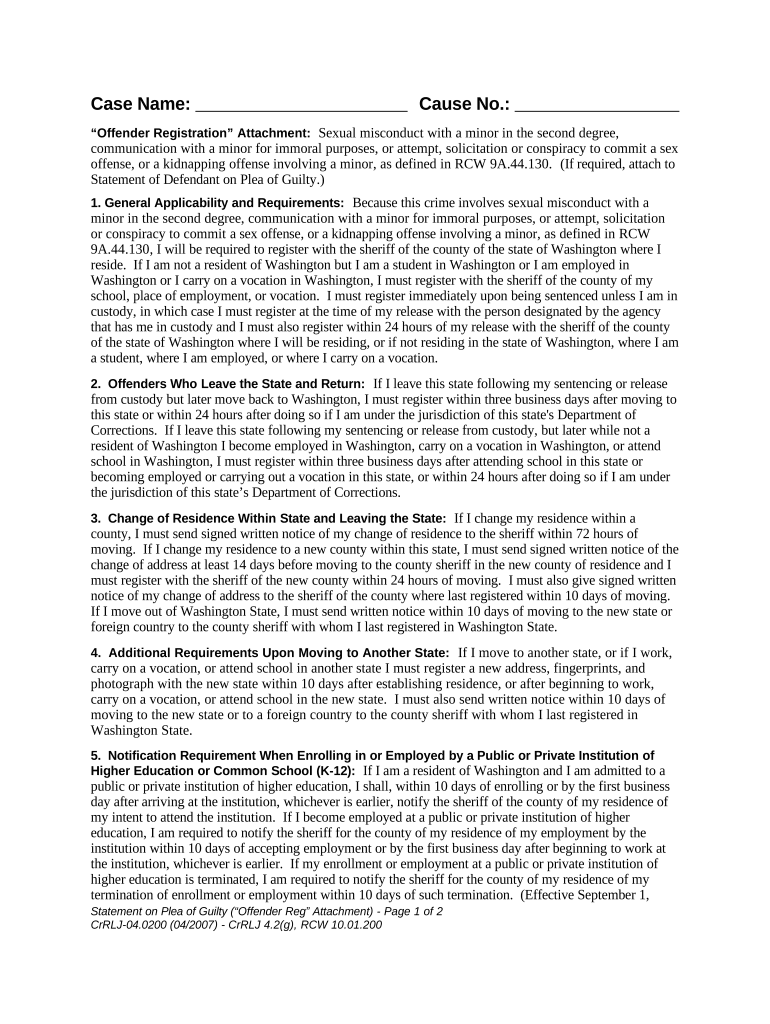
The Washington Offender Registration Statement is a law-enforcement filing used to record identifying and location information required of persons subject to state offender registration laws. It documents the registrant’s legal name, aliases, date of birth, physical description, residential and mailing addresses, and any required electronic identifiers. Agencies use the statement to verify compliance with Washington registration statutes, maintain public-safety records, and share information with authorized registries. The form is completed by the registrant or their legal representative and submitted to the designated state or local registration authority within specified deadlines.

Why accurate registration matters

Completing a Washington Offender Registration Statement documents legal compliance, supports public-safety reporting, and creates an auditable record. Electronic submission and signatures are generally valid under ESIGN (15 U.S.C. §7001) and UETA where state law permits, subject to statutory exceptions.

Why accurate registration matters

Who completes and relies on this statement

Registrants, local agencies, and supervising officers commonly interact with the registration statement.

  • Registered individuals required to report residence or status changes to state authorities.
  • Local law-enforcement agencies maintaining community notification and registry databases for compliance.
  • Probation/parole officers and court clerks verifying court-ordered registration compliance.

Primary signers and representatives

Registrant

The registrant is the primary signatory and must sign to attest to the accuracy of the information. If incapacitated, the registrant may authorize a legally recognized representative but should ensure the receiving agency accepts representative filings and retains the necessary proof of authority.

Authorized Rep

A legal guardian, attorney-in-fact, or court-appointed representative may sign when authorized by law or court order. Provide documentation evidencing authority (power of attorney or appointment) and include the representative’s contact information for agency verification.

Essential elements of a professional registration statement

A professional Washington Offender Registration Statement is complete, legible, verified, and includes supporting documentation to speed processing and avoid compliance issues.

Identifying Data

Full legal name, date of birth, sex, race, height, weight, hair and eye color, and unique identifiers. Provide consistent data to match law-enforcement and NCIC records and prevent processing delays.
Addresses

Current residential address plus any additional residences, seasonal or temporary locations, and mailing address. Include start and end dates and proof of residence such as a lease, utility bill, or affidavit.

Contact Info

Primary phone number, an email address if accepted by the agency, and emergency contact. Indicate whether the registrant uses location-based services or electronic monitoring devices and provide consent where required.

Criminal Details

Offense of conviction, conviction date, sentencing jurisdiction, and any parole or probation conditions relevant to registration duties. Attach court orders, judgments, or sentencing documents where applicable.

Electronic Identifiers

Provide required electronic identifiers such as email addresses, social media handles, IP addresses, or mandated GPS tracking details when applicable under state registration rules and agency policy.

Supporting Docs

Attach copies of government-issued ID, court judgments, proof of address, and any written court orders. Use clear, legible scans or certified copies to avoid rejections for poor image quality.

Step-by-step: completing and submitting the statement

Follow these sequential steps to complete and submit a Washington Offender Registration Statement correctly, online or in person.

  • 01
    Prepare Documents: Gather ID, court paperwork, and current address proof.
  • 02
    Complete Form: Enter required fields accurately; use MM/DD/YYYY dates.
  • 03
    Sign and Date: Sign in the authorization block and date the form.
  • 04
    Submit: File with the designated state or local registry by deadline.

Configuring an online filing workflow

Configure an online filing workflow to capture mandatory fields, attach documents, and require signer authentication before submission.

Field Configuration
Required Fields Make legal name, DOB, and address mandatory.
Document Attachments Require ID and court documents upload for verification.
Signer Authentication Use email plus SMS code or knowledge-based authentication.
Audit Trail Enable IP capture, timestamps, and version history.

Where and how to file the statement

Submission routes vary: in-person at local law enforcement, mail, or electronic upload to the state registry when available.

  • In Person: Deliver completed statement to sheriff or police records office.
  • Mail: Send certified mail to the designated registration address.
  • Online Portal: Upload via state registry system or authorized upload form.
  • Agency Intake: Probation or parole officer may file on registrant's behalf.

Technical requirements for eSubmission and integrations

Online submissions and e-signatures require compatible file formats (PDF, DOCX), secure transport, and integration with records systems used by agencies.

  • File Formats: PDF and DOCX preferred; images OK.
  • Integrations: Supports Salesforce, MS 365, NetSuite, Box.
  • Security: TLS in transit, AES-256 at rest.

Typical deadlines and processing expectations

Deadlines for initial registration and change-of-address reporting vary by statute and offense class; confirm with the Washington registration authority or local agency.

Initial Registration:

Typically due at conviction, sentencing, or release; timing varies.

Change of Address:

Report within the state-prescribed period; many states require prompt notice.

Temporary Moves:

Notify registry of temporary residence or travel when required.

Failure Response:

Noncompliance can prompt compliance checks and enforcement.

Agency Processing:

Processing times depend on workload; expect variable turnaround.

Penalties and risks from incorrect or late filings

Criminal Liability: Arrest, prosecution, and additional sentencing.
Civil Consequences: Probation revocation or extended supervision.
Collateral Impact: Employment, housing, and travel restrictions.
Data Errors: Incorrect entries can cause misidentification.
Delayed Filing: Late submission may trigger enforcement action.
Privacy Risks: Sensitive data exposure if not secured.

Common mistakes to avoid

  • Incomplete address details or use of P.O. boxes can lead to jurisdictional confusion and delayed verification by law enforcement agencies.
  • Using nicknames or partial legal names instead of the full legal name on file causes mismatches with criminal and DMV records.
  • Poor-quality scans or missing supporting documents result in rejected electronic submissions and require resubmission, extending processing time.
  • Failing to confirm agency acceptance of electronic signatures or RON before e-filing may invalidate an otherwise complete submission.

Required data elements at a glance

Legal Name: Registrant's full legal name.
Date of Birth: Enter date of birth in MM/DD/YYYY format.
Residential Address: Street, city, state, ZIP required.
Aliases: All prior names and nicknames.
Identifiers: State ID, FBI/NCIC or registry number.
Signature/Date: Signed and dated by registrant or representative.

Illustrative filing scenarios

Real-world scenarios show how registrants and agencies handle initial filings, address updates, and verification workflows across different circumstances.

Urban Registry

An urban sheriff's office implemented online intake, allowing registrants to upload documents and submit statements without an in-person visit.

  • Reduced backlog and cut processing steps.
  • The office established ID verification procedures, a standard checklist for supporting documents, and a local hotline to resolve mismatches quickly, which decreased return requests and improved registry accuracy over subsequent audits.

Rural Handling

A rural probation office relies on mailed statements and scheduled in-person appointments when online portals are unavailable or bandwidth is limited.

  • Coordinated postal timing and appointment windows.
  • Clerks accepted notarized documents and scanned copies, verified identities during scheduled visits, and maintained paper archives, ensuring compliance despite limited digital infrastructure and variable internet access.

Practical tips for accurate, efficient completion

Adopt consistent procedures to reduce errors, speed verification, and preserve an auditable trail for registration records.

Validate Identity
Confirm the registrant's identity against government-issued ID and cross-check with criminal history and DMV records. Use two forms of ID when possible and document the verification steps in the file to support future audits.
Standardize Documents
Use a checklist for required attachments, file clear scanned copies, and apply consistent naming conventions. Standardization reduces review time and prevents avoidable rejections for missing or unclear documentation.
Record Changes Promptly
Update addresses, travel plans, or electronic identifiers immediately upon change. Timely updates decrease enforcement risk and demonstrate compliance in audits or court reviews; log each change with date and supporting evidence.
Confirm Electronic Acceptance
Before e-filing, verify the receiving agency accepts electronic signatures and the chosen authentication method; obtain written confirmation when feasible to avoid disputes over signature validity.

Comparing baseline eSignature pricing and features

Common eSignature vendor features and starting prices for document workflows; signNow appears first for side-by-side comparison of core criteria.

signNow DocuSign Adobe Sign PandaDoc HelloSign
Starting Price $8/user/mo $15/user/mo $14/user/mo $19/user/mo $15/user/mo
Free Trial 7-day free trial Varies Varies Varies Varies
Bulk Send Yes Yes Yes Yes No
Audit Trail Yes Yes Yes Yes Yes
HIPAA Compliant Yes Yes Yes No No

Frequently asked questions about filing and signing

Answers to common questions about completing, signing, submitting, and correcting a Washington Offender Registration Statement.


Need help? Contact support

be ready to get more
Join over 28 million airSlate SignNow users