Establishing secure connection…Loading editor…Preparing document…

Landlord Tenant Notice

This template is fully customizable. Edit the text, fill out the fields, and send it for signature. Give it a try!
Landlord Tenant Notice

What a Landlord Tenant Notice Is and when it's used

Landlord Tenant Notice is a formal written communication used by landlords or tenants to notify the other party of a defined issue or action under a lease or rental agreement. Typical uses include notices to pay rent or quit, termination or nonrenewal notices, repair requests, breach notices, and entry notices. The document records the date, parties, property, description of the issue, and required remedy or timeframe. Properly completed notices support legal compliance, establish timelines for remedies, and may be necessary before filing for eviction or other remedies.

Why precise notices matter for rights and remedies

A clear Landlord Tenant Notice preserves legal rights, creates an objective record of notice and deadlines, and helps avoid disputes by specifying required actions and timeframes. Using a compliant notice is often a prerequisite to pursuing remedies such as eviction or damage claims.

Why precise notices matter for rights and remedies

Typical users and responsible parties

Common users include landlords, property managers, tenants, and housing attorneys who handle rental communications and disputes.

  • Independent landlords managing one or several single-family rental properties without on-site staff.
  • Property management firms issuing standardized notices to many tenants across portfolios.
  • Tenants asserting rights or responding to breach, repair, or termination communications.

Representative roles who prepare or sign notices

Landlord (Manager)

Responsible for delivering notices required under the lease or state law; must follow form, timing, and service rules. Accurate notices protect statutory rights, start cure periods, and are often required before filing for eviction or damages in court.

Tenant (Resident)

Receives or serves notices to assert rights or request repairs; should document delivery and keep copies. Timely responses can cure breaches or preserve defenses in litigation, and missteps may waive statutory protections or trigger penalties.

Essential data items to include on every notice

Date: Enter as MM/DD/YYYY; controls effective date.
Parties: Full legal names and contact info.
Property Address: Street, city, state, and ZIP required.
Lease Reference: Lease section and execution date.
Notice Type: Pay rent, cure breach, termination, entry.
Remedy/Deadline: Specific action with deadline in days.

Step-by-step: prepare, serve, and document a notice

Follow this step-by-step sequence to prepare, serve, and properly document a compliant Landlord Tenant Notice.

  • 01
    Identify Issue: Describe breach or reason in plain language.
  • 02
    Reference Lease: Cite lease section and dates.
  • 03
    Choose Service Method: Use the legally required delivery method.
  • 04
    Document Delivery: Keep proof: receipt, affidavit, or tracking.

Where to send the notice and how routing usually works

Typical routing steps for sending a Landlord Tenant Notice and recording proof of service electronically.

  • Send to Tenant: Deliver to tenant via required statutory method.
  • File with Court: If pursuing eviction, file notice with court as required.
  • Serve Agent: Send copies to authorized property manager or agent.
  • Retain Records: Store proof for statutory retention period.

Configuring an online workflow for notices

Configure an online workflow to populate, sign, and store Landlord Tenant Notices securely and with audit trails.

Field Configuration
Template Name Prebuilt standardized notice with editable fields.
Auto-fill Populate tenant, property, and lease data.
Signature Type Electronic signature or in-person signing.
Audit Trail Capture timestamp, IP, and signer email.
Retention Rule Automated retention per compliance policy

Delivery methods and technical proof for service

Deliver via methods that meet state service rules and preserve audit evidence for enforcement later.

  • Email Delivery: Acceptable if statute allows.
  • Certified Mail: Common requirement for rent/termination notices.
  • Personal Service: Court-preferred proof in many jurisdictions.

Common notice periods and critical deadlines

Common notice periods vary by notice type and state; missing deadlines can invalidate remedies in many jurisdictions.

Pay Rent or Quit:

Usually 3 to 14 days depending on state and lease provisions.

Cure Breach:

Commonly 7 to 30 days; varies widely by jurisdiction.

Termination Notice:

30 to 60 days for nonrenewal in many states.

Entry Notice:

Advance notice 24 to 48 hours typical for inspections and repairs.

Eviction Filing:

Must meet notice prerequisites before court filing; timelines vary.

Key milestones from notice drafting to enforcement

Key milestones from notice drafting through enforcement form a sequence; track each stage to maintain enforceability and evidence.

01

Draft Notice

Prepare accurate facts, dates, and cure language.

02

Serve Notice

Deliver by required method and record proof.

03

Wait Cure Period

Allow statutory deadline to run; document any tenant response.

04

File For Enforcement

If uncured, proceed to court with evidence.

Core components to include in a professional notice

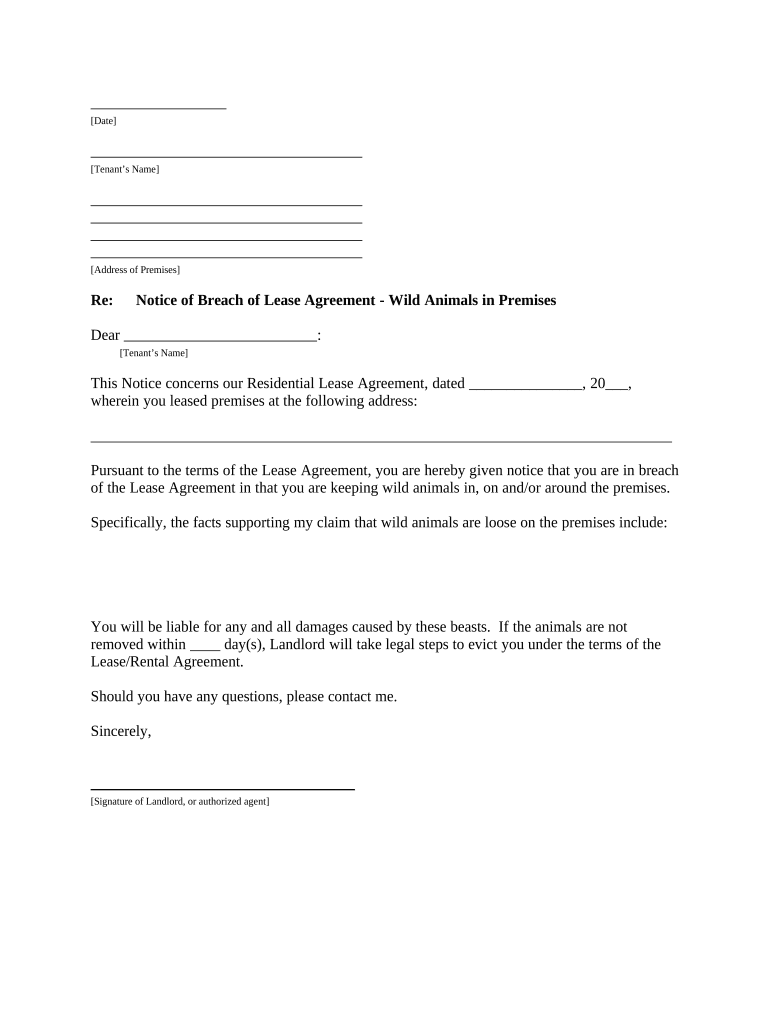
A professional Landlord Tenant Notice includes standardized header, parties, property details, factual description, legal basis, remedy requested, clear deadline, signature, and proof of service.

Header

State the document title, date of issue, and a brief reference to the lease and unit number so recipients immediately know the notice type and the affected premises.
Parties

Identify landlord, property manager, and tenant by full legal name and contact information, including mailing address and email, to avoid ambiguity and ensure correct service and recordkeeping for enforcement.

Property Details

Provide exact street address, unit number, and any identifying lease or account number; accurate property data prevents misdelivery and supports court filings if enforcement becomes necessary.

Statement of Facts

Present concise, dated facts describing the breach or issue (missed rent amounts, dates of noncompliance, repair history) with supporting documentation references attached or referenced.

Demand and Remedy

Specify the exact action required (pay overdue rent, cure violation, vacate) and the precise deadline measured in calendar days from the date of service, including any late fee calculations.

Proof of Service

Describe the chosen service method and attach proof (certified mail return, signed receipt, affidavit of personal service or electronic delivery record) to support legal compliance and evidentiary needs.

Real-world scenarios showing notice outcomes

Real-world examples show how notices are used across contexts to resolve issues, document compliance, and prepare for legal steps.

Single-Unit Landlord

A landlord sends a Pay Rent or Quit notice after two missed rent payments, documenting amounts owed and dates of nonpayment.

  • Tenant cures within five days and pays arrears.
  • Because the notice followed statutory language and delivery requirements, the landlord was able to avoid court by negotiation; if the tenant had failed to cure, the notice provided necessary proof to proceed with eviction filing.

Property Management Company

A management firm uses templated cure notices with automated population of tenant and lease data, then sends certified mail and retains tracking records.

  • Bulk sending and eSign quickens resolution at scale.
  • Automated workflows reduced manual errors and allowed the company to show consistent proof of service in hearings; having audit trails and delivery receipts simplified disputes and often led to faster tenant compliance or negotiated resolutions before court.

Practical best practices to reduce risk and delays

Best practices reduce disputes and ensure enforceability; follow statute-prescribed language, document service, and keep organized records.

Use exact statutory language required
Replicate the statutory notice wording when statute mandates specific language; court decisions frequently find notices invalid if required phrases or cure periods are altered or omitted.
Choose correct service method
Verify state law and lease terms for acceptable service; where required, use certified mail with return receipt, personal delivery with affidavit, or court-approved posting procedures to create admissible proof.
Document proof meticulously
Keep copies of sent notices, certified mail receipts, tracking records, signed acknowledgements, and affidavits of service; organize chronology and attachments to present a clear evidentiary trail in court.
Consult counsel when unsure
If a notice triggers statutory protections or complex remedies, seek legal advice to confirm timing, wording, and method of service to avoid procedural dismissal or waiver of rights.

Common preparation and delivery mistakes to avoid

  • Using a generic template without checking state-specific notice periods or required language risks invalid service and delays enforcement.
  • Failing to include an exact cure timeframe or clear remedy creates ambiguity and may allow tenant to contest the notice in court.
  • Delivering notice by improper service method—such as email when statute requires personal or certified mail—can nullify the notice.
  • Mismatched names, wrong property description, or missing execution date are frequent defects that lead to dismissal.

Consequences of incorrect or defective notices

Eviction Delay: Procedural defects can delay eviction.
Void Notice: Missing information may invalidate notice.
Financial Penalties: Late fees and back rent accrue.
Increased Costs: Court costs and attorney fees increase.
Tenant Defenses: Improper service strengthens tenant defenses.
Statutory Fines: State statutes impose fines in some cases.

Comparing eSignature vendors for notice workflows

Compare common pricing and feature criteria for eSignature vendors frequently used to deliver and sign Landlord Tenant Notices.

signNow DocuSign Adobe Sign PandaDoc HelloSign
Starting Price $8/user/mo $15/user/mo $14/user/mo $19/user/mo $15/user/mo
Free Trial Yes, 7-day trial No No Yes, limited Yes, limited
Bulk Send Yes Yes Yes Yes No
Audit Trail Yes Yes Yes Yes Yes
HIPAA Compliant Yes Yes Yes No No
Envelope Cap No envelope cap 100 envelopes/user/year Varies by plan Varies by plan Varies by plan

Frequently asked questions and troubleshooting tips

Answers to common questions about preparing, serving, and preserving Landlord Tenant Notices, with practical troubleshooting tips for avoidable issues.


Need help? Contact support

be ready to get more
Join over 28 million airSlate SignNow users