Establishing secure connection…Loading editor…Preparing document…

Vermont Last Will and Testament Form for Civil Union Partner with Adult and Minor Children

This template is fully customizable. Edit the text, fill out the fields, and send it for signature. Give it a try!
Vermont Last Will and Testament Form for Civil Union Partner with Adult and Minor Children

What this Vermont last will and testament form covers

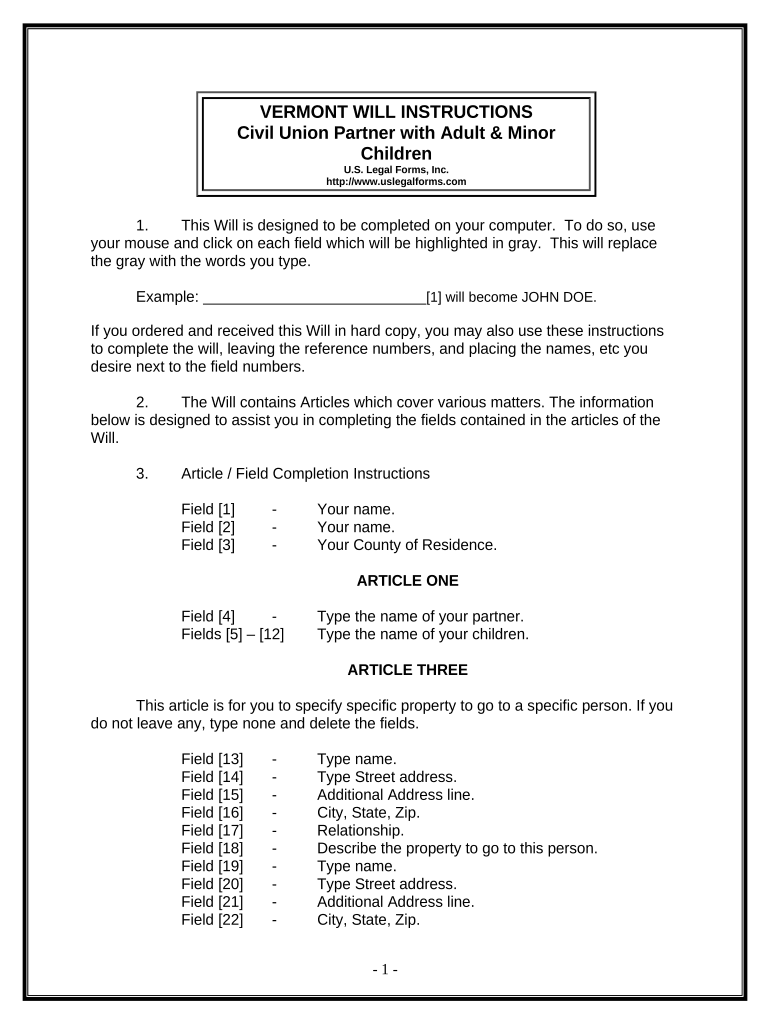
The Vermont Last Will and Testament Form for Civil Union Partner with Adult and Minor Children is a state-focused testamentary template that lets a civil union partner specify distribution of assets, guardianship for minor children, and appointment of an executor. It is written to reflect Vermont testamentary concepts, to distinguish adult-child bequests from minor-child provisions (including guardianship and trust directions), and to record any unequal distributions between the partner and children while meeting common witness and notarization expectations for probate.

Why a tailored will matters for civil union partners with mixed-age children

A will tailored to a civil union partner with both adult and minor children clarifies who receives specific property, names an executor, and, crucially, designates guardians or trustees for minors. It reduces probate ambiguity and helps align the testator's intentions with Vermont law and probate practice.

Why a tailored will matters for civil union partners with mixed-age children

Who typically completes this Vermont will

People creating this will usually have a legally recognized civil union or similar partnership in Vermont and need to plan for both adult beneficiaries and one or more minor children.

  • Civil union partners with a blended family and asset distribution preferences
  • Parents who must name a guardian or trustee for minor children
  • Individuals who want to appoint an executor and specify funeral or digital asset instructions

The form is suitable for straightforward estates; complex estates or unique family or tax issues should be reviewed with counsel.

Step-by-step: completing the Vermont will form

Follow these sequential steps to fill the form correctly, witness it, and prepare it for probate filing if needed.

  • 01
    Collect information: Gather full legal names, DOBs, asset lists, and beneficiary details.
  • 02
    Specify bequests: Describe specific gifts and residuary estate allocations clearly.
  • 03
    Name guardians/trustees: Designate guardians for minors and trustees for any testamentary trusts.
  • 04
    Sign, witness, notarize: Sign in presence of required witnesses and complete any self-proving affidavit or notarization steps.

How the execution and probate process typically flows

This summarises the common routing from signature to probate to distribution under Vermont practice.

  • Drafting: Complete the form with beneficiaries and guardians specified.
  • Execution: Testator signs; required witnesses sign; notary or self-proving affidavit is completed if used.
  • Probate filing: Executor files will and petition for probate in the county probate court where decedent resided.
  • Asset distribution: Executor pays debts and distributes assets according to the will or court directions.

Recommended digital workflow for completion and signature

A reliable electronic workflow reduces errors and preserves an audit trail during remote completion and signing.

Field Configuration
Document upload Use a PDF or DOCX master of the will form
Place fields Add name, date, signature, witness fields, and initials where required
Signer order Set testator first, witnesses next, then notary/self-proving affidavit
Audit trail Enable timestamping and IP capture for each signing event

Digital signing: technical and legal considerations

Use a platform that supports audit trails, PDF output, and optional higher-assurance signer authentication for estate documents.

  • File formats: PDF and DOCX are accepted; final executed will should be saved as PDF/A for archiving
  • Authentication: Use email+SMS or multi-factor authentication to strengthen signer attribution
  • Notary integration: Choose a solution that supports RON sessions if remote notarization is required

Retain the signed PDF and supporting audit trail; if a self-proving affidavit is used, include the notary record or RON session log.

Key sections to include in a professional Vermont will

A complete will should include these primary sections to ensure clarity and enforceability in probate.

Declaration

Statement identifying the testator, domicile, and revocation of prior wills; helps probate courts confirm intent and residence.
Executor provisions

Names executor and alternates, specifies bond waivers or compensation, and authorizes estate administration powers.

Specific bequests

Lists gifts of cash or property to named beneficiaries with clear descriptions and successor plans for unlocated items.

Residuary clause

Directs distribution of the remaining estate after debts and specific bequests; avoids partial intestacy.

Guardianship for minors

Names guardians and successor guardians, and instructs on physical custody or decision-making for minor children.

Testamentary trusts

Creates trusts for minors or vulnerable beneficiaries, names trustees, distribution schedule, and investment powers.

Supporting sections and practical inclusions

These additional provisions address common administrative, tax, and digital-asset concerns that arise during probate.

Digital assets

Provide access instructions and designate a fiduciary for digital accounts, including credentials storage guidance.

Funeral directions

Record burial or cremation preferences and any funding source or payable-on-death arrangements.

Tax provisions

Clarify payment sources for estate and income taxes and empower the executor to settle tax matters.

No-contest clause

Include narrowly drafted contest provisions if desired, noting state enforcement limits and judicial discretion.

Essential data elements to verify before signing

Testator identity: Full legal name
Partner identity: Civil union partner name
Children: Names and DOBs
Executor: Name and contact
Guardians: Primary and successor
Asset list: Key real and personal property

Risks and legal consequences of errors or omissions

Invalid execution: Missing witness or improper notarization can render the will void
Intestate fallback: Ambiguous provisions may result in intestacy rules applying to part or all of the estate
Guardianship disputes: Failure to name a clear guardian can prompt contested court-appointed guardianship
Tax exposure: Unclear tax direction can increase estate administration costs
Creditor claims: Improper creditor notice or missed deadlines can reduce estate value
Contests: Vague or inconsistent provisions invite will contests and litigation

Common mistakes to avoid when preparing the will

  • Failing to update beneficiary designations on retirement accounts and life insurance
  • Using informal or ambiguous beneficiary descriptions rather than legal names
  • Not naming successor guardians or trustees for minors
  • Skipping a self-proving affidavit or notarization where recommended

Critical timing considerations and probate deadlines

Key dates and timing impact administration and statutory limitation periods for estate matters.

Effective date:

Use MM/DD/YYYY; date determines testamentary capacity timing

Probate filing:

File petition soon after death; statute of limitations varies by claim

Tax returns:

Executor must file final income tax return and estate tax returns as required

Claims period:

Creditors typically have a limited window to present claims against the estate

Record retention:

Keep estate records for federal and state retention periods

Milestone timeline from signature to distribution

A sequential overview of the major stages after the will is executed and death occurs.

01

Execution Completed

Will signed and witnessed; self-proving affidavit executed if used

02

Death and Notice

Executor notified and death certificate obtained

03

Probate Petition

Executor files will for probate and requests letters testamentary

04

Administration

Assets marshaled, debts paid, distributions made per court approval

Comparison: eSignature vendor pricing and key compliance features

Typical vendor price and capability differences that matter when signing estate documents; signNow is listed first for comparison consistency.

signNow DocuSign Adobe Sign PandaDoc HelloSign
Starting Price $8/user/mo $15/user/mo $14/user/mo $19/user/mo $15/user/mo
Free Trial Yes, 7-day trial No No Yes, limited Yes, limited
Bulk Send Yes Yes Yes Yes No
Audit Trail Yes Yes Yes Yes Yes
HIPAA Compliant Yes Yes Yes No No

Real-world examples of use for blended families

Practical scenarios where the form clarifies estate outcomes and reduces court intervention.

Case Study 1

A civil union partner with two adult children and one minor named a guardian and a testamentary trust for the minor

  • The trust provided staged distributions until age 25
  • Probate proceeded without contest because the will named alternates and included a self-proving affidavit, minimizing court delays.

Case Study 2

A testator used the form to leave specific personal items to adult children and residual estate to partner

  • One adult beneficiary contested a specific bequest
  • The clear residuary clause and executor direction expedited court resolution and limited attorney fees.

Frequently asked questions about this Vermont will form

Answers to common concerns about validity, witnesses, notarization, and updating a will in Vermont.


Need help? Contact support

be ready to get more
Join over 28 million airSlate SignNow users