Establishing secure connection…Loading editor…Preparing document…

Letter of Rejection for Scholarship Applicant

This template is fully customizable. Edit the text, fill out the fields, and send it for signature. Give it a try!
Letter of Rejection for Scholarship Applicant

What a Letter of Rejection for Scholarship Applicant Is

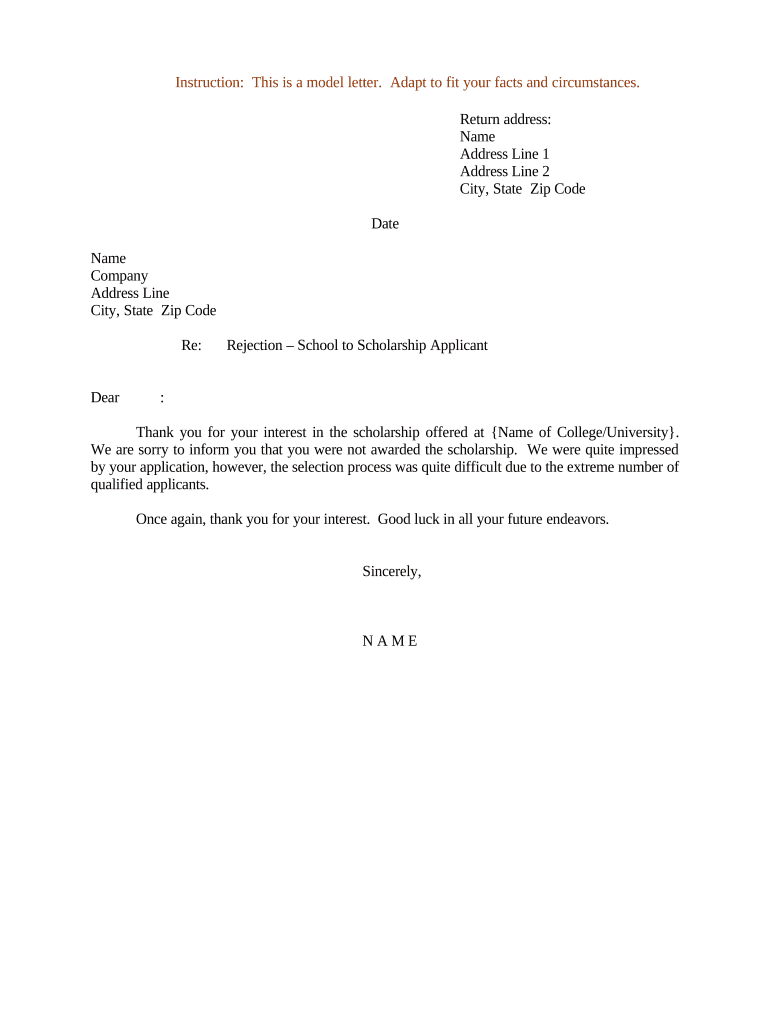
A Letter of Rejection for Scholarship Applicant is a formal written notice informing an applicant that their scholarship application was not selected. The letter documents the decision, explains next steps or appeal options if applicable, and preserves a clear record for institutional compliance and applicant records. It should be factual, respectful, and consistent with institutional policy and privacy obligations under federal law such as FERPA and applicable state rules.

Why a Clear Rejection Letter Matters

A well‑crafted rejection letter reduces confusion, limits appeals, and documents the decision for audit purposes. It helps protect institutional fairness, preserves applicant goodwill, and supports compliance with privacy and nondiscrimination obligations.

Why a Clear Rejection Letter Matters

Who Prepares and Receives These Letters

Typically written by scholarship administrators, admissions or financial aid officers, and sometimes by foundation staff or external selection committees.

  • Scholarship administrators and financial aid officers manage case records, communication, and compliance with institutional policy.
  • Selection committee chairs finalize decisions and ensure reasons for rejections align with published criteria and conflict‑of‑interest rules.
  • Applicants and their guardians receive the notice and any information about appeals, alternative funding, or reapplication timelines.

The letter should be routed and retained according to institutional recordkeeping policy and applicable federal or state retention rules.

Step-by-Step: Complete the Rejection Letter

Follow a concise sequence to draft, review, approve, and send the letter to ensure clarity and compliance.

  • 01
    Prepare details: Enter applicant name, program, application ID, and decision date.
  • 02
    State reason: Give a neutral, concise reason consistent with selection criteria.
  • 03
    Include process info: State appeal rights or reapplication timelines if applicable.
  • 04
    Sign and send: Authorized official signs; send through approved channel.

Typical Workflow for Issuing a Rejection Letter

A standard routing ensures review, authority signoff, and secure delivery while preserving an audit trail.

  • Draft: Template populated with applicant details.
  • Review: Committee or administrator verifies facts.
  • Authorize: Authorized official signs the letter.
  • Deliver: Send via institution electronic mail or secure portal.

Configuring an Online Workflow

When using an electronic process, configure fields, routing, and retention before bulk sending to ensure consistency.

Field Configuration
Applicant Details Auto-fill from application database to avoid typos
Decision Flag Trigger event that launches the rejection workflow
Reviewer Approval Require one or two signers depending on policy
Delivery Channel Email with secure attachment or institution portal

Digital Tools and Integration Considerations

Confirm the eSignature platform supports required security, audit trails, and integration with your student information system.

  • Authentication: Email link, SMS code, or institutional SSO
  • Audit Trail: Timestamp, IP, and action log
  • Integrations: CRM, SIS, or document storage connectors

Ensure the chosen configuration maintains FERPA compliance and document retention rules; consult IT and legal before scaling.

Security and Compliance Data Points

Encryption: TLS 1.2/1.3 in transit; AES-256 at rest
Audit Trail: Timestamped events and signer metadata
HIPAA: BAA required for protected health data
ESIGN / UETA: Compliant for electronic signature validity
Access Controls: Role-based permissions and SSO
Certifications: SOC 2 Type II and ISO 27001 available

Legal Risks of an Improper Rejection Letter

Discrimination Claims: Potential civil litigation or OCR complaints
FERPA Violations: Improper disclosure of student education records
Breach of Policy: Internal compliance failures and audits
Defamation Risk: Avoid inaccurate or pejorative statements
Recordkeeping Failure: Loss of evidentiary trail for appeals
Data Privacy: State privacy law exposures (e.g., CCPA)

Common Mistakes to Avoid

  • Giving overly detailed criticism or subjective judgments can lead to disputes and potential reputational harm for the institution.
  • Using inconsistent reasons across applicants undermines fairness and can trigger appeals or discrimination allegations.
  • Failing to redact sensitive personal data in shared copies may violate FERPA or state privacy laws.
  • Delaying notification beyond institutional timelines increases the risk of administrative errors and frustrates applicants.

Essential Elements to Include in the Letter

Include clear identification, a concise reason aligned to criteria, appeal or next‑step information, and an authorized signature to create an auditable record.

Applicant ID

Unique identifier that ties the letter to the applicant’s file and minimizes mistaken identity in administrative records.
Decision Summary

Short factual statement that the application was not selected; avoid subjective language and cite the program or award name.

Rationale

A neutral explanation referencing published selection criteria or listing competitive factors without disclosing peer details.

Appeal or Reapply Info

State whether appeals are permitted, include deadlines, or provide reapplication guidance when appropriate.

Confidentiality Note

Remind recipients how personal data is handled under FERPA and your institution’s privacy policy if relevant.

Authorized Signature

Printed name, title, department, and date from an authorized institutional official to validate the notice.

Timing and Expected Processing Steps

Set clear internal deadlines for drafting, review, approval, and delivery so applicants receive timely notification and records remain consistent.

Decision Finalized:

Institution completes selection and records the decision date immediately.

Draft Issued:

Draft letter prepared within 3 business days of decision.

Approval Window:

Authorized signature obtained within 5 business days of drafting.

Send Notice:

Deliver notice within 7 business days of final decision when possible.

Record Closure:

Update applicant file and retention flags after delivery.

Comparing eSignature Providers for Sending Rejection Letters

Quick vendor comparison showing starting prices, common features, and compliance notes to help evaluate eSignature options for institutional correspondence.

signNow DocuSign Adobe Sign PandaDoc HelloSign
Starting Price $8/user/mo $15/user/mo $14/user/mo $19/user/mo $15/user/mo
Free Trial 7-day free trial Varies by plan Varies by plan Varies by plan Varies by plan
Bulk Send Yes Yes Yes Yes No
Audit Trail Yes Yes Yes Yes Yes
HIPAA Compliant Yes Yes Yes No No

Frequently Asked Questions About Rejection Letters

Practical answers to common issues when preparing and sending rejection letters, focusing on accuracy, privacy, and appeal handling.


Need help? Contact support

be ready to get more
Join over 28 million airSlate SignNow users