Establishing secure connection…Loading editor…Preparing document…

Letter Regarding Discovery Responses

This template is fully customizable. Edit the text, fill out the fields, and send it for signature. Give it a try!
Letter Regarding Discovery Responses

What a Letter Regarding Discovery Responses Is and When It’s Used

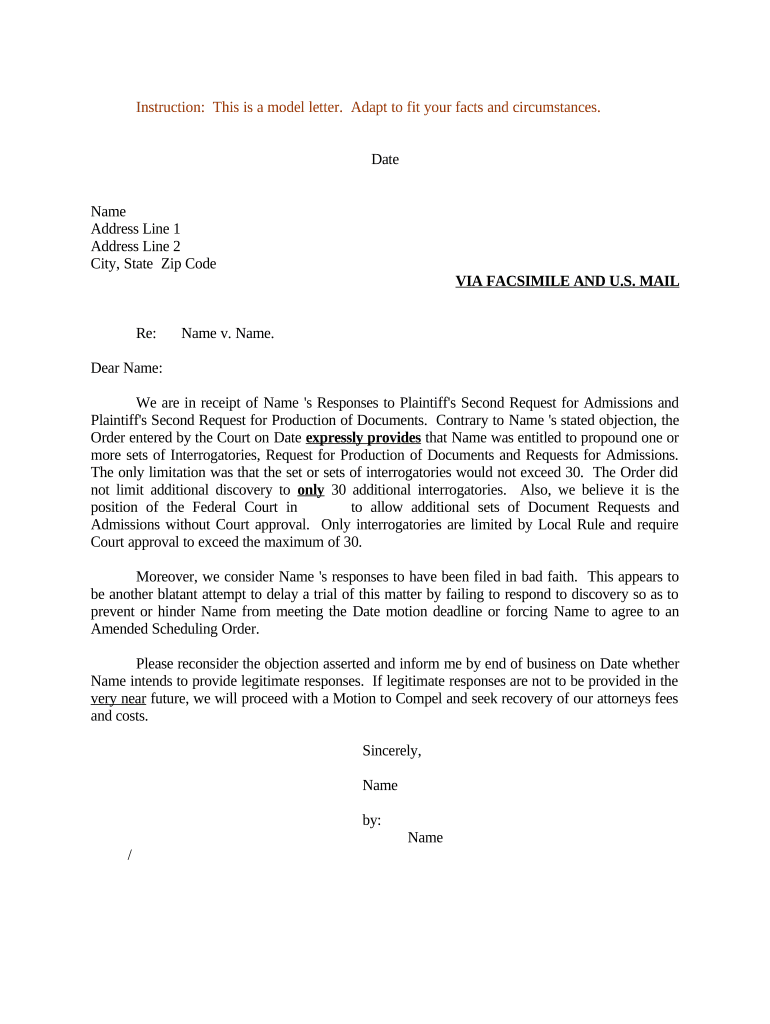
A Letter Regarding Discovery Responses is a written communication sent by a party or counsel that accompanies, clarifies, or supplements formal discovery answers (interrogatories, requests for production, requests for admission) in civil litigation. It documents objections, identifies withheld or redacted materials, references privilege logs, and explains search or production limitations. The letter may also serve as a meet-and-confer record, state supplemental disclosures, or confirm a production schedule. Proper form and timing help preserve objections and reduce the risk of motions to compel or sanctions under the Federal Rules of Civil Procedure.

Why a Clear Letter Improves Discovery Outcomes

A focused letter ensures the receiving party and the court understand what was produced, what was withheld, and why. It creates a documented record that supports privilege claims and limits future disputes.

Why a Clear Letter Improves Discovery Outcomes

Who Typically Prepares and Receives These Letters

Counsel for plaintiffs and defendants usually prepare these letters as part of formal discovery exchanges.

  • Litigation counsel for parties: Drafts explanations, objections, and privilege assertions.
  • In-house legal teams: Coordinates production logistics and vendor exports.
  • Paralegals and litigation support: Assembles bates ranges and attachment indexes.

Recipients include opposing counsel, court clerks when required by local rule, and third-party vendors who manage document repositories.

Core Elements of a Professional Letter Regarding Discovery Responses

A professional letter is concise, cites the specific discovery requests, states objections or limitations, references produced bates ranges, and attaches a privilege log when applicable.

Caption

Include court name, case caption, and docket number at the top so the letter is immediately associated with the litigation file and easily indexed.
Identification

List the served discovery requests by type and number (e.g., Interrogatory No. 1; RFP No. 3) so the recipient can match responses to requests quickly.

Production Index

Give bates ranges or file names for produced documents and note format (native, TIFF, PDF), delivery method, and any searchable metadata fields.

Objections

State specific objections with legal bases (e.g., relevance, overbreadth, privilege) and identify any partial responses or narrowed search parameters.

Privilege Log

Attach or reference a privilege log identifying withheld documents, privilege type, authors, recipients, dates, and privilege grounds consistent with local rules.

Certification

Include any required signature block certifying compliance with FRCP 26(g) or applicable state rule and identify the signer and date of certification.

Step-by-Step: Preparing the Letter Regarding Discovery Responses

Follow these practical steps to prepare a clear, defensible letter that supports your production and privilege positions.

  • 01
    Identify Requests: Match each response to the specific request numbers and types.
  • 02
    Assemble Production: List bates ranges, formats, and number of documents produced.
  • 03
    State Objections: Cite the legal basis and whether objections are partial or total.
  • 04
    Sign and Serve: Include certification, sign, and serve under local rules or court e-filing procedures.

How to Customize and Complete the Letter Online

Configure the document workflow to automate fields, attach logs, and record delivery for the discovery record.

Field Configuration
Auto-populate Caption Pull case caption from a central matter database to ensure consistency.
Conditional Objections Show objection text only when a checkbox for 'withhold' or 'privilege' is selected.
Attach Privilege Log Require upload of a privilege log file before finalizing the letter.
Recipient Authentication Record signer attribution and delivery timestamp for the service record.

Where to Send or File the Letter Regarding Discovery Responses

Select delivery and filing methods that comply with federal and local rules and preserve a verifiable service record.

  • Opposing Counsel: Email or e-service under local rule with production attachments and bates ranges.
  • Court Clerk: File only if local rule or judge requires a filed discovery correspondence copy.
  • Document Repository: Upload produced files and logs to case management or e-discovery platforms.
  • Vendor Delivery: Provide native files to e-discovery vendors with delivery receipts and checksums.

Digital Signing, eSubmission, and Platform Needs

Use a platform that captures signer attribution, timestamps, and an audit trail for each production and letter.

  • Audit Trail: Captures timestamps and IP addresses.
  • Authentication Options: Supports email, SMS, or advanced verification.
  • File Formats: Accepts PDF, DOCX, and native files.

Platforms with integrations to case management, cloud storage, and e-discovery tools streamline production and preserve evidentiary metadata for future motions; verify HIPAA or other compliance as needed.

Typical Timing and Deadlines for Discovery Responses

Observe federal and local rules for response windows and supplementation obligations to avoid waiver or sanctions.

Federal Response Window:

Responses are generally due within 30 days after service (see FRCP 33(b)(2); 34(b)(2)(A)).

Requests for Admission:

Admissions typically must be answered in 30 days after service under FRCP 36(a).

Supplementation Duty:

Under FRCP 26(e), parties must seasonably supplement or correct disclosures and responses.

Court-Ordered Variations:

Local rules or court orders may shorten or extend response periods; always check local rules.

Extensions and Stipulations:

Parties may agree to extensions or seek court approval for scheduling changes.

Key Milestones in the Discovery Response Process

Track milestones from receipt of requests through final supplementation to maintain an enforceable record and meet meet-and-confer obligations.

01

Receipt of Requests

Record the service date and preserve relevant custodial sources.

02

Search and Review

Complete collection, filtering, and privilege review within the response window.

03

Production and Letter

Produce documents, prepare the letter with bates ranges, and serve opposing counsel.

04

Supplementation

Supplement deficiencies promptly under FRCP 26(e) if new responsive materials are found.

Common Mistakes to Avoid When Preparing Discovery Letters

  • Failing to map responses to specific request numbers, which creates confusion and increases dispute risk.
  • Providing incomplete production details or missing bates ranges, leaving recipients unable to verify produced materials.
  • Overbroad or boilerplate objections without supporting facts, which courts often find insufficient under FRCP 34.
  • Neglecting to attach or properly reference a privilege log, risking waiver of privilege claims.

Consequences of Inaccurate or Late Discovery Letters

Sanctions: Court may impose sanctions under FRCP 37.
Waiver: Untimely or insufficient objections may be deemed waived.
Monetary Costs: Court may award attorney fees and expenses.
Adverse Inference: Judge may draw negative inferences about withheld materials.
Motion to Compel: Opposing party can seek an order compelling compliance.
Evidentiary Bar: Improper production can compromise admissibility at trial.

Practical Examples: How These Letters Are Used

Below are two common scenarios showing how a Letter Regarding Discovery Responses clarifies production and preserves positions.

Employment Dispute

Counsel attaches a privilege log and cites limited custodial search terms

  • Opposing counsel seeks clarity on withheld emails
  • The letter documents efforts and narrows issues, reducing the scope of a motion to compel and creating a record for the court.

Commercial Litigation

Defendant produces contract files with bates ranges and redactions

  • Plaintiff requests an unredacted copy for specific entries
  • The letter explains redaction bases and offers meet-and-confer dates, which often resolves disputes without court intervention.

Comparison: eSignature Options for Signing and Submitting Discovery Letters

Compare common eSignature vendors for price, bulk send, audit trails, HIPAA support, and envelope limits when selecting a platform for discovery letters and privileged logs.

signNow DocuSign Adobe Sign PandaDoc HelloSign
Starting Price $8/user/mo $15/user/mo $14/user/mo $19/user/mo $15/user/mo
Free Trial 7-day free trial Varies by vendor Varies by vendor Varies by vendor Varies by vendor
Bulk Send Yes (Premium) Yes Yes Yes No
Audit Trail Yes Yes Yes Yes Yes
HIPAA Compliant Yes (BAA) Yes Yes No No

Frequently Asked Questions About Letters Regarding Discovery Responses

Answers to common questions about timing, privilege logs, e-service, and certification of discovery responses.


Need help? Contact support

be ready to get more
Join over 28 million airSlate SignNow users