Heading
Recipient name, committee or office, and current date placed at the top for immediate identification by staff and for docket indexing.
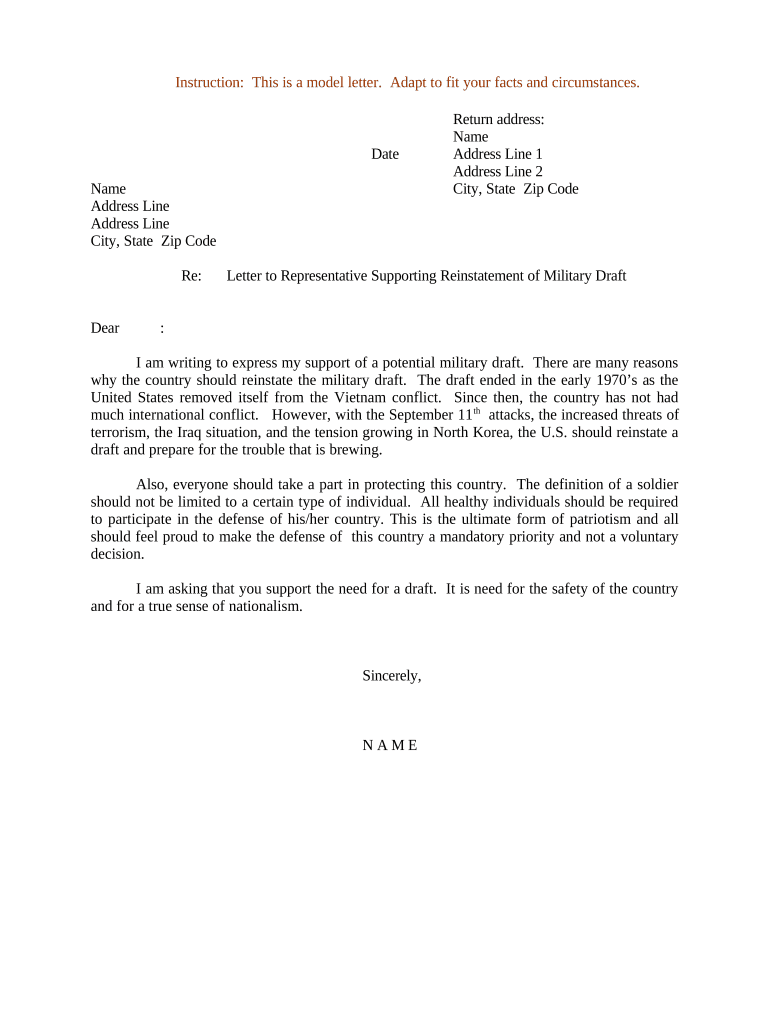
A concise, fact-based letter increases credibility with decision makers, clarifies the author’s position and qualifications, and ensures statements enter the official record in a searchable, preservable format. Proper formatting and accurate signer details reduce follow-up inquiries and make it easier for legislative staff to route the document to the right committee or official.

Advocates, veterans groups, policy researchers, elected officials, and private citizens commonly prepare letters supporting reinstatement of the draft.
Each sender should tailor tone and supporting evidence to the recipient—legislative aides typically prefer concise, referenced statements while formal submissions may require attachments and notarization.
Recipient name, committee or office, and current date placed at the top for immediate identification by staff and for docket indexing.
One-sentence declaration of support that states the position clearly and explains the author’s interest or stake in the issue.
Two to four concise points or data citations that underpin the request and refer to publicly available sources where possible.
Organization, role, years of experience, or relevant service history that establish authority and perspective on the subject.
List any supporting exhibits such as policy briefs, research citations, or letters from allied organizations attached or hyperlinked in the submission.
Handwritten or e-signature plus direct contact information so staff can follow up for clarification or verification.
| Field | Configuration |
|---|---|
| Document format | PDF/A for long-term preservation |
| Authentication | Email plus optional SMS code |
| Signature type | Standard electronic signature with audit trail |
| Retention | Store signed PDF and audit trail for legal retention period |
Choose a platform that supports secure signatures, audit trails, and the integrations you need for distribution and recordkeeping.
Ensure the chosen provider supports ESIGN/UETA compliance, optional notarization or RON workflows, and preserves a tamper-evident audit trail for each signed copy.
Send before committee hearings or markups for best effect
Legislative offices may acknowledge within 7–30 business days
Keep copies for at least 3 years for administrative reference
If used, retain audio-video per state notary rules
Plan follow-up 2–6 weeks after submission
Finalize text and attachments; verify facts and tone
Confirm signer name and contact details
Apply signature; obtain notary or RON if required
Deliver to office and save signed record with audit trail
An advocacy group submits a coordinated letter signed by five chapters
An individual constituent writes a personal account supporting reinstatement
| Criteria | Letter Supporting Draft | Petition |
|---|---|---|
| Purpose | position statement | request signature collection |
| Formality | moderate to high | varies; often informal |
| Attachments typical | policy briefs, citations | list of signatories |
| Routing | direct to office or committee | public petition portals |
| signNow | DocuSign | Adobe Sign | PandaDoc | HelloSign | |
|---|---|---|---|---|---|
| Starting Price | $8/user/mo | $15/user/mo | $14/user/mo | $19/user/mo | $15/user/mo |
| Free Trial | 7-day free trial | Varies by plan | Varies by plan | Varies by plan | Varies by plan |
| Bulk Send | Yes | Yes | Yes | Yes | No |
| Audit Trail | Yes | Yes | Yes | Yes | Yes |
| HIPAA Compliant | Yes | Yes | Yes | No | No |