Establishing secure connection…Loading editor…Preparing document…

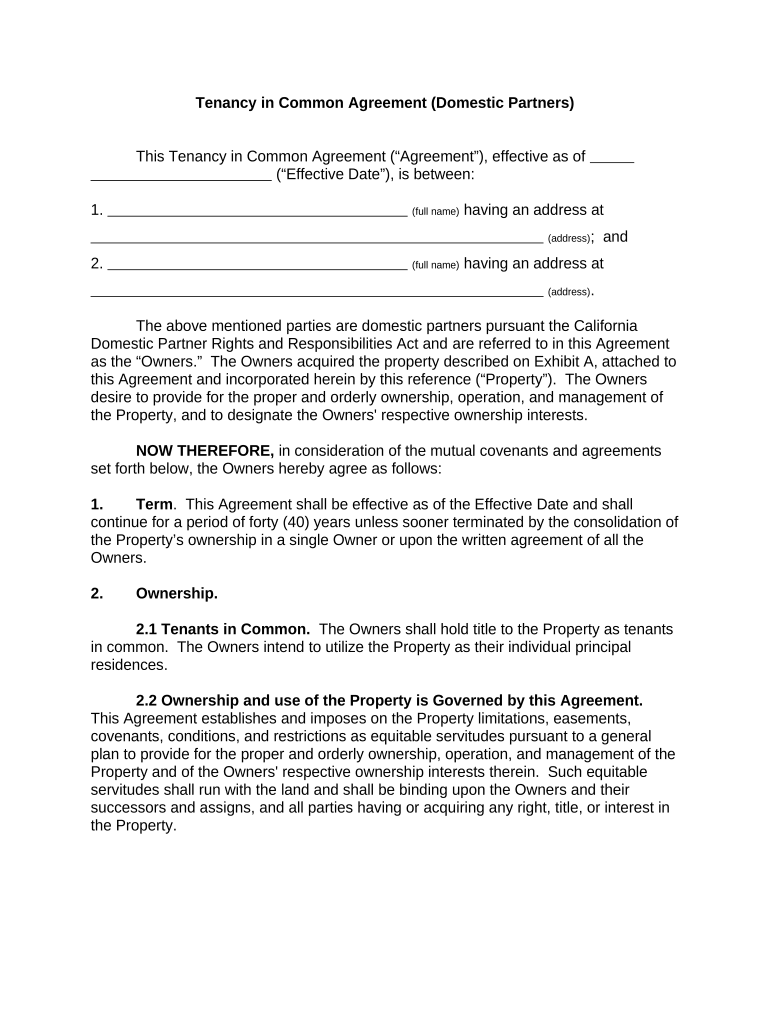
Tenancy Common Agreement

This template is fully customizable. Edit the text, fill out the fields, and send it for signature. Give it a try!
Tenancy Common Agreement

What a Tenancy Common Agreement Is and When It Applies

A Tenancy Common Agreement documents the ownership rights and obligations of two or more co-owners who hold property as tenants in common. It defines each co-owner's percentage interest, contributions to purchase and upkeep, decision-making processes, allocation of income and expenses, and procedures for sale, transfer, or buyout. Parties typically use this agreement for residential or investment real estate when co-ownership shares or exit rules differ from joint tenancy. The document can be recorded with the county recorder as an exhibit to the deed if parties choose to make terms publicly enforceable.

Why a Formal Agreement Matters for Co-Owners

A written Tenancy Common Agreement clarifies ownership percentages, reduces disputes, preserves marketability, and defines exit options. It creates predictable obligations for repairs, taxes, and cash flow distributions while providing a clear path for selling or partitioning interests.

Why a Formal Agreement Matters for Co-Owners

Who Typically Prepares and Uses a Tenancy Common Agreement

Co-owners, property managers, real estate investors, and attorneys commonly create Tenancy Common Agreements to set expectations and formalize co-ownership arrangements.

  • Individual co-owners sharing investment property or a family home
  • Real estate partnerships and small investor groups
  • Title agents, lenders, and attorneys reviewing ownership terms

Core Components to Include in a Professional Agreement

A comprehensive Tenancy Common Agreement organizes ownership, governance, and exit terms so each party’s rights are transparent and enforceable. Include clear language that can be recorded or attached to title documents if desired.

Ownership Interest

State each party’s percentage or fractional share and how it was calculated, whether equal or unequal.
Contributions

Document purchase amounts, mortgage responsibilities, and capital improvements allocation among co-owners.

Use and Possession

Describe occupancy rights, rental management, and rules for third-party leasing or short-term rentals.

Expenses and Income

Specify allocation of taxes, insurance, maintenance, and distribution of rental or sale proceeds.

Transfer and Buyouts

Include right-of-first-refusal, buyout formulas, valuation methods, and permitted transfers to heirs or assignees.

Dispute Resolution

Agree on mediation, arbitration, or court processes, and designate governing law and venue.

Essential Information to Capture

Parties' Names: Full legal names
Property Description: Legal description and parcel number
Ownership Shares: Percentage or fraction
Consideration: Purchase price or contribution
Effective Date: MM/DD/YYYY format
Signature Block: Signed and dated lines

Step-by-Step: Completing a Tenancy Common Agreement

Follow these steps to prepare, sign, and preserve the agreement so co-ownership rights are clear and enforceable.

  • 01
    Collect Documents: Gather deed, mortgage, and IDs for verification.
  • 02
    Draft Terms: Specify shares, contributions, and governance rules.
  • 03
    Review with Counsel: Have an attorney confirm legal and tax effects.
  • 04
    Sign and Record: Sign, notarize if required, and record with county.

Configuring an Online Completion Workflow

Set up a secure digital workflow to collect signatures, required IDs, and supporting documents while preserving an audit trail.

Field Configuration
Document Format Use PDF or DOCX to preserve layout and allow auditing.
Signer Authentication Email link, SMS code, or ID verification depending on risk.
Conditional Fields Show buyout formulas only when transfer checkbox selected.
Integrations Connect to title systems, cloud storage, or CRMs.

Where to Send or File the Completed Agreement

After execution, distribute copies to parties, retain originals, and determine if recording is necessary to protect third-party rights.

  • Co-Owners: Provide each party a signed copy for their records.
  • Title Company: Share agreement when obtaining title insurance or during closing.
  • County Recorder: Record as an exhibit to the deed if public notice is desired.
  • Lender / Servicer: Deliver copy if mortgage or financing terms reference co-ownership.

Technical Options for Digital Signing and Distribution

Choose tools that support PDF/DOCX formats, strong authentication, and a verifiable audit trail for signatures and timestamps.

  • Document Formats: PDF, DOCX supported
  • Integrations: Salesforce, NetSuite, Google Workspace
  • Authentication: Email, SMS, or higher verification

Timing and Deadlines to Watch

Some actions have timing implications: prompt recording, tax reporting, and notice periods can affect priority, tax treatment, and enforceability.

Effective Date:

Set by parties; affects obligation start

Recording Promptly:

Record quickly to protect priority against later claims

Tax Reporting:

Report rental income and basis changes in relevant tax year

Notice Periods:

Follow any contract notice windows for buyouts or sales

Statute of Limitations:

Claims and disputes follow state limitation periods

Common Mistakes to Avoid

  • Using informal email agreements without signatures leads to disputed intent and unclear obligations.
  • Entering imprecise property descriptions can break the chain of title and complicate recording or insurance.
  • Failing to address buyout valuation results in costly disputes or protracted litigation between co-owners.
  • Skipping professional review for tax or liability consequences can create unexpected estate or capital gains exposures.

Potential Risks and Consequences of Errors

Title Dispute: Clouded title risk
Partition Lawsuit: Court-ordered sale risk
Tax Exposure: Missed reporting or basis issues
Loss of Priority: Unrecorded interests suffer
Lien Problems: Unaddressed liens attach to share
Enforcement Costs: Litigation and attorney fees

Practical Scenarios Where This Agreement Is Used

These examples show typical situations and practical effects of a Tenancy Common Agreement for co-owners and service providers.

Family Co-Ownership

A family retains a vacation home with unequal shares to reflect contributions

  • Agreement sets buyout formula and maintenance allocation
  • The document prevented a dispute when one owner wanted to sell, enabling a structured buyout instead of forced sale.

Investor Partnership

Three investors buy rental property with different capital inputs

  • Agreement assigns income shares and property management duties
  • Clear dispute resolution and right-of-first-refusal clauses streamlined a sale to an outside buyer without litigation.

Typical Signatories and Their Roles

Individual Co-Owner

A co-owner signs to confirm ownership percentage, contribution, and obligations. They are responsible for complying with the agreement, paying taxes and maintenance share, and participating in buyout or sale processes as provided.

Attorney or Property Manager

A legal or management representative often prepares or reviews the agreement, manages collections, and enforces terms. They can sign as agent with written authorization and must retain records for legal and tax compliance.

eSignature Provider Comparison for Tenancy Common Agreement Workflows

Compare typical plan attributes and compliance features when selecting an eSignature provider for executing Tenancy Common Agreements and related closing documents.

signNow DocuSign Adobe Sign PandaDoc HelloSign
Starting Price $8/user/mo $15/user/mo $14/user/mo $19/user/mo $15/user/mo
Free Trial 7-day free trial Varies Varies Varies Varies
Bulk Send Yes Yes Yes Yes No
Audit Trail Yes Yes Yes Yes Yes
HIPAA Compliant Yes Yes Yes No No
Envelope Cap No cap 100 envelopes/user/year Varies Varies Varies

Key Milestones from Draft to Recorded Agreement

Track these sequential milestones to ensure timely execution, notarization, and recording to protect rights and priority.

01

Draft Completion

Finalize terms and obtain legal review before signature.

02

Execution and Notarization

All parties sign; notarize if state or county requires it.

03

Recording Submission

Submit agreement or deed exhibit promptly to county recorder.

04

Post-Recording Distribution

Provide recorded copies to parties, title insurer, and lenders.

Frequently Asked Questions About Tenancy Common Agreements

Answers to common execution, recording, and enforceability questions for co-owners preparing a Tenancy Common Agreement.


Need help? Contact support

be ready to get more
Join over 28 million airSlate SignNow users