Establishing secure connection…Loading editor…Preparing document…

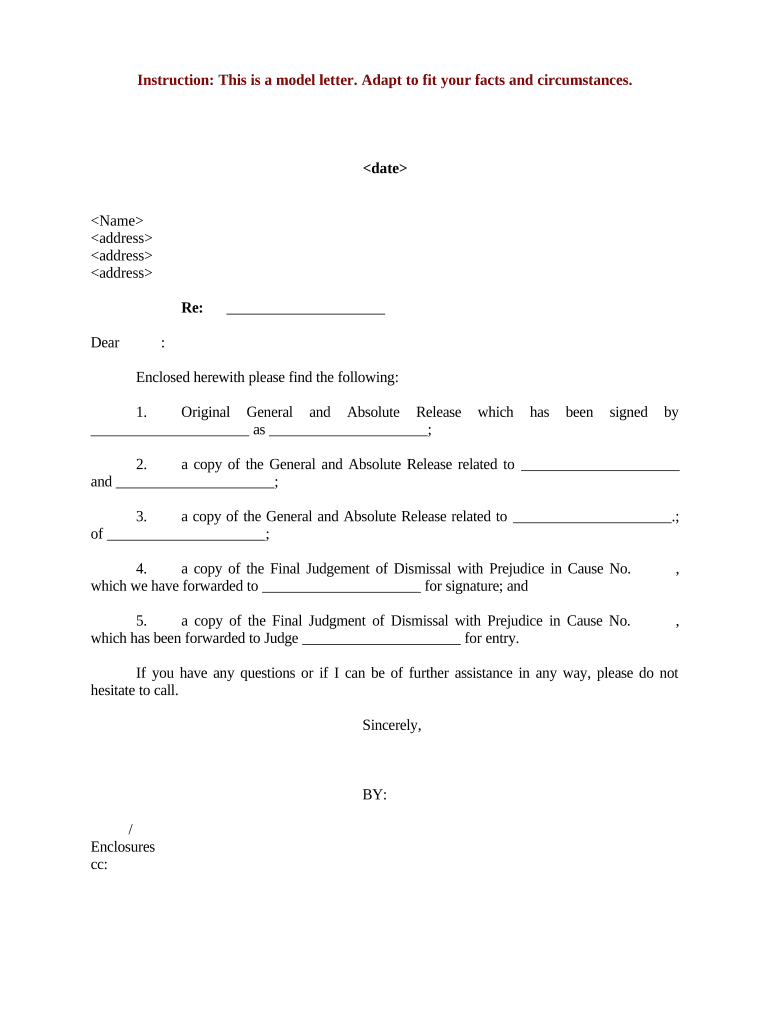
Letter Regarding General and Absolute Release

This template is fully customizable. Edit the text, fill out the fields, and send it for signature. Give it a try!
Letter Regarding General and Absolute Release

What the Letter Regarding General and Absolute Release Is

A Letter Regarding General and Absolute Release is a written instrument in which a releasing party irrevocably discharges another party from past, present, and future claims arising from a specified event, transaction, or relationship. It typically identifies the parties, describes the subject matter being released, specifies the effective date, and confirms consideration if any. These letters are used to resolve disputes, settle claims, or close transactions without further liability. Properly drafted releases limit future litigation and clarify which obligations survive, but they must be precise in scope and signatory authority.

Why a Clear, Complete Release Letter Matters

A properly drafted general and absolute release reduces legal uncertainty, documents mutual expectations, and records final settlement terms. It provides evidence of the parties' intent to discharge claims and can prevent future disputes when scope and consideration are explicit.

Why a Clear, Complete Release Letter Matters

Typical Parties Who Use This Release

Release letters are common where one party needs certainty that past claims will not be revived after settlement or final payment.

  • Individual claimants and plaintiffs settling disputes with a business or insurer.
  • Employers and employees completing severance or separation agreements and final-pay releases.
  • Corporate parties, lenders, and contractors closing accounts or resolving breach and performance claims.

Representative Signatories and Roles

Releasor — Individual

A private person who gives up rights in exchange for consideration or settlement; must sign using the exact legal name on identification to avoid ambiguity and possible challenge.

Releasee — Authorized Signer

An organization representative (officer or authorized agent) whose authority should be documented; include title and corporate capacity to ensure enforceability against the entity.

Step-by-Step: Completing the Release Letter

Follow these sequential steps to prepare, review, and execute a legally sound general and absolute release.

  • 01
    Draft core terms: Identify parties, effective date, scope, and consideration clearly.
  • 02
    Review authority: Confirm signers have legal authority to bind individuals or entities.
  • 03
    Add authentication: Include witnesses or notarization where helpful or required.
  • 04
    Execute and distribute: Collect all signatures and provide copies to each party.

Typical Workflow for Drafting and Signing

A standard workflow moves from drafting to review, execution, and distribution; include retention and proof steps for records management.

  • Upload Draft: Place the document in a secure file storage or eSignature platform for editing and field placement.
  • Assign Reviewers: Circulate to counsel and authorized signers for approval before sending for signature.
  • Collect Signatures: Obtain signatures in the required order and authentication strength.
  • Archive Records: Store executed copies and audit trails in a compliant retention system.

Configuring an Electronic Signing Workflow

Set up a stepwise signing flow that enforces signer order, required fields, and verification methods before sending the release for signature.

Field Configuration
Signature Field Required for each signer; set to capture date and typed or drawn signature.
Authentication Level Email link or SMS code; use stronger ID verification for higher-risk releases.
Signer Order Sequence signers to prevent backdated or out-of-order execution.
Audit Trail Enable full action log with IP, timestamp, and email confirmations.

Technical and Security Considerations for eSigning

Choose a platform that supports reliable audit trails, secure storage, and flexible authentication for high-value releases.

  • File Formats: PDF and DOCX are standard; ensure platform preserves document integrity.
  • Authentication: Support for email, SMS, KBA, or SSO strengthens signer attribution.
  • Retention: Encrypted storage and exportable audit logs are essential for admissibility.

Security and Compliance Highlights for Electronic Execution

Encryption: TLS 1.2/1.3 in transit, AES-256 at rest
HIPAA: BAA available for protected health information
ESIGN / UETA: Compliant with federal and state e-signature laws
Audit Trails: Detailed action logs and timestamps
SOC 2: SOC 2 Type II certification available
21 CFR Part 11: Controls for FDA-regulated records

Key Risks and Legal Consequences to Watch

Ambiguous Scope: May permit subsequent litigation
Improper Authority: Signatures lacking capacity can void release
Missing Consideration: May render release unenforceable
I-9 / Tax Errors: Noncompliance can trigger fines
Intentional Misstatement: Fraud allegations risk rescission
Notarization Omitted: Reduces evidentiary weight in some courts

Common Preparation Errors to Avoid

  • Using informal or inconsistent party names that later require corrective affidavits or amendments.
  • Failing to describe the claims or time period covered, creating disputes over whether a claim was released.
  • Omitting capacity language when entities sign through agents or officers, which can cause enforceability challenges.
  • Relying on verbal confirmation of release terms instead of preserving executed written copies and audit trails.

Real-World Examples of Release Letters in Use

These condensed examples show how different organizations applied release letters to resolve disputes, close transactions, and avoid further claims.

Optica Ventures — Settlement

A small investor settlement was documented with a general release of claims

  • The release covered claims through the closing date
  • The executed letter eliminated further litigation risk, enabled prompt disbursement, and provided clear proof of mutual agreement for company records and auditors.

Martin Properties — Final Pay

A contractor accepted final payment and signed a broad release

  • The release specifically named the project and payment date
  • Including precise project identifiers and a notary block reduced later disputes and sped up lien waiver processing with subcontractors and lenders.

Practical Tips for Accurate, Efficient Completion

Adopt clear drafting rules and verification steps to reduce rework and strengthen enforceability of the release letter.

Use precise language
Define the subject matter, time period, and types of claims released. Precision prevents divergent interpretations and reduces litigation risk.
Confirm signer authority
Obtain proof of corporate authority or power of attorney when an entity signs. Keep corporate resolutions or authorization letters on file.
Preserve execution evidence
Retain signed copies, notarizations, and audit logs. These records support admissibility and the chain of custody if a dispute arises.
Consider limited attorney review
For bespoke or high-value releases, a targeted attorney review of scope and consideration reduces downstream risk more cost-effectively than full drafting.

Distribution and Storage Options for Executed Releases

Decide how executed releases will be distributed (email, registered mail, secure portal) and where originals will be stored for legal compliance.

  • Email Delivery: Send signed PDFs to all parties and retain delivery receipts.
  • Secure Portal: Use encrypted document portals for controlled access and longer retention.
  • Physical Storage: Store originals in a locked file or safe where required.

Comparing eSignature Options for Executing Release Letters

Select an eSignature provider that matches the document's security, authentication, and compliance needs; the table shows base pricing and common capabilities for consideration.

signNow DocuSign Adobe Sign PandaDoc HelloSign
Starting Price $8/user/mo $15/user/mo $14/user/mo $19/user/mo $15/user/mo
Free Trial 7-day free trial Varies by vendor Varies by vendor Varies by vendor Varies by vendor
Bulk Send Yes Yes Yes Yes Yes
Audit Trail Yes Yes Yes Yes Yes
HIPAA Compliant Yes Yes Yes No No

Frequently Asked Questions About General and Absolute Releases

Answers to common execution, enforceability, and recordkeeping questions to help avoid the most frequent pitfalls when preparing and signing releases.


Need help? Contact support

be ready to get more
Join over 28 million airSlate SignNow users