Establishing secure connection…Loading editor…Preparing document…

Letter Requesting Permission to Use Copyrighted Material

This template is fully customizable. Edit the text, fill out the fields, and send it for signature. Give it a try!
Letter Requesting Permission to Use Copyrighted Material

What this Letter Is and when to use it

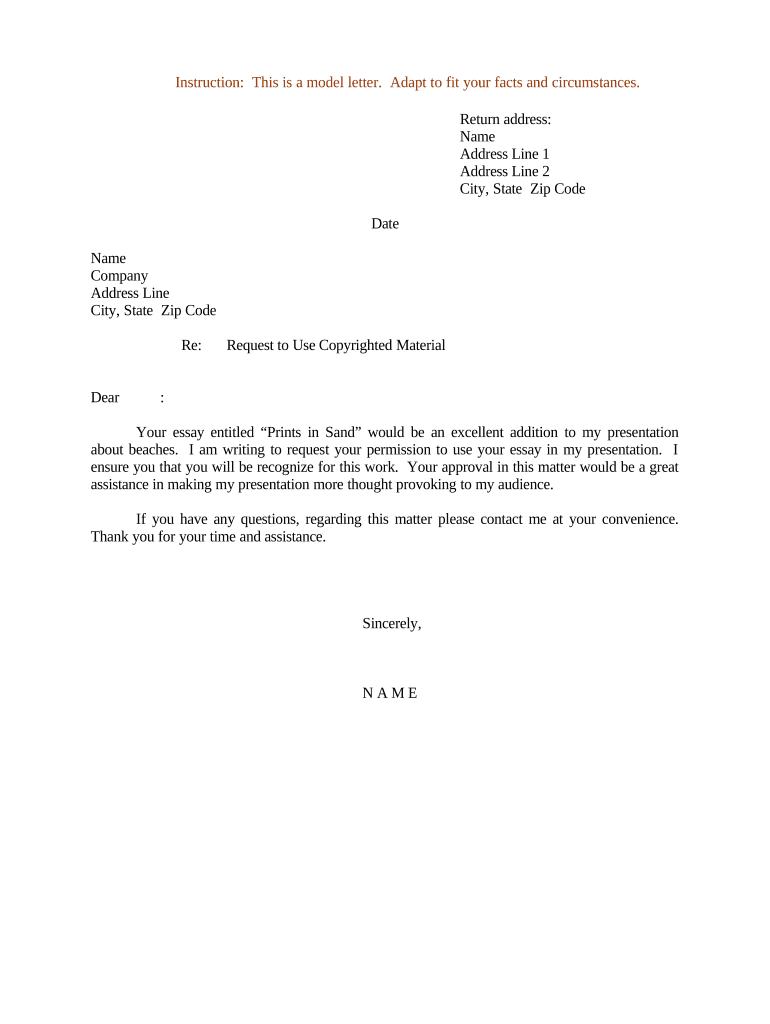
A Letter Requesting Permission to Use Copyrighted Material is a formal, written request sent to a rights holder asking for authorization to reproduce, display, distribute, adapt, or otherwise use copyrighted work. It explains the material you want to use, how you will use it, the intended audience, the duration and territorial scope of the license, and any compensation or attribution proposed. The letter creates an auditable record of permission discussions and is often the first step before drafting a binding license agreement or paying licensing fees.

Why a clear permission letter matters

A well‑written request documents your intent, reduces misunderstandings, and creates evidence of consent if a license is later formalized. It clarifies scope, timing, and payment, and helps rights holders make prompt licensing decisions.

Why a clear permission letter matters

Who typically prepares and receives these letters

Recipients are usually authors, publishers, photographers, production companies, or copyright administrators empowered to grant licenses.

  • Freelance creators and agencies requesting reuse rights for client projects or portfolios.
  • Academic and education staff requesting excerpts for course packs or research dissemination.
  • Corporate communications and marketing teams clearing images, video, or text for promotional use.

Simple step-by-step: preparing and sending the request

Follow these steps to prepare a complete, professional permission letter and route it to the correct rights holder.

  • 01
    Gather details: Collect exact title, author, date, and excerpt boundaries.
  • 02
    Draft scope: Describe intended use, duration, territory, and format.
  • 03
    Propose terms: State compensation, attribution, and distribution limits.
  • 04
    Send and record: Deliver to rights holder and save a dated copy of the request.

How to set up an online clearance workflow

Digital workflows make permission requests trackable and auditable; configure fields and routing before sending.

Field Configuration
Material Identifier Required text field with exact citation
Use Description Long text field describing format and audience
Proposed Terms Dropdown for fee, attribution, or no fee
Approver Routing Specify legal, editorial, and finance approvers

Typical routing from request to license

Requests often follow a predictable path: request, review, negotiation, and written permission or refusal.

  • Submit: Sender uploads letter and supporting citations.
  • Review: Rights holder evaluates scope and ownership.
  • Negotiate: Parties agree terms or request clarification.
  • Record: Signed permission or license is returned and retained.

Digital delivery and format considerations

Store signed permissions in a secure, searchable system with immutable audit logs for future verification and compliance.

  • Document Formats: PDF or DOCX preserves text and metadata.
  • Authentication: Use email or SMS codes for signer identity.
  • Integrations: Connect to CRM or cloud storage for tracking.

Essential elements to include in the letter

A professional request is concise but complete. Include identification, scope, timing, compensation, contact details, and a deadline for reply.

Identification

Author and requester names with contact information and legal entity details to ensure the request reaches the right administrator.
Precise Material

Exact title, edition, page numbers, timestamps, or other identifiers to avoid ambiguity about which work you seek to use.

Proposed Use

Detailed description of format, distribution channels, purpose, and any modifications or excerpts planned.

Term and Territory

Clear start and end dates and the geographic scope where the license would apply.

Compensation

Proposed fee, royalty structure, or statement of no fee; include invoicing and payment contacts if applicable.

Signature

Authorized signer name, title, and signature line to confirm authority of the requestor.

Common preparation pitfalls to avoid

  • Incomplete material identification leads to additional requests and delays in obtaining a final license decision.
  • Vague intended use prompts conservative refusals or overly broad licensing terms from rights holders.
  • Missing contact or billing details prevents timely issuance of fee invoices and slows negotiation.
  • Assuming fair use without analysis can expose you to refusal or later infringement claims if rights are asserted.

Risks if permission is not obtained or the letter is incorrect

Infringement Liability: Statutory damages possible
Injunction Risk: Use may be enjoined
Reputational Harm: Public disputes can damage brand
Financial Exposure: License fees and legal costs
Removal Demands: Platforms may require takedown
Contract Voidance: Misstated authority can invalidate license

Typical timelines and response expectations

Timelines vary by rights holder; set realistic response windows and follow-ups in your initial letter.

Initial Response Window:

Allow 14–30 days for a rights holder to acknowledge receipt.

Negotiation Period:

Expect 2–6 weeks for term and fee discussions in typical cases.

Rush Requests:

Offer expedited payment or a firm deadline when immediate use is required.

License Effective Date:

Do not presume permission until a signed license or explicit written consent is returned.

Record Retention:

Maintain correspondence and signed licenses for at least three years after use ceases.

Key milestones from request to completed permission

A practical milestone sequence helps stakeholders track progress and meet publication schedules.

01

Draft and Review

Requester prepares a complete letter and supporting citations for submission.

02

Submit to Rights Holder

Send by recorded method and log delivery date for follow‑up tracking.

03

Negotiate Terms

Discuss fees, scope, and attribution until both parties agree in writing.

04

Execute License

Obtain signed permission or license and file it with project records.

Real-world examples of permission workflows in practice

Two illustrative customer scenarios show typical outcomes and how documented requests helped close licensing.

Optica Ventures — Brian Fitzgibbons

Optica prepared precise excerpts and contact details to speed review.

  • Rights holder approved a limited one‑year license.
  • Brian reported the clear letter reduced back‑and‑forth and enabled timely publication without additional legal review.

Xerox — Kodi‑Marie Evans

Xerox used an integration to attach prior license history and metadata.

  • The rights owner requested minor attribution edits.
  • With clear documentation and integrated routing, Xerox secured permission and recorded the license in their content library for audit purposes.

Practical tips to speed approval and reduce risk

Implement consistent templates and recordkeeping to minimize negotiation time and ensure enforceable permissions.

Use precise citations
Cite exact titles, editions, page numbers, or timestamps; precise identification prevents mistaken refusals and narrows negotiation points.
Limit scope initially
Request the minimal necessary rights (format, territory, term) to reduce licensing fees and speed approvals.
Document all communications
Keep dated copies of emails, signed letters, and final licenses in a secure repository for future proof of consent.
Confirm signer authority
Ensure the person signing on behalf of a rights holder is authorized; request corporate signatory information when needed.

Frequently asked questions about permission letters and e‑signing

Answers to common practical and legal questions about preparing, delivering, and validating permission letters.


Need help? Contact support

Sample eSignature solution comparison for managing permission letters

Comparing core pricing and compliance features helps choose a platform for sending and tracking permission letters and signed licenses.

signNow DocuSign Adobe Sign PandaDoc HelloSign
Starting Price $8/user/mo $15/user/mo $14/user/mo $19/user/mo $15/user/mo
Free Trial 7-day free trial Varies Varies Varies Varies
Bulk Send Yes Yes Yes Yes No
Audit Trail Yes Yes Yes Yes Yes
HIPAA Compliant Yes Yes Yes No No
be ready to get more
Join over 28 million airSlate SignNow users