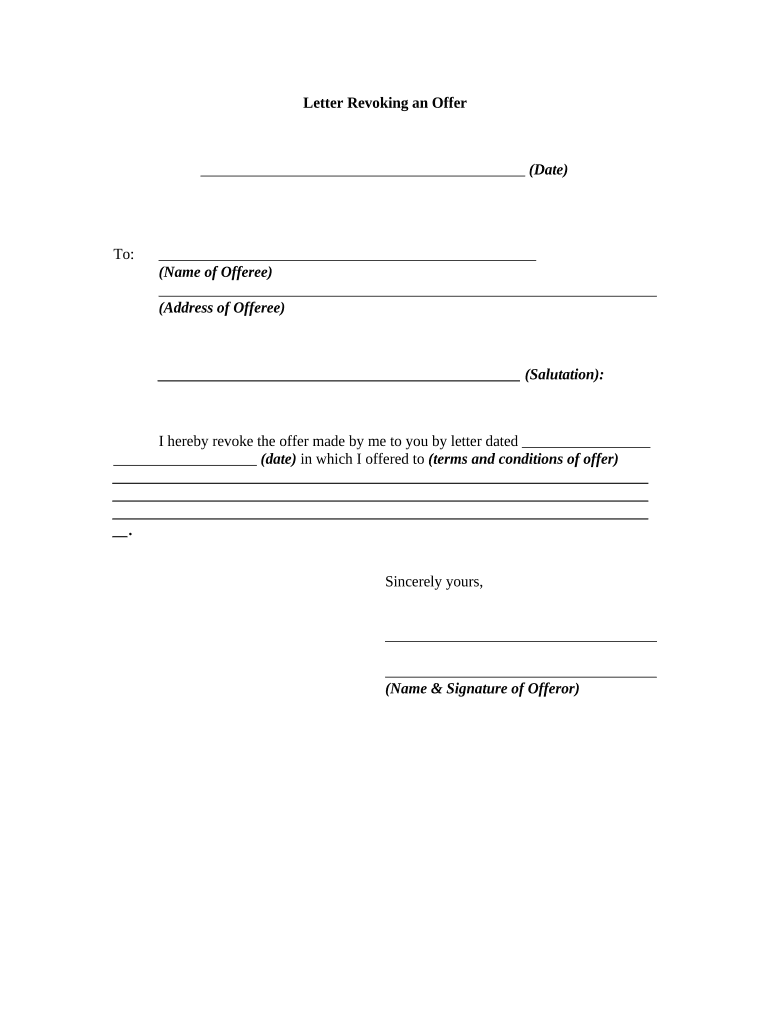
Letter Revoking an Offer
What a Letter Revoking an Offer Is and when it applies
Why a clear revocation letter matters
A concise, properly worded revocation protects the offeror by documenting intent, preventing misunderstandings, and reducing legal risk by addressing timing, conditions, and notice methods under applicable law.
Who typically issues or receives a revocation letter
Organizations and individuals use these letters whenever an outstanding offer must be withdrawn before acceptance; recipients may be job candidates, prospective buyers, or counterparties in transaction negotiations.
The document helps ensure both sides have a clear record of the withdrawal and the reasons behind it, minimizing dispute potential.
Key people involved
Offeror — Authorized Representative
Typically a hiring manager, business owner, sales agent, or contracting officer. This person must have authority to make and revoke offers under company policy or delegation of authority; include title and contact details in the letter to avoid disputes.
Offeree — Recipient
The individual or entity to whom the offer was extended. Use the exact legal name and contact information for the offeree to ensure the revocation reaches and is attributable to the correct party.
Step-by-step: preparing and sending the revocation
-
01Confirm authority: Verify the signer has authority to revoke the offer under company policy or contract.
-
02Reference the original offer: Cite the original offer date and any identifying details so it is clear which offer is being revoked.
-
03State the reason and effective date: Provide a concise factual reason and the date the revocation takes effect.
-
04Choose delivery method: Send via email with delivery/read receipt, certified mail, personal delivery, or eSignature platform to create an audit trail.
How the revocation process typically flows
-
Draft Letter: Prepare a concise written notice referencing the original offer and reasons for withdrawal.
-
Review Authority: Confirm legal and HR or sales approvals as required by internal policy.
-
Deliver Notice: Use an evidence-producing method (eSignature with audit trail, certified mail, or email read receipt).
-
Retain Record: Store the signed notice and delivery proof in the organization’s records for retention compliance.
Configuring an online revocation workflow
| Field | Configuration |
|---|---|
| Signer Role | Offeror — required signer with title verification |
| Authentication | Email link plus optional SMS code or SSO for higher assurance |
| Attachments | Include original offer and supporting documents as referenced exhibits |
| Audit Options | Enable timestamp, IP capture, and certificate of completion |
Technical considerations for eSubmission and eSignature
Choose a platform that provides an audit trail, strong authentication, and secure storage to support enforceability and recordkeeping.
- Document formats: PDF or DOCX accepted; ensure the platform preserves exact final PDF for the audit trail
- Integrations: Connect with cloud storage and HR or CRM systems (Salesforce, Microsoft 365, NetSuite) for automated record retention
- Security: Use TLS encrypted transport and AES-256 at-rest storage for protected delivery
Strong platform controls reduce disputes by proving who signed, when, and how the notice was delivered; choose options that match the legal risk and sensitivity of the transaction.
Timing: deadlines and effective dates to watch
Effective Date:
State exact MM/DD/YYYY when the revocation takes effect
Receipt Considerations:
A revocation sent but not received may still be ineffective if acceptance occurs prior to receipt
Employment Offers:
Revocation before an offeree's signed acceptance is typically effective; document delivery time
Real Estate Offers:
State any contract contingencies and whether revocation withdraws the offer or terminates negotiations
Regulatory Notices:
Certain consumer or statutory notices may have specific timing rules; verify applicable statutes
Key milestones from offer to formal revocation
Offer Extended
Original offer is communicated and documented in writing.
Conditions Monitored
Track any conditions (background check, financing) tied to the offer.
Decision to Revoke
Authorized representative confirms revocation and reason.
Notice Delivered
Send the revocation via chosen method and retain delivery evidence.
Common mistakes to avoid
- Using vague or emotional language that invites dispute rather than stating objective facts
- Failing to reference the original offer’s date or identifying details, creating ambiguity
- Not confirming signer authority under internal policies or delegation rules
- Delivering notice by informal means without obtaining proof of receipt or an audit trail
Risks and potential consequences of an improper revocation
Practical examples of revocation scenarios
Employment Revocation
A company rescinded a conditional job offer after an untimely background check failure
- The employer cited the contingency and effective date
- The notice was sent by eSignature with audit trail and stored in HR records to support later inquiries and avoid misunderstanding.
Real Estate Offer Withdrawal
A seller withdrew a purchase offer when the buyer’s lender failed to confirm financing
- The seller referenced the original offer date and financing contingency
- The withdrawal was delivered via certified mail and email, with copies retained electronically to document the timing and justification.
Practical tips for a defensible revocation letter
eSignature vendor comparison for issuing revocations
| signNow | DocuSign | Adobe Sign | PandaDoc | HelloSign | |
|---|---|---|---|---|---|
| Starting Price | $8/user/mo | $15/user/mo | $14/user/mo | $19/user/mo | $15/user/mo |
| Free Trial | 7-day free trial | Yes, trial | Yes, trial | Yes, trial | Yes, trial |
| Bulk Send | Yes | Yes | Yes | Yes | No |
| Audit Trail | Yes | Yes | Yes | Yes | Yes |
| HIPAA Compliant | Yes | Yes | Yes | No | No |
FAQs and troubleshooting for revoking an offer
-
When is a revocation effective?
A revocation is generally effective when received by the offeree unless the offer or applicable law specifies a different method or timing; document delivery and retention proof to establish timing.
-
Can I revoke after acceptance?
Once a valid acceptance is communicated and the parties form a binding contract, unilateral revocation is usually ineffective and may lead to breach claims; consult legal counsel before attempting to revoke after acceptance.
-
Is an electronic revocation valid?
Yes—electronic revocations can be legally valid if they meet ESIGN/UETA criteria: clear intent to sign, consent to electronic records, attribution, and reliable retention.
-
Should I notarize a revocation?
Notarization is rarely required for simple purchase or employment revocations but may be necessary in certain real estate or statutory contexts; follow state rules where applicable.
-
What delivery method is safest?
Use a method that produces verifiable proof—eSignature audit trail, certified mail with return receipt, or courier—so you can demonstrate when the offeree received notice.
-
Do I need an attorney to send a revocation?
Simple revocations often do not require an attorney, but obtain counsel when the revocation may trigger regulatory issues, discrimination risk, or exposure to contract or employment claims.