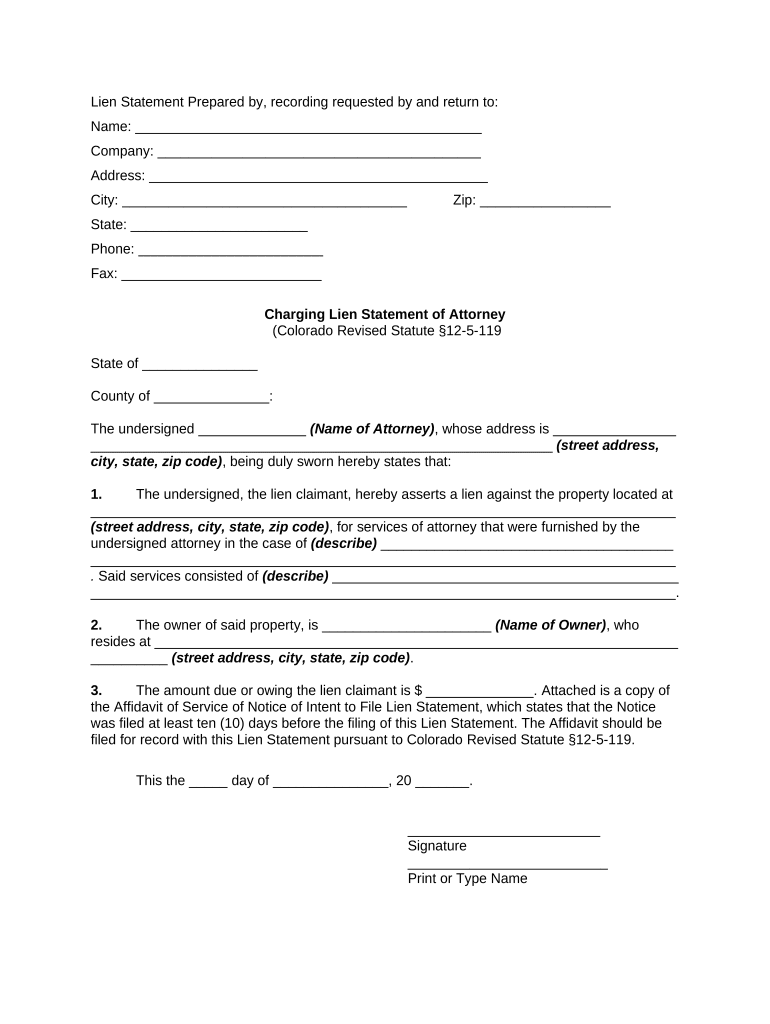
Colorado Lien Statement
What a Colorado Lien Statement Is and when it applies
Why the Colorado Lien Statement matters for claimants and owners
A correctly completed lien statement preserves a claimant’s statutory remedy to enforce payment while providing owners and lenders notice of an encumbrance. It helps preserve priority, supports negotiations, and provides a clear administrative path to resolve payment disputes under Colorado mechanics’ lien rules.
Typical users and roles for a Colorado Lien Statement
These groups rely on accurate statements, proper service, and timely filing to preserve legal rights and avoid costly disputes.
- General contractors protecting unpaid balances and establishing lien priority on improved property.
- Subcontractors and suppliers who provided labor or materials but lack direct payment from the owner.
- Title companies, lenders, and attorneys monitoring or responding to recorded encumbrances during closing or litigation.
Representative signer profiles
General Contractor
A licensed contractor who contracted directly with the property owner or acted as prime on a project; typically files when subcontractors are unpaid or to preserve priority. The contractor must supply accurate contract dates, property legal description, and total amount claimed to avoid procedural defects.
Subcontractor / Supplier
A trade contractor or materials supplier without a direct contract with the owner who supplied labor or materials; files to protect payment rights under statutory lien provisions. Proper service to the owner and prime contractor is frequently required by statute.
Consequences of errors or missed requirements
Common preparation mistakes to avoid
- Using an informal or incomplete property description that fails to match public records and causes recording delays or rejection.
- Submitting a claim with the wrong claimant name, e.g., trade name instead of legal entity, leading to challenges on standing.
- Failing to serve required parties or to document service properly, which can result in a procedural defeat of the claim.
- Relying on handwritten totals or unclear calculations rather than a clear, itemized claim amount tied to invoices or change orders.
Step-by-step: completing a Colorado Lien Statement
-
01Gather documents: Collect contracts, invoices, and delivery tickets.
-
02Complete form: Enter claimant, property, dates, and amounts.
-
03Authenticate: Sign and notarize if required.
-
04File and serve: Record with county and serve required parties.
Overview: filing and notice workflow
-
Prepare the statement: Assemble data and supporting invoices.
-
Sign and notarize: Execute with claimant signature and notary when needed.
-
Record with county: Submit to the county clerk and recorder.
-
Serve notice: Serve owner, lender, and primary contractor.
Typical online setup for preparing and routing
| Field | Configuration |
|---|---|
| Property Description | Auto-format to match county records |
| Signature Type | Electronic signature or wet ink |
| Authentication | Email, SMS code, or RON |
| Document Storage | PDF/A with audit trail |
Digital tools and integrations that help
These capabilities lower rework risk, simplify notarization, and preserve an auditable trail of delivery and signature events.
- File formats: PDF and DOCX supported
- Integrations: CRM, accounting, and cloud storage
- Authentication: Email, SMS, or RON options
eSignature vendor comparison for preparing and signing lien statements
| signNow | DocuSign | Adobe Sign | PandaDoc | HelloSign | |
|---|---|---|---|---|---|
| Starting Price | $8/user/mo | $15/user/mo | $14/user/mo | $19/user/mo | $15/user/mo |
| Free Trial | 7-day free trial | Varies | Varies | Varies | Varies |
| Bulk Send | Yes | Yes | Yes | Yes | Yes |
| Audit Trail | Yes | Yes | Yes | Yes | Yes |
| Envelope Cap | No cap | 100 envelopes/user/year | Varies | Varies | Varies |
Real-world examples of how teams used digital tools for lien work
Martin Properties — Tim Martin
Tim Martin processed lien-related paperwork entirely online to maintain compliance and speed.
- He emphasized mobile and offline signing.
- I can process and execute all of these documents online with 100% compliance and built-in security. Whether on mobile or working offline, I can get forms back to their necessary parties efficiently.
Optica Ventures — Brian Fitzgibbons
Optica streamlined claim documentation and signatures to reduce turnaround time.
- The interface simplified customer interactions.
- The interface is simple and easy-to-use for our team; more importantly, it is just as easy for our customers.
Practical tips to improve accuracy and reduce rework
Typical timing considerations and filing windows
Filing window after final work:
Often 60–120 days after completion; varies by state and project type
Priority calculation:
Priority usually relates back to a statutory date or notice to owner
Service timing:
Service may need to occur before or at filing; follow statutory sequence
Extension or tolling:
Bankruptcy or dispute may toll filing deadlines in specific circumstances
Recording backlog:
Allow extra time for county processing and indexing
Frequently asked questions about Colorado Lien Statements
-
Where do I record the statement?
Record the lien statement in the county where the affected property is located, typically with the county clerk and recorder. Contact the county office for format and fee details before submission.
-
Can the statement be signed electronically?
Electronic signatures are generally enforceable under the federal ESIGN Act (15 U.S.C. ch. 96) and state UETA rules where adopted. Confirm local recording office acceptance and any notarization or RON requirements.
-
Is notarization always required?
Notarization requirements vary by jurisdiction and by the type of lien claim; some counties accept notarized statements or require acknowledgements. Check local rules or county guidance before filing.
-
What if I filed incorrect information?
If material errors exist, prepare and record an amended statement or affidavit correcting the error and serve affected parties. Timing and permissible corrections depend on local rules and should be coordinated with counsel.
-
How do I revoke or release a lien?
A claimant can record and serve a release or satisfaction document once the debt is paid or resolved. Forms and procedure vary by county and should reference the recorded lien instrument.
-
When should I get legal advice?
Consult an attorney before filing if amounts are disputed, if multiple claimants exist, or when enforcement (foreclosure) is contemplated; legal review helps avoid procedural defects.