Establishing secure connection…Loading editor…Preparing document…

Resolution of Members of Limited Liability Company

This template is fully customizable. Edit the text, fill out the fields, and send it for signature. Give it a try!
Resolution of Members of Limited Liability Company

What a Resolution of Members of Limited Liability Company Is

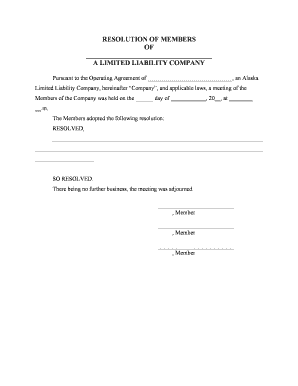
A Resolution of Members of Limited Liability Company is a formal written record of one or more members’ decision to authorize specified actions on behalf of the LLC, such as opening bank accounts, entering contracts, approving loans, appointing officers, or transferring property. The resolution identifies the action, scope, effective date, and authorized signers, and when executed becomes part of the company’s minute book. Third parties and regulators rely on the resolution to verify member authority and to document internal corporate decision-making.

Why a Member Resolution Matters for Your LLC

Use a member resolution to establish clear authority, reduce disputes, and satisfy third-party requirements such as bank or vendor documentation. Resolutions provide a concise, auditable record that clarifies who may act on behalf of the LLC and under what conditions.

Why a Member Resolution Matters for Your LLC

Who Prepares and Relies on Member Resolutions

Typical users who prepare or rely on a Resolution of Members include members, managers, and corporate officers needing authorized action on behalf of the LLC.

  • LLC members and managing members — draft, approve, and sign member resolutions for major company actions.
  • Banks and financial institutions often request a certified resolution when opening accounts or authorizing signatories.
  • Attorneys and accountants use resolutions as evidence of authority for filings, tax elections, and contractual obligations.

Core Elements to Include in a Professional Member Resolution

Include components that identify the action, who authorized it, its limits, and how third parties can rely on the authorization.

Authorization Details

Specify the exact action approved (for example, open a bank account or execute a lease), any monetary or temporal limits, and whether authority is conditional or subject to additional approvals.
Effective Date

State the effective date in MM/DD/YYYY format and indicate whether authority is immediate, retroactive, or contingent on subsequent events to avoid ambiguity.

Member Signatures

List each approving member’s printed name, signature, title, and date; document voting results or unanimous consent as required by the operating agreement.

Scope of Authority

Describe permitted transactions, account details, signing limits, and whether authority is sole, joint, or subject to prior managerial review.

Recordkeeping

State where originals and certified copies will be held (minute book, custodian) and note who is authorized to certify copies for third-party reliance.

Certification Clause

Include a signed certification by an officer or manager confirming the resolution was adopted according to the operating agreement and state law.

Security and Compliance Considerations

Encryption: AES-256 encryption at rest and TLS in transit.
Access Controls: Role-based access controls and MFA.
Audit Trail: Timestamps, IP, and action log.
HIPAA Protections: BAA required for PHI workflows.
Storage Location: Cloud with SOC 2 and ISO 27001.
Retention Policy: Retention schedule with version history.

Step-by-Step: Create and Execute a Member Resolution

Follow these steps to prepare, authorize, and distribute a member resolution correctly and efficiently today.

  • 01
    Draft: Draft clear resolution language describing action and limits.
  • 02
    Confirm Authority: Verify signatory authority per the operating agreement.
  • 03
    Sign and Date: Obtain wet or electronic signatures with matching printed names.
  • 04
    Distribute: Provide certified copies to banks, counsel, and company records.

Online Workflow Settings for Completing Resolutions

Configure document and signer settings to match your compliance and audit requirements before sending for signature.

Field Configuration
File Type PDF (flattened)
Signer Authentication Email link or SMS code
Certificate Audit trail with timestamp and IP
Storage Encrypted cloud storage, SOC 2/ISO 27001

How Document Routing Typically Works

Typical routing for a member resolution includes preparation, signer authentication, execution, and certified distribution to stakeholders.

  • Prepare: Upload document and place signature and date fields.
  • Authenticate: Choose email, SMS, or KBA authentication as required.
  • Execute: Signer reviews and applies electronic or wet signature.
  • Certify: Issue certified copies and save original in minute book.

Platform Requirements for eSigning and Recordkeeping

Choose a platform that supports PDF, DOCX imports, audit trails, and common integrations for reliable execution.

  • Supported Formats: PDF, DOCX, HTML, Excel
  • Integrations: Salesforce, NetSuite, Microsoft 365
  • Authentication: Email, SMS, SSO options

Penalties and Risks of an Incorrect or Deficient Resolution

Bank Refusal: Bank may decline unsigned or uncertified resolutions.
Invalid Authority: Action may be void if signer lacked authority.
Tax Consequences: Incorrect dates affect reporting and deductions.
Litigation Risk: Disputes over authority may lead to lawsuits.
Regulatory Noncompliance: Fines for improperly documented actions.
Notarization Issues: Banks sometimes require notarized certification.

Common Preparation Mistakes to Avoid

  • Using inconsistent entity or member names between the resolution, articles, and bank forms causes delays and may trigger identity verification failures.
  • Omitting required member signatures, incorrect dates, or unsigned certification blocks are common errors that undermine enforceability and delay acceptance.
  • Assuming a bank accepts an unsigned or non-certified copy without prior confirmation frequently leads to rejected transactions and wasted administrative effort.
  • Drafting vague or perpetual authority without measurable limits can expose the LLC to unauthorized commitments and complicate future reversals.

Practical Tips to Ensure a Reliable Member Resolution

Adopt consistent practices when creating and issuing member resolutions to reduce disputes and ensure quick acceptance by third parties.

Ensure consistency with operating agreement
Confirm the operating agreement's approval thresholds and reference the specific sections authorizing the action; if the operating agreement requires a vote, document the vote tally and include it in the resolution record.
Use precise monetary limits and conditions
Specify exact dollar limits, authorized accounts, and any multi-signature requirements; avoid vague terms like 'reasonable amount' that create ambiguity for banks and auditors.
Provide certified copies to banks and vendors
Deliver a certified copy on company letterhead with a certifier signature; ask the receiving institution whether they require notarization or an original.
Maintain and index minute book originals
Keep the original signed resolution in the LLC minute book, note its filing location, and track distribution of certified copies for compliance evidence and internal audits.

Typical Roles Involved with Member Resolutions

Managing Member

A managing member typically drafts and signs resolutions to authorize day-to-day and strategic transactions; they should confirm operating agreement procedures, record votes, and ensure certified copies are provided to banks and counsel.

Bank Officer

A bank officer reviews the resolution to accept signatories and may require certified or notarized copies, specimen signatures, or additional bank forms before opening accounts or authorizing wire transfers.

Timing Considerations and When to Distribute the Resolution

Key timing points affect when a resolution takes effect and when third parties should receive certified copies.

Effective Date and Time:

Resolution takes effect as of the stated date/time.

Bank Processing Window:

Banks typically process within 3–10 business days.

State Filing Deadlines:

If tied to amendments, file per state deadlines.

Distribution to Parties:

Provide certified copies promptly after execution.

Record Retention Start:

Retention begins on execution date or effective date.

Frequently Asked Questions About Member Resolutions

Common questions about member resolutions focus on signature authority, electronic signing, notarization, revocation, and third-party acceptance.


Need help? Contact support

eSignature Vendor Pricing and Capabilities for Member Resolutions

Compare baseline pricing and key capabilities across vendors; signNow is listed first per table requirements and includes core eSignature features and compliance support.

signNow DocuSign Adobe Sign PandaDoc HelloSign
Starting Price $8/user/mo $15/user/mo $14/user/mo $19/user/mo $15/user/mo
Free Trial 7-day trial Varies by plan Varies by plan Varies by plan Varies by plan
Bulk Send Yes Yes Yes Yes No
Audit Trail Yes Yes Yes Yes Yes
HIPAA Compliant Yes Yes Yes No No
Envelope Cap No cap 100 envelopes/user/year Varies by plan Varies by plan Varies by plan
be ready to get more
Join over 28 million airSlate SignNow users