Establishing secure connection…Loading editor…Preparing document…

Oklahoma Discrimination Complaint - Client or Vendor

This template is fully customizable. Edit the text, fill out the fields, and send it for signature. Give it a try!
Oklahoma Discrimination Complaint - Client or Vendor

What this Oklahoma Discrimination Complaint form is and when to use it

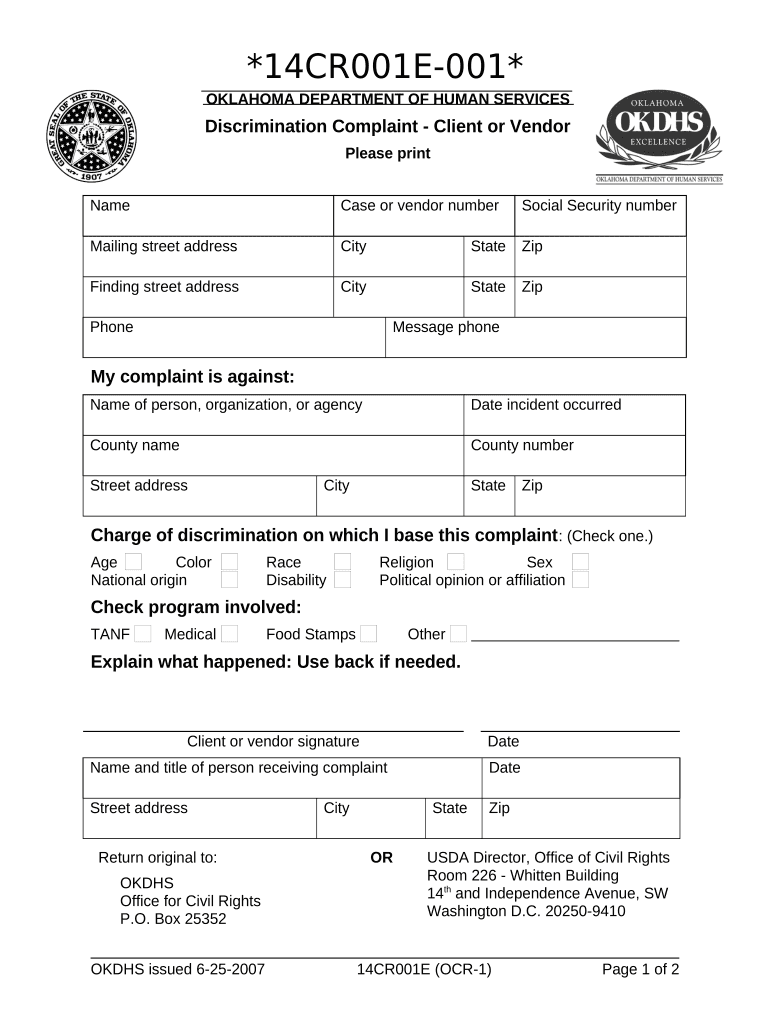
The Oklahoma Discrimination Complaint — Client or Vendor is a standardized written complaint used to report alleged discrimination arising from a commercial or client relationship, or from vendor interactions, to a relevant investigator or administrative agency. It collects party details, factual allegations, dates, locations, bases for the claim (race, sex, disability, etc.), and requested remedies. The form is used by individuals and organizational representatives who want a formal record that initiates an administrative review or supports subsequent legal steps under state or federal anti‑discrimination laws.

Why completing a clear complaint matters

A properly completed complaint preserves facts and triggers an administrative or investigatory process that can lead to remedies, mediation, or evidence preservation. Clear, dated allegations and supporting documents improve the likelihood of timely review and prevent procedural dismissals.

Why completing a clear complaint matters

Who typically files this complaint and why it matters

Use this form if you are an individual, in-house counsel, HR representative, or vendor liaison reporting discriminatory treatment in a client-vendor context.

  • Individual claimants seeking a formal record and agency investigation into discriminatory acts or practices.
  • Company HR or compliance officers documenting an external complaint for mitigation and vendor oversight.
  • Outside counsel or advocacy organizations preparing a complaint to preserve facts for administrative or civil action.

Accurate completion helps agencies route the matter correctly and supports timely collection of evidence, witness statements, and any remedies sought.

Core parts of a professional Oklahoma Discrimination Complaint

A clear complaint contains the minimum structural elements investigators expect; each section helps establish jurisdiction, identity, chronology, and relief sought.

Complaint Header

Case title and contact fields for the complainant and respondent; includes mailing address, phone, and email so investigators can confirm jurisdiction and notify parties.
Jurisdiction Statement

Identify whether the claim is filed under federal law, state law, or both; list the agency or court intended to receive the complaint and any concurrent filings.

Factual Allegations

A chronological narrative of incidents with dates, locations, names of involved persons, and specific conduct that is alleged to be discriminatory.

Protected Basis

State the protected characteristic(s) implicated (for example race, sex, disability, age) and explain how actions targeted that characteristic.

Remedy Requested

Specify relief sought (investigation, corrective action, damages, injunctive relief, policy change) and any interim protections requested.

Attachments

List supporting documents (emails, contracts, invoices, communications, photos) and identify witnesses or other corroborating evidence.

Step-by-step: preparing and filing the complaint

Follow this sequence to assemble, sign, and submit a complaint that can be readily reviewed by investigators.

  • 01
    Gather Evidence: Collect emails, invoices, contracts, and witness names supporting each allegation.
  • 02
    Draft Narrative: Write a clear chronological statement of events with dates and locations.
  • 03
    Attach Documents: Label and reference attachments inside the complaint for easy review.
  • 04
    Submit to Agency: File with the appropriate state or federal agency and retain proof of submission.

Overview of the submission and review flow

This flow describes typical routing from complaint submission to initial agency response and potential next steps.

  • Submit Complaint: File with the receiving agency or office in the correct jurisdiction.
  • Intake Review: Agency confirms jurisdiction and completeness of the submission.
  • Investigation: Agency may request documents, interview witnesses, or mediate.
  • Determination: Agency issues findings and recommends remedies or closure.

Configuring an online workflow for this complaint

Use a consistent electronic workflow to collect, authenticate, and store complaint records for agency submission and internal tracking.

Field Configuration
Complainant Contact Required; validated email and phone
Document Upload Allow PDF, DOCX; max 25 MB per file
Signer Authentication Email link or SMS code; stronger methods optional
Audit Trail Enable timestamps, IP logging, and downloadable certificate

Digital submission and technical considerations

Choose a platform that supports reliable eSignature, secure storage, and a full audit trail compatible with agency requirements.

  • File formats: Accept PDF and DOCX for fidelity
  • Security: TLS 1.2/1.3 in transit; AES-256 at rest
  • Integrations: Connectors to cloud storage and case tracking

Ensure the platform can export a signed PDF with an audit certificate and supports retention and access controls for compliance.

Key timelines and response expectations

File promptly and retain proof of transmission; agencies and courts often impose strict deadlines for administrative charges and appeals.

Initial Filing:

Submit as soon as possible after the alleged incident to preserve rights

Agency Intake Response:

Expect an initial acknowledgement within a few weeks

Investigation Period:

Investigation timing varies by caseload and complexity

Mediation or Conciliation:

May be offered before formal determination

Appeals or Civil Action:

Follow statutory windows; missing them can forfeit remedies

Risks of an incomplete or incorrect complaint

Missed Deadline: Loss of filing rights
Insufficient Facts: Agency dismissal risk
Incorrect Party: Misrouted investigation
Missing Evidence: Weakened legal position
Unauthorized Disclosure: Privacy and compliance exposure
Unsigned Form: Rejection or delay

Common mistakes to avoid when preparing a discrimination complaint

  • Providing vague timelines or unspecified locations, which makes corroboration difficult and slows agency intake.
  • Failing to attach supporting communications or documents that directly reference the disputed conduct or decision.
  • Using legal conclusions without factual support; investigators and reviewers expect concrete examples and witness identifiers.
  • Submitting unsigned or undated complaints, or using inconsistent names across attachments and filings, which can trigger administrative rejection.

Comparison: eSignature providers for submitting and signing complaint documents

Selection criteria include price, bulk send, audit capabilities, HIPAA support, and any envelope limits; signNow is listed first per comparison requirements.

signNow DocuSign Adobe Sign PandaDoc HelloSign
Starting Price $8/user/mo $15/user/mo $14/user/mo $19/user/mo $15/user/mo
Free Trial 7-day trial Varies Varies Varies Varies
Bulk Send Yes Yes Yes Yes Varies
Audit Trail Yes Yes Yes Yes Yes
HIPAA Compliant Yes Yes Yes No No
Envelope Cap No cap 100 envelopes/user/year Varies Varies Varies

Real-world examples of digital complaint workflows

These customer examples show how organizations preserved evidence, collected signatures, and tracked submissions using an eSignature platform.

Optica Ventures — COO

The company streamlined customer signatures using signNow across mobile and desktop.

  • Interface was simple and easy for customers.
  • Brian Fitzgibbons, COO, said the interface is simple and easy to use for their team and for customers, improving response rates and document return times.

Tech Data — CEO

Tech Data centralized external and internal forms for faster processing.

  • Faster contract turnaround.
  • Bob Dutkowsky, CEO, noted airSlate SignNow improved internal and external customer service while increasing speed to revenue through streamlined eSignature workflows.

Frequently asked questions about filing an Oklahoma discrimination complaint

Answers address common procedural and technical questions about completing, signing, and submitting this complaint form to agencies or investigators.


Need help? Contact support

be ready to get more
Join over 28 million airSlate SignNow users