Establishing secure connection…Loading editor…Preparing document…

Limited Liability Partnership Agreement

This template is fully customizable. Edit the text, fill out the fields, and send it for signature. Give it a try!
Limited Liability Partnership Agreement

What a Limited Liability Partnership Agreement Is

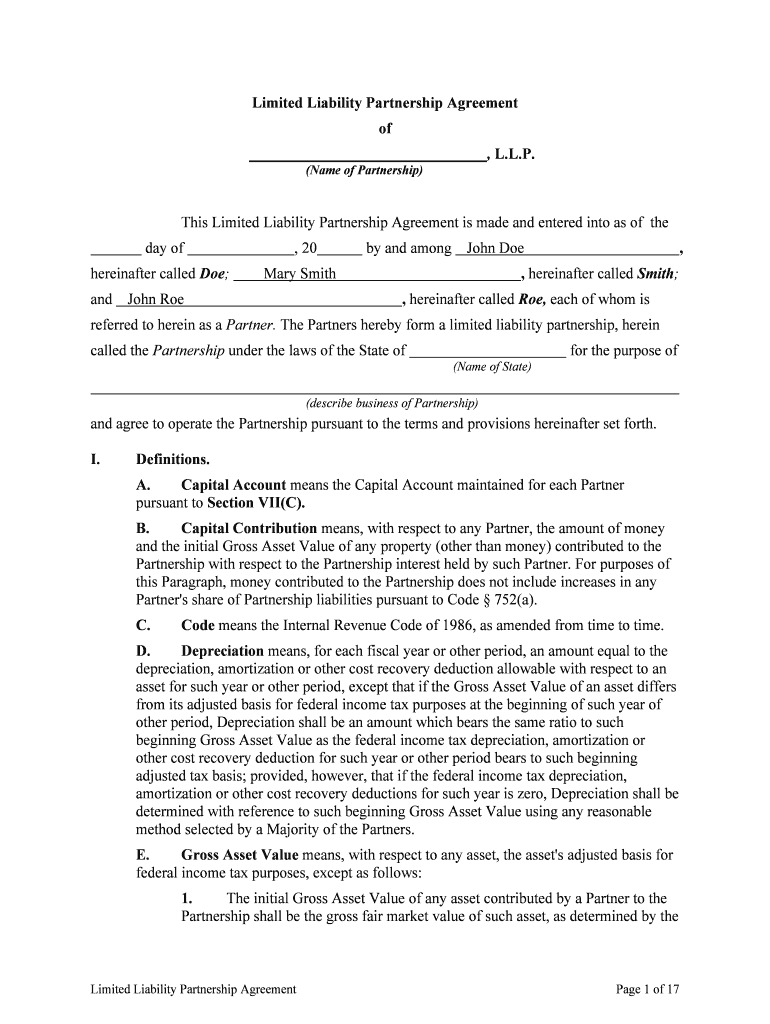
A Limited Liability Partnership Agreement is a legally binding contract among partners that sets out the partnership's name, purpose, capital contributions, management structure, voting rules, profit and loss allocation, admission and withdrawal procedures, and dissolution terms. The agreement governs internal rights and obligations and supports the liability protections available under state LLP statutes. While formation and registration are handled with the Secretary of State where required, the partnership agreement is usually maintained with the partnership's records and is the primary reference for resolving internal disputes and enforcing partner responsibilities.

Why a Clear LLP Agreement Matters

A written LLP Agreement reduces ambiguity about authority, financial duties, and exit terms, supports limited liability protections, clarifies tax treatment, and creates predictable dispute-resolution and amendment processes for current and incoming partners.

Why a Clear LLP Agreement Matters

Who Typically Prepares and Uses an LLP Agreement

Lead partners, legal counsel, and accountants commonly prepare or review the agreement before partners sign.

  • Law firms and professional practices preparing role-based governance and ethical compliance provisions.
  • Accounting and tax advisors ensuring allocations and reporting align with IRS rules and partnership taxation.
  • Business owners and partners documenting contributions, decision authority, and exit processes for continuity.

Primary Roles Involved

Managing Partner

Typically the partner responsible for day-to-day operations, contract execution, and implementing governance; the agreement should specify authority limits and reporting obligations in detail to avoid disputes.

Corporate Counsel

Lawyers or outside counsel review statutory compliance, draft amendment procedures, and advise on liability protections, tax impact, and state filing consequences to ensure enforceability.

Step-by-Step: Completing the Agreement

Follow these sequential steps to prepare, review, and finalize the LLP Agreement correctly.

  • 01
    Draft Core Terms: Define name, purpose, capital, governance, and distributions.
  • 02
    Allocate Tax Items: Confirm profit/loss allocations and tax reporting approach with accountant.
  • 03
    Review and Revise: Have counsel check statutory compliance and conflict rules.
  • 04
    Execute and Store: Obtain signatures, retain originals, and distribute executed copies to partners.

How to Configure an Online Signing Workflow

Set up a clear, auditable workflow for signature routing, authentication, and retention when using digital tools.

Field Mapping Map signature, date, and initial fields to each partner.
Authentication Level Select email link, SMS code, or two-factor authentication.
Template Naming Use a consistent template name for version control.
Reminder Schedule Set automatic reminders and expirations for signers.
Retention Policy Configure secure storage and audit trail retention durations.

Digital Signing and Integration Considerations

Choose a platform that supports legal e-signature standards, audit trails, and the integrations you need.

  • Authentication Options: Email, SMS code, or advanced 2FA
  • Integrations: CRM, document storage, and accounting
  • Format Support: PDF, DOCX, and audit logs

Ensure the platform can produce a verifiable certificate of completion and meets any industry compliance (for example, HIPAA if PHI is involved).

Where to Keep and Where to Send Signed Agreements

Signed LLP Agreements should be retained by the partnership and shared with parties who have ongoing rights or obligations under the contract.

  • Partnership Records: Keep original signed agreement in official partnership file.
  • Registered Agent: Provide a copy if the agent requires it for registration.
  • Partners: Distribute executed copies to all partners for their records.
  • Tax Advisors: Send copy to accountant for tax filing and recordkeeping.

Core Provisions to Include in the Agreement

Ensure the agreement addresses governance, money matters, decision rules, liability limitations, transfer restrictions, and exit/dissolution processes in clear, enforceable terms.

Partnership Purpose

Describe the primary business activities, permissible secondary activities, and any restrictions to prevent scope disputes or unauthorized ventures by partners.
Capital Contributions

Detail initial contributions, valuation of noncash assets, timelines for additional funding, and remedies for shortfalls or defaulting contributors.

Profit and Loss Allocation

Specify allocation percentages or formulas, tax allocation rules versus cash distributions, and procedures for interim and year-end distributions.

Management and Voting

Define management roles, ordinary-course decision thresholds, special-majority votes for major actions, and procedures for appointing managers or committees.

Transfer Restrictions

Include restrictions on assignment, right of first refusal, buy-sell triggers, and approval mechanics for admitting new partners.

Dissolution and Exit

Set out voluntary and involuntary dissolution processes, winding-up steps, asset distribution order, and valuation methodology for departing partners.

File Formats, Supporting Documents, and Version Control

Choose standard formats and store companion records with the agreement so the partnership has a complete, auditable contract history.

Export Formats

Save executed agreements as PDF/A for long-term preservation; retain a DOCX master copy for controlled edits and template updates.

Primary Exhibits

Attach schedules for capital accounts, partner contact information, and contributed-asset descriptions as numbered exhibits to avoid confusion.

Ancillary Documents

Keep registration certificates, tax elections, buy-sell agreements, and consent waivers with the agreement for a complete record.

Versioning and Audit

Record amendment dates, editor identities, and provide an audit trail showing each executed version and its effective date.

Timing Considerations and Common Deadlines

Plan for effective dates, tax reporting, registration windows, and notice periods when preparing and executing the agreement.

Effective Date:

Agreement becomes operative on the chosen MM/DD/YYYY effective date.

Tax Elections:

File any partnership tax elections per IRS timeline for the tax year.

State Registration:

Complete required filings with the Secretary of State within state-prescribed windows.

Amendment Notice Period:

Observe any notice periods for partner votes on material amendments.

Annual Filings:

Maintain any required annual reports and franchise tax filings per state schedule.

Key Formation and Post-Formation Milestones

Track formation and post-formation steps to keep legal status and records current.

01

Draft and Approve

Partners negotiate and approve the initial agreement terms.

02

Execution

All partners sign on the effective date to bind the partnership.

03

Register (If Required)

File any registration documents with the state to obtain LLP status.

04

Store and Distribute

Retain originals and distribute signed copies to partners and advisors.

Common Preparation Mistakes to Avoid

  • Using informal or inconsistent names for partners, causing identity and tax-reporting mismatches.
  • Failing to specify valuation methods for contributed assets, which can lead to disputes on capital accounts.
  • Overlooking required state registration or relying on a draft agreement without final signatures.
  • Neglecting amendment procedures, leaving the partnership unable to adapt to new partners or changed circumstances.

Risks and Consequences of Incomplete or Incorrect Agreements

Enforceability Risk: Ambiguous terms may be unenforceable.
Tax Exposure: Incorrect allocations can trigger IRS adjustments.
Liability Exposure: Poor documentation may weaken liability protections.
State Penalties: Late filings can incur state fines.
Partner Disputes: Undefined exit rules create litigation risk.
Recordkeeping Deficit: Missing originals impede audits and transfers.

Realistic Use Cases for an LLP Agreement

These examples show how agreements are tailored for governance, liability protection, and partner transitions.

Small Professional Firm

A three-partner accounting practice formalized capital contributions and voting thresholds to avoid deadlock.

  • The agreement set a buyout formula and valuation method.
  • After implementation, partners reported fewer disputes and a clear process for admitting new partners.

Regional Consulting LLP

Five partners agreed on unequal profit shares tied to performance and client origination.

  • It included an annual reconciliation mechanism.
  • The structure aligned incentives and simplified year-end tax allocations and distributions.

How to Amend or Update the Agreement

Use a documented amendment process with clear notice, voting, and signature steps to ensure enforceability.

01

Propose Amendment:

Draft amendment text and circulate to partners.
02

Notice Period:

Provide required advance notice per agreement terms.
03

Partner Vote:

Conduct vote using specified thresholds.
04

Execute Amendment:

Obtain signatures from all required partners.
05

Record Version:

Attach amendment to the agreement as a dated exhibit.
06

Notify Third Parties:

Send updated copies to registered agent and advisors.

Practical Tips for Accurate and Efficient Completion

Apply consistent naming, consult counsel for state issues, and use clean electronic workflows to reduce delays and errors.

Use Exact Legal Names
Always match partner names and entity names to government records to prevent tax or title issues and to ensure enforceability.
Document Valuations
Record how contributed assets are valued and who performed the valuation to reduce later disputes over capital accounts.
Standardize Templates
Maintain a controlled template for the agreement and track version history to avoid contradictory language across copies.
Centralize Storage
Keep executed originals and electronic copies in a secure, auditable repository for fast retrieval and compliance.

Comparing eSignature Vendors for Executing an LLP Agreement

Basic capability comparisons and starting price points help evaluate eSignature options for preparing and executing partnership agreements.

signNow DocuSign Adobe Sign PandaDoc HelloSign
Starting Price $8/user/mo $15/user/mo $14/user/mo $19/user/mo $15/user/mo
Free Trial 7-day free trial Varies Varies Varies Varies
Bulk Send Yes Yes Yes Yes No
Audit Trail Yes Yes Yes Yes Yes
HIPAA Compliant Yes Yes Yes No No
Envelope Cap No cap 100 envelopes/user/year Varies Varies Varies

Frequently Asked Questions About LLP Agreements and eSignatures

Answers to common legal and practical questions about executing, amending, and storing Limited Liability Partnership Agreements.


Need help? Contact support

be ready to get more
Join over 28 million airSlate SignNow users