Establishing secure connection…Loading editor…Preparing document…

Louisiana Act Correction

This template is fully customizable. Edit the text, fill out the fields, and send it for signature. Give it a try!
Louisiana Act Correction

What the Louisiana Act Correction Is and When it Applies

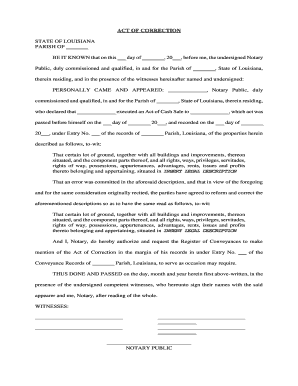
The Louisiana Act Correction is a written amendment or correction to an existing official act, record, or agreement executed under Louisiana law that clarifies, fixes typographical errors, or corrects factual mistakes without creating new substantive obligations. It is used to maintain an accurate public or private record and may be executed as an addendum, amendment, or sworn affidavit depending on the original document type and whether notarization or witness attestation is required by Louisiana civil law.

Why a Clear Correction Matters

A properly drafted Louisiana Act Correction reduces ambiguity, prevents disputes, and preserves the original intent of the parties while maintaining enforceability under state and federal e-signature laws.

Why a Clear Correction Matters

Who Typically Prepares and Signs a Louisiana Act Correction

Common users include parties to the original act, their attorneys, notaries public, and institutional record-keepers who must preserve legal accuracy.

  • Parties to the original act — individuals or entities that must approve factual changes or clarifications.
  • Attorneys and legal staff — draft corrections, confirm legal effect, and advise on notarization or witness needs.
  • Notaries public and record offices — authenticate signatures and file corrected records when required.

Core Elements to Include in a Professional Louisiana Act Correction

A corrective instrument should be concise, reference the original act, state the correction clearly, identify parties, and include required authentication to ensure enforceability.

Title

A precise title that references the original act by name, docket or instrument number, and original execution date to ensure clear linkage to the record being corrected.
Recital

A brief recital describing the original document, the reason for the correction, and a statement confirming that the correction does not create new obligations unless expressly stated.

Correction Text

A clear, redlined or bracketed statement showing the exact language to be removed or replaced and the corrected language in full to avoid ambiguity.

Effective Date

An explicit effective date for the correction, entered as MM/DD/YYYY when the timing affects rights or filing obligations.

Signatures

Signature blocks for all required signatories, with printed names, titles, dates, and notary or witness lines where Louisiana formalities demand them.

Filing Instructions

Clear instructions for where to file or record the corrected instrument and any supporting documents required by the registry or clerk.

Step-by-Step: Preparing and Executing a Louisiana Act Correction

Follow this compact sequence to prepare, authenticate, and file a correction while minimizing processing delays.

  • 01
    Review Original: Confirm instrument number, parties, and exact language to be corrected.
  • 02
    Draft Correction: Draft a concise correction referencing the original act and stating the precise change.
  • 03
    Authenticate: Arrange notarization or witness attestation in accordance with Louisiana formalities.
  • 04
    File or Record: Submit the correction to the appropriate recorder, clerk, or registry and obtain a stamped copy.

How to Configure a Digital Correction Workflow

Configure an online workflow to collect signatures, audit activity, and route the corrected instrument for filing.

Field Configuration
Document Template Create a reusable template with placeholders for original reference and corrected text.
Signer Order Set signing order to collect required party signatures before notarization.
Authentication Require multi-factor or ID verification where notarization or strong attribution is needed.
Audit Trail Enable full audit logging and attach certificate of completion to the final PDF.

Where to File and How Corrections Move Through Next Steps

After execution, the correction typically flows from signatories to authentication and then to the recording or administrative office. Follow local filing rules.

  • Signatories: Parties sign and date the correction document.
  • Notary or Witness: Notary or witnesses authenticate signatures as required.
  • Submit to Recorder: File with parish recorder, clerk, or agency that holds the original record.
  • Receive Filed Copy: Obtain stamped or recorded copy and distribute to interested parties.

Digital Signing and eSubmission Considerations

Electronic completion can speed execution but must meet legal and authentication requirements in Louisiana.

  • File Formats: PDF or DOCX
  • Integrations: Google Workspace, Microsoft 365, NetSuite
  • Auth Options: Email, SMS, or KBA

Timing: When to Execute and File a Correction

Certain corrections must be filed promptly to preserve legal rights, meet recording deadlines, or avoid tax and regulatory consequences.

Immediate Corrections:

Clerical errors that affect notice should be corrected and recorded as soon as discovered.

Tax-Related Timing:

Coordinate with tax filing deadlines to avoid reporting inconsistencies; consult an accountant before altering financial records.

Statute of Limitations:

Effective date can affect limitation periods; enter the correct effective date to avoid future disputes.

Agency Deadlines:

Some agencies impose explicit filing windows for amended records—verify with the receiving office.

Notary Scheduling:

Allow time to schedule notarization or remote online notarization if required.

Key Milestones from Draft to Recorded Correction

This milestone sequence tracks the typical lifecycle of a Louisiana Act Correction from initial review to final recording.

01

Draft Completed

Draft prepared and internal review completed before signatures are requested.

02

Signatures Collected

All parties add signatures and dates in the designated blocks.

03

Authentication Done

Notary and witness attestations obtained as required by Louisiana law.

04

Recordation Finalized

Corrected instrument filed and a recorded copy retrieved for all parties.

Common Mistakes to Avoid When Preparing a Correction

  • Referencing the wrong instrument number or date, which can cause the recorder to reject or misapply the correction.
  • Using vague language that appears to create new obligations rather than clarifying an existing provision.
  • Failing to obtain required notarization or witness signatures under Louisiana civil formalities, risking non-recordability.
  • Not distributing the recorded copy to taxpayers, registries, or other parties who rely on the corrected information.

Consequences of an Incorrect or Improperly Filed Correction

Recording Rejection: May be refused by the recorder.
Title Risk: Creates uncertainty in property title searches.
Regulatory Exposure: Can trigger agency inquiries or penalties.
Tax Reporting Errors: May cause mismatches with tax filings.
Litigation Risk: Could be contested in court if materially ambiguous.
Delay Costs: Additional legal and administrative expense.

Comparison: eSignature Vendor Pricing and Key Attributes

The table below summarizes starting prices and common attributes for representative eSignature vendors; signNow is listed first per platform comparisons.

signNow DocuSign Adobe Sign PandaDoc HelloSign
Starting Price $8/user/mo $15/user/mo $14/user/mo $19/user/mo $15/user/mo
Free Trial 7-day free trial Varies by vendor Varies by vendor Varies by vendor Varies by vendor
Bulk Send Yes Yes Yes Yes No
Audit Trail Yes Yes Yes Yes Yes
HIPAA Compliant Yes Yes Yes No No
Envelope Cap No cap 100 envelopes/user/year Varies by plan Varies by plan Varies by plan

Frequently Asked Questions About Louisiana Act Corrections

Answers to common practical questions about validity, authentication, and digital completion for corrections under Louisiana law.


Need help? Contact support

be ready to get more
Join over 28 million airSlate SignNow users