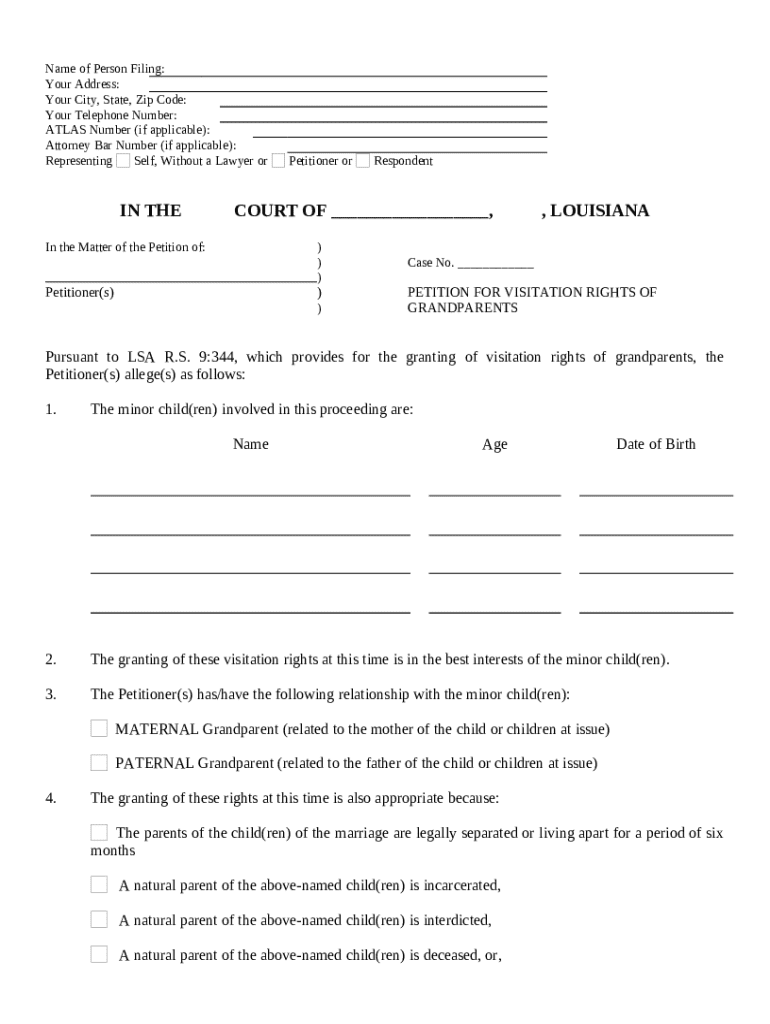
Louisiana Petition for Visitation Rights of Grandparents
What the Louisiana Petition for Visitation Rights of Grandparents Is
Why Filing This Petition Can Matter
A petition provides a legal pathway to preserve relationships and ask the court to set consistent visitation when informal requests fail. It creates enforceable terms and a record that protects grandparents’ access while centering the child’s welfare.
Who Typically Files and When It Makes Sense
Grandparents, legal guardians, or their counsel usually prepare this petition when informal contact has ended or access is disputed.
- Grandparent petitioners seeking regular, supervised, or limited visits after parental refusal
- Court-appointed guardians or custodians requesting defined contact terms
- Family law attorneys representing grandparents in contested visitation matters
Step-by-step: Preparing and Filing the Petition
-
01Gather Evidence: Collect IDs, birth certificates, photos, communication records.
-
02Complete Form: Fill the petition with factual statements and requested schedule.
-
03File with Court: Submit at the appropriate parish family or juvenile court clerk.
-
04Serve Respondent: Arrange legally required service of process and file proof.
Where the Petition Goes and the Court Process
-
Filing Location: Parish family or juvenile court clerk where the child resides.
-
Case Assignment: Clerk assigns a case number and judge for family matters.
-
Temporary Orders: Court may issue interim visitation or protective orders pending hearing.
-
Final Hearing: Judge hears evidence, considers best interest standard, issues final order.
How to Set Up an Online Filing and Signing Workflow
| Document Type | Court Petition PDF, exhibits, declarations |
|---|---|
| Signer Roles | Petitioner | Attorney | Notary (if required) |
| Authentication | Email verification | SMS code | ID upload as needed |
| Audit Capture | Timestamps, IP, and action history |
| Export Format | Flattened PDF with certificate of completion |
Digital Signing and eSubmission Considerations
Courts accept electronically prepared documents but verify local filing rules and whether e-signatures are permitted on specific family filings.
- Authentication: Email link, SMS code, or stronger ID verification
- Audit Trail: Capture IP, timestamp, and signer attribution
- File Formats: PDF/A or flattened PDF accepted by many courts
Common Preparation Pitfalls to Avoid
- Vague visitation requests that give courts no enforceable schedule
- Incorrect party names or missing child DOB causing jurisdictional issues
- Failure to attach proof of prior attempts at informal resolution
- Incomplete service of process leading to delays or dismissal
Risks of Filing Incorrect or Incomplete Petitions
Typical Timelines and What to Expect
Initial Processing:
Clerk assigns case number within days of filing
Service Period:
Respondent must be served per local rules; timing varies by server
Temporary Hearing:
Court may schedule temporary relief within 7–30 days
Final Hearing:
Hearing often scheduled 30–90 days after filing depending on docket
Appeal Window:
Post-judgment appeal deadlines vary; consult rules of civil procedure
Key Milestones from Filing to Final Order
File Petition
Submit completed petition and pay clerk fees
Serve Respondent
Arrange legally required service and file proof
Temporary Relief Hearing
Judge may set interim visitation or protective terms
Final Evidentiary Hearing
Judge hears testimony and issues final visitation order
Real-World Examples of Petition Use
Case Example 1
A grandparent filed after repeated denial of weekend visits following a parental separation.
- The petition included texts documenting denied handoffs.
- The court ordered supervised weekend access and referral to mediation to preserve the relationship while monitoring the child’s safety and stability.
Case Example 2
A petitioner sought visitation after the parent relocated out of parish without notice.
- The petition documented prior consistent contact and sudden relocation.
- The court considered jurisdiction, ordered interim virtual contact, and scheduled a hearing to evaluate travel logistics and long-term arrangements.
Practical Tips for Stronger Petitions
Comparing eSignature Options for Preparing and Signing Petitions
| signNow | DocuSign | Adobe Sign | PandaDoc | HelloSign | |
|---|---|---|---|---|---|
| Starting Price | $8/user/mo | $15/user/mo | $14/user/mo | $19/user/mo | $15/user/mo |
| Free Trial | 7-day free trial, no credit card | Varies by plan | Varies by plan | Free trial available | Free trial available |
| Bulk Send | Yes | Yes | Yes | Yes | No |
| Audit Trail | Yes | Yes | Yes | Yes | Yes |
| HIPAA Compliant | Yes | Yes | Yes | No | No |
Frequently Asked Questions About Grandparent Visitation Petitions in Louisiana
-
Can this petition be e-signed?
Electronic signatures are generally acceptable for preparing and signing documents under ESIGN and UETA, but some courts may require original signatures or notarization for specific filings; confirm local parish rules before e-filing.
-
Do grandparents always have standing?
Standing depends on the facts and statutory standards; courts evaluate proximity, prior relationship, parental fitness concerns, and the child’s best interest rather than granting automatic rights.
-
Is notarization required?
Most Louisiana parish filing clerks do not require notarization for the petition itself, but specific affidavits or sworn declarations may require notarized signatures—check clerk instructions.
-
What if the respondent cannot be located?
If the respondent cannot be located, courts may permit substitute service methods after good-faith search efforts; demonstrate diligent attempts to find the respondent to satisfy due process.
-
Can visitation be enforced across state lines?
Interstate enforcement can be complex; UCCJEA principles and interstate procedures apply—seek local counsel to pursue registration or enforcement in another state.
-
When should I consult an attorney?
Consult an attorney for contested matters, complex jurisdictional questions, enforcement of orders, or when safety concerns exist for the child or petitioner.