Establishing secure connection…Loading editor…Preparing document…

Louisiana Separate Property Form

This template is fully customizable. Edit the text, fill out the fields, and send it for signature. Give it a try!
Louisiana Separate Property Form

What the Louisiana Separate Property Form Is and when it’s used

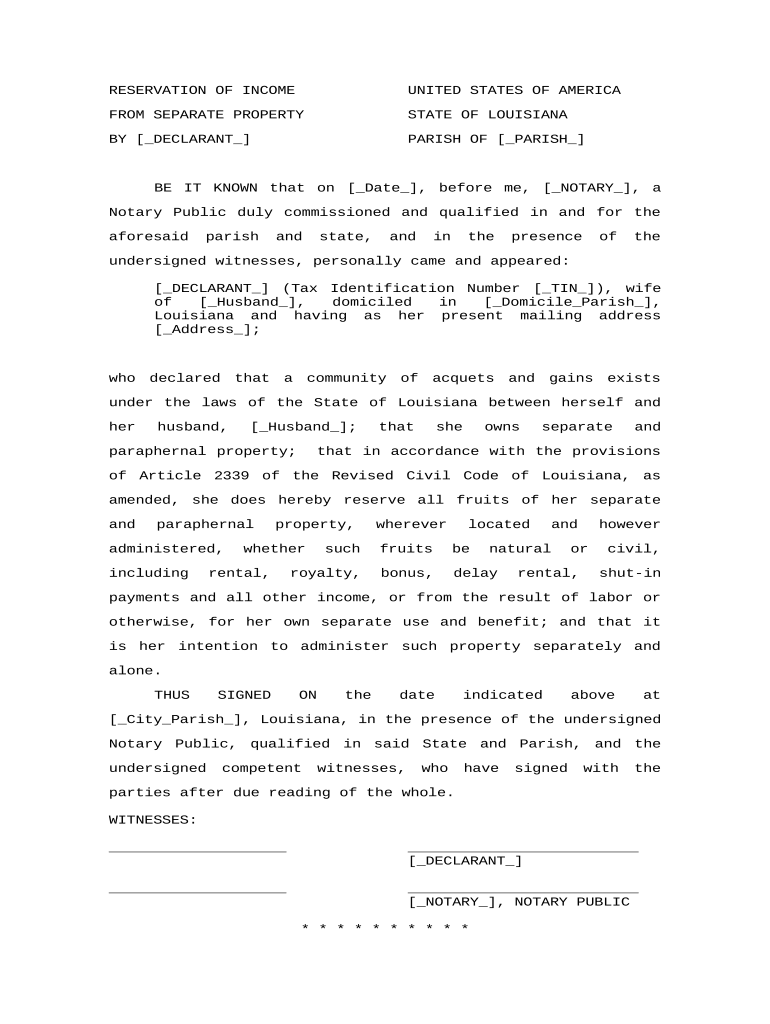
The Louisiana Separate Property Form documents an assertion that specific assets or property are separate (non-community) property under Louisiana civil law. It is commonly used when spouses, prospective spouses, or property owners want to confirm that real estate, business interests, or other assets are to remain owned separately rather than become community property. The form can appear as a standalone affidavit, an attachment to a sale or transfer, or part of a marital agreement. Execution, notarization, and local recording practices determine how the declaration will be recognized by courts or title offices.

Why a clear Separate Property Form matters in Louisiana

A properly completed Louisiana Separate Property Form helps preserve ownership rights, reduce title disputes, and create a clear contemporaneous record of intent. Under ESIGN (15 U.S.C. §7001) and state law, an electronically executed form can be legally binding if intent, attribution, consent, and retention requirements are met.

Why a clear Separate Property Form matters in Louisiana

Who typically completes this form and why it matters for each party

Typical signers include property owners, spouses, attorneys, real estate closing agents, and lenders; each party relies on the form for different legal or transactional protections.

  • Property owners and sellers protecting non-community assets during a sale or refinance.
  • Spouses or fiancés documenting property brought into or retained outside the community estate.
  • Attorneys and title companies creating a clear record to support closing and underwriting.

Representative signer profiles

Homeowner (Grantor)

A homeowner asserting separate ownership typically signs to confirm acquisition source (inheritance, pre-marital, or gift). The statement should align with deed language and be notarized to assist recording and title search processes.

Spouse or Co-owner

A spouse or co-owner may sign an acknowledgement or waiver to confirm they do not claim community interest. Legal counsel often prepares this to ensure the language withstands future disputes.

Security and compliance features to expect

Encryption: TLS 1.2/1.3 in transit; AES-256 at rest
Audit Trail: Timestamps, IP, and action log retained
Access Controls: Role-based permissions and password protection
HIPAA / BAA: BAA available where required
Certifications: SOC 2 Type II; ISO 27001
Formats: PDF and DOCX with tamper-evident output

Step-by-step: completing the Louisiana Separate Property Form

Follow this sequence to prepare, verify, and execute the form to reduce errors and preserve enforceability.

  • 01
    Prepare the facts: List property, acquisition date, and source of funds
  • 02
    Draft clear language: State separate property claim and basis concisely
  • 03
    Verify identity: Have signers provide government ID for notarization
  • 04
    Execute and retain: Sign, notarize, and keep recorded copies

How the form flows through a typical transaction

A Louisiana Separate Property Form moves from preparation to notarization, then to any recording or closing steps depending on the transaction type.

  • Document Preparation: Drafted by owner, attorney, or title agent
  • Identity Verification: IDs checked for notarization
  • Execution and Notary: Signatures witnessed and notarized
  • Recording / Retention: File with clerk or retain in closing file

Configuring an online workflow for this form

Set up a digital workflow to collect signatures, notarization, and confirmations in a controlled sequence.

Field Configuration
Signer Authentication Email + SMS code or stronger KBA
Notary Integration Enable RON or schedule in-person notarization
Conditional Fields Show fields only when relevant
Auto-Reminders Schedule reminders until completion

Technical considerations for eSigning and eNotarization

Choose a platform that supports authenticated e-signatures, common file formats, and notary integrations where RON is used.

  • File formats: PDF and DOCX supported for upload
  • Integrations: Salesforce, NetSuite, Box, Google Workspace supported
  • Authentication: Email, SMS, and advanced signer methods

Timing: notarization, recording, and processing expectations

Deadlines vary by parish and transaction; plan time for notarization, local recording, and title processing to avoid closing delays.

Notarization timing:

Immediate at signing when notary available

Recording timeline:

Varies by parish; often 1–30 business days

Title review:

Allow 3–10 business days for underwriting checks

Closing windows:

Coordinate with lender and escrow schedules

Document retention:

Keep executed originals for recording or legal proof

Consequences of errors or incomplete forms

Title disputes: Loss of clear ownership claims
Invalid notarization: Recording refusal or later challenge
Mismatched names: Title search and insurance denials
Insufficient detail: Ambiguity inviting litigation
Late recording: Priority issues with subsequent claims
Unclear consideration: Tax or probate complications

Common preparation mistakes to avoid

  • Using informal property descriptions instead of full legal descriptions from the deed or title commitment.
  • Failing to have signatures notarized or using an out-of-state notary without validating acceptance by local recording offices.
  • Omitting the acquisition source (inheritance, gift, premarital funds), which weakens proof of separate ownership.
  • Allowing name mismatches between IDs, deed, mortgage, and the separate property form; consistency is essential.

Comparing eSignature vendor costs and basic features

Select a vendor based on pricing model, compliance needs, and feature set; signNow appears first for comparison. Vendor pricing and features vary by plan and billing cycle.

signNow DocuSign Adobe Sign PandaDoc HelloSign
Starting Price $8/user/mo $15/user/mo $14/user/mo $19/user/mo $15/user/mo
Free Trial 7-day free trial (no card) Varies by vendor Varies by vendor Varies by vendor Varies by vendor
Bulk Send Yes (Business Premium) Yes Yes Yes Varies by vendor
Audit Trail Yes Yes Yes Yes Yes
HIPAA Compliant Yes (BAA available) Varies by vendor Varies by vendor Varies by vendor Varies by vendor
Envelope Cap No envelope cap 100 envelopes/user/year Varies Varies Varies

Real-world scenarios where a Separate Property Form is used

Below are two representative examples showing how the form supports different transactions.

Residential Sale

A homeowner documents an inherited parcel as separate property to avoid community claim

  • Enables title underwriting and faster closing
  • The recorded declaration reduced title objections during closing and provided straightforward proof of non-community status to the title company and lender.

Premarital Asset

A fiancé documents business equity held before marriage as separate

  • Prevents mixing with community assets
  • Clear contemporaneous records helped a later ante-nuptial agreement and reduced the risk of future valuation disputes in the event of dissolution.

Frequently asked questions about the Louisiana Separate Property Form

Answers to common questions about enforceability, notarization, electronic signatures, and correcting errors when completing the form.


Need help? Contact support

be ready to get more
Join over 28 million airSlate SignNow users