Establishing secure connection…Loading editor…Preparing document…

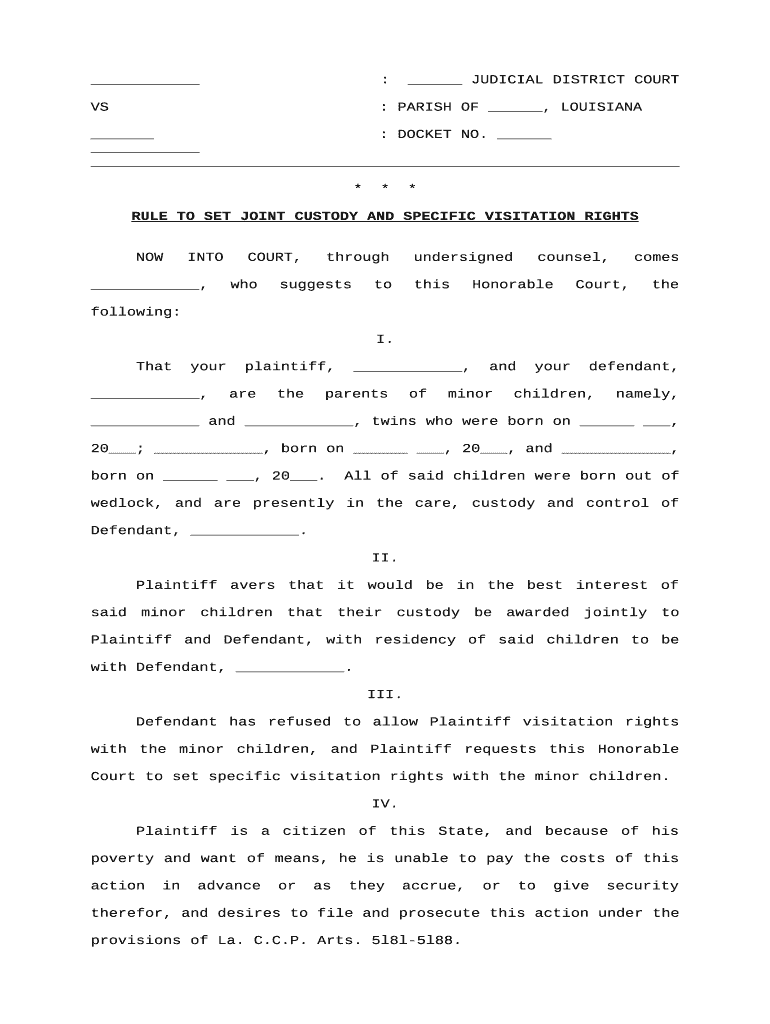
Louisiana Rule to Set Joint Custody and Visitation Rights

This template is fully customizable. Edit the text, fill out the fields, and send it for signature. Give it a try!
Louisiana Rule to Set Joint Custody and Visitation Rights

What the Louisiana Rule to Set Joint Custody and Visitation Rights Covers

Louisiana Rule to Set Joint Custody and Visitation Rights is a court procedure and local rule used in Louisiana family courts to establish joint custody arrangements, parental responsibilities, and visitation schedules. It guides judges and parties on criteria for shared custody, parenting plans, residential schedules, decision-making authority, and dispute resolution processes. The rule informs required filings and supporting evidence and interacts with Louisiana Civil Code provisions on custody. Use of the rule ensures orders address the child's best interests while documenting parental rights, responsibilities, and enforcement mechanisms for the court.

Why This Rule Matters for Custody and Visitation

Using the Louisiana Rule to Set Joint Custody and Visitation Rights promotes clarity in parenting schedules, defines decision-making responsibilities, and helps produce enforceable court orders tailored to a child's best interests. It reduces post-judgment disputes and supports consistent implementation by courts and parents.

Why This Rule Matters for Custody and Visitation

Typical Users and Stakeholders

Typical users include parents, family law attorneys, and judges managing custody and visitation disputes in Louisiana courts.

  • Parents negotiating custody who need court-ordered schedules and written parenting plans.
  • Family law attorneys preparing pleadings, proposed orders, and evidence for custody hearings.
  • Judges and clerks applying local rules to set custody terms and monitor compliance.

Representative Roles Involved

Family Attorney

A family attorney represents a parent, drafts custody motions, proposes parenting plans, and compiles supporting evidence such as parenting class records or custody evaluations. They ensure filings comply with Louisiana Civil Code and local court rules and advise on modification strategies.

Custodial Parent

A custodial parent may use the rule to request joint custody or opposed arrangements, provide proposed schedules, and document concerns about relocation, schooling, or medical decisions. Accurate forms help courts assess the child's best interests and parental fitness.

Essential Elements of a Professional Custody Rule Filing

Core components of the Louisiana Rule to Set Joint Custody and Visitation Rights outline custody types, parenting time, decision authority, dispute resolution, enforcement mechanisms, and required supporting documentation.

Custody Types

Specifies sole, joint, or shared custody models and criteria for awarding parental rights, including primary residence considerations and allocation of decision-making authority for health, education, and religious upbringing.
Parenting Schedule

Sets regular residential schedules, holiday rotations, school-year and summer plans, pickup/drop-off logistics, and procedures for short-term changes to accommodate unexpected travel, illness, or work commitments.

Decision Authority

Defines how major decisions are made—sole or joint authority—for medical care, education, extracurricular activities, and emergency medical consent, and specifies notice and consultation expectations between parents.

Dispute Resolution

Requires mediation or other alternative dispute resolution before return to court in many jurisdictions, outlines procedures for emergency hearings, and may assign costs for noncompliance or repeated motions.

Support Documentation

Lists necessary attachments such as parenting evaluations, school records, medical reports, proof of income, and proposed parenting plans to substantiate custody requests and help the court evaluate the child's needs.

Enforcement Terms

Includes contempt procedures and penalties, modification standards, relocation notice requirements, and mechanisms for changing parenting time when circumstances materially change or when orders are violated.

Security, Compliance, and Technical Standards to Consider

Encryption: TLS 1.2/1.3 in transit, AES-256 at rest
Certifications: SOC 2 Type II, ISO 27001, PCI DSS
HIPAA: Compliant with BAA required
ESIGN/UETA: Legal compliance for electronic signatures
Audit Trail: Full timestamp, IP, action history
Accessibility: WCAG 2.0 Level AA support

Potential Risks and Consequences of Errors

Invalid Signatures: May invalidate order
Late Filings: Delay hearings, possible sanctions
Missing Evidence: Weakened custody claims
Incorrect Dates: Affect enforceability
Noncompliance: Contempt, fines, custody changes
Jurisdiction Errors: Wrong venue voids orders

Common Preparation Errors to Avoid

  • Failing to include complete parenting schedules leads to ambiguity in enforcement, increasing detention of hearings and disputes over pickup rights.
  • Not attaching supporting evaluations or school records can weaken a parent’s position and slow the court’s assessment of the child's needs.
  • Using inconsistent names or incorrect dates across documents risks administrative rejection or later challenges to order authenticity.
  • Failing to follow local court formatting and filing procedures often causes delays, additional fees, and the need for resubmission.

Step-by-Step: Preparing and Filing the Rule

Follow these sequential steps to prepare and file the joint custody and visitation rule form correctly.

  • 01
    Review Local Rule: Confirm parish-specific forms and requirements.
  • 02
    Assemble Records: Collect evaluations, school and medical records.
  • 03
    Draft Proposed Order: Detail custody, schedule, and decision rules.
  • 04
    File and Serve: Submit to court and serve opposing party.

How eSubmission and Court Routing Typically Work

Typical eSubmission workflow for custody rules includes uploading form, placing fields, adding signers, and submitting to the court and parties.

  • Upload Document: Start with a correctly formatted PDF or DOCX.
  • Place Fields: Add signature, date, and text fields for consent.
  • Authentication: Use email, SMS, or identity verification as required.
  • Save Audit: Retain timestamped audit trail for court submission.

Configuring an Online Workflow for Custody Filings

Configure an online workflow to collect signatures, authenticate signers, and produce court-ready PDFs with audit trails.

Workflow field name and configuration Configuration
Signer authentication method and options available Email link, SMS code, or ID verification.
Signature and initial field placement per page Signature, initials, dates, and text fields.
Conditional fields and required data validation Use conditional fields for parenting time variations.
Automated routing and court copy generation Auto-send to judge, opposing counsel, and parties.

Technical Requirements for eFiling and eSignatures

For eSubmission, verify file formats, signer access, and privacy safeguards before filing with the court.

  • File Types: PDF and DOCX accepted.
  • Signer Access: Email, guest links, or authenticated accounts.
  • Integrations: Works with Google Workspace and NetSuite.

Timing Considerations and Local Deadlines

Filing and hearing timelines vary by parish; observe local rules for service, scheduling, and expedited emergency hearings.

Initial petition filing and service timeframe:

File petition and serve respondent per parish procedures before initial hearing.

Prehearing mediation and evaluation deadlines:

Complete mediation or evaluations if ordered by the court within required timelines.

Scheduling of temporary custody hearings:

Emergency or temporary relief hearings scheduled typically within days to weeks.

Filing of parenting plans and evidence:

Submit proposed parenting plans before the final hearing per local filing rules.

Modification and appeal timing considerations:

Modifications require showing material change; appeals follow state appellate deadlines.

Key Milestones from Filing to Final Order

Key milestones from filing through final order outline actions parties and court must take timelines.

01

File Petition

Prepare and file petition, serving other parent per local rules.

02

Temporary Orders Hearing

Request temporary custody or support pending final hearing.

03

Evidence Exchange

Exchange evaluations, records, and witness lists before the final hearing.

04

Final Order Entry

Court issues final custody and visitation order with enforcement terms.

Practical Examples from Court and Firm Practice

Real-world examples show how the rule standardizes orders and reduces post-judgment disputes in practice across parishes.

County Court Practice

A parish family court adopted a standardized custody form aligning parenting schedules and decision authority for families.

  • Reduced motion practice and scheduling confusion.
  • After implementing consistent template orders and clear exhibit labeling, the court saw fewer emergency filings, faster resolution of parenting disputes, and improved clarity for custodial handoffs; counsel reported reduced drafting time and clients experienced fewer enforcement hearings.

Attorney Workflow Change

A law firm switched to electronic fillable custody templates to submit proposed orders and evidence packets to the court more consistently.

  • Cut review time and improved accuracy.
  • Using a template reduced repetitive drafting, minimized typographical errors, and enabled batch PDF exports for court filing; the firm documented a marked drop in correction cycles and reduced client billing for clerical tasks associated with custody pleadings.

eSignature Vendor Pricing and Compliance Snapshot

Comparing eSignature vendors for completing and submitting custody and visitation forms; signNow listed first per vendor data for pricing and compliance.

signNow DocuSign Adobe Sign PandaDoc HelloSign
Starting Price $8/user/mo $15/user/mo $14/user/mo $19/user/mo $15/user/mo
Free Trial 7-day free trial Varies by vendor Varies by vendor Varies by vendor Varies by vendor
Bulk Send Yes Yes Yes Yes No
Audit Trail Yes Yes Yes Yes Yes
HIPAA Compliant Yes Yes Yes No No
Envelope Cap No envelope cap 100 envelopes/user/year Varies Varies Varies

Frequently Asked Questions About Filing and Execution

Frequently asked questions about preparing and filing the Louisiana Rule to Set Joint Custody and Visitation Rights, with concise answers to common procedural issues.


Need help? Contact support

be ready to get more
Join over 28 million airSlate SignNow users