Parties
Full legal names and capacity (individual, trustee, company).
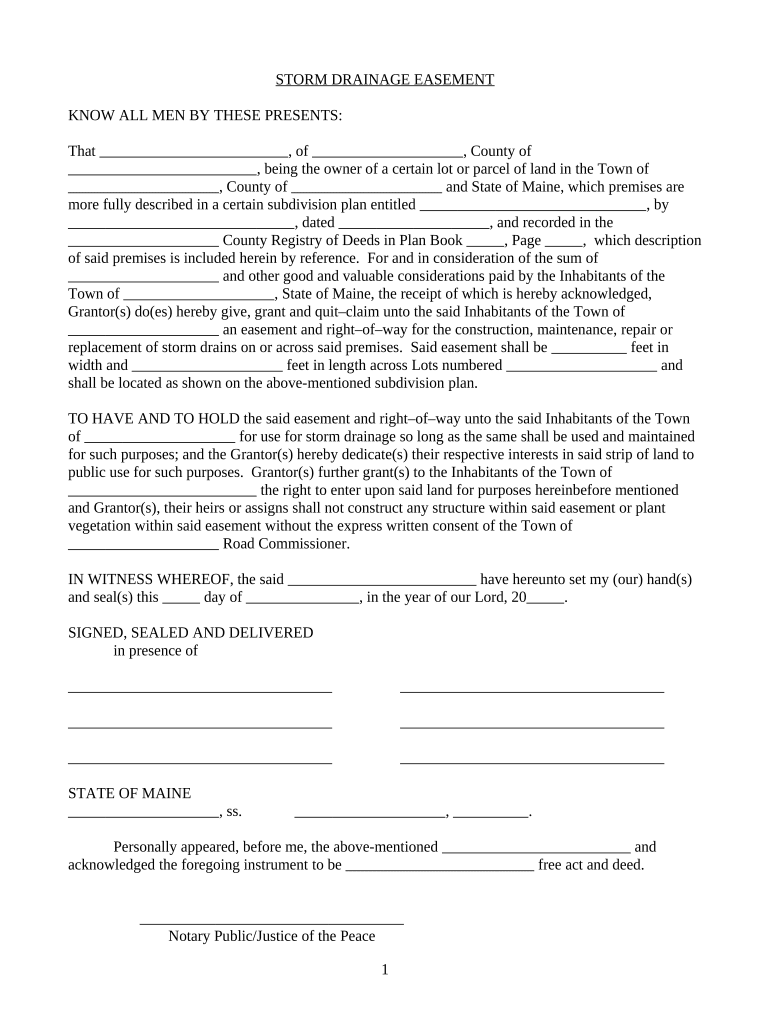
A recorded Maine Easement clarifies property rights, preserves access or utility routes, establishes priority against later purchasers, and reduces litigation risk by putting the public on notice of encumbrances.

Various parties use easements to formalize access, utilities, conservation, or maintenance rights across properties.
In practice, owners, adjacent property users, developers, and public entities are the primary signatories and beneficiaries of these instruments.
A private owner who grants rights over a portion of their parcel. The landowner must ensure the legal description matches recorded deed language, sign in capacity shown on title, and often appear before a notary to acknowledge the conveyance.
A company officer or authorized agent who accepts an easement on behalf of a utility. The signer should have board or delegated authority, verify grant conditions, and attach required insurance or maintenance obligations where applicable.
Full legal names and capacity (individual, trustee, company).
Metes and bounds or recorded lot reference to identify servient parcel precisely.
Clear statement of permitted uses, access corridor, maintenance responsibilities.
Fixed term, perpetual language, or conditions for termination or release.
Monetary amount or other exchange describing what grantee provides.
Signature, notary acknowledgment, and county recording instructions or exhibits.
| Field | Configuration | Field Name | Required/Optional |
|---|---|
| Signature Field | Required | eSign with date |
| Notary Block | Required | Add acknowledgment and date |
| Survey Exhibit | Optional | Attach PDF exhibit |
| Recording Copy | Required | Generate final PDF for Registry |
Confirm format, signer authentication, and delivery options before e-signing or sending a recording copy.
When using eSubmission or e-notary, verify county Registry practices for accepting electronic originals or stamped copies and retain unalterable final PDFs and audit trails for the record.
File at the Registry of Deeds soon after execution to protect priority.
Notarize contemporaneously with signatures to satisfy acknowledgment requirements.
Remote notarization may be permitted subject to state notary rules.
Update or review title commitments after recording to ensure coverage.
Keep originals and recording receipts until at least statute of limitations periods expire.
Prepare legal description and attach survey exhibits and maps.
Obtain signatory authority and any board or trustee approvals required.
Sign, date, and notarize before or at closing as appropriate.
Record at county Registry and retain recording receipt as proof of notice.
| signNow | DocuSign | Adobe Sign | PandaDoc | HelloSign | |
|---|---|---|---|---|---|
| Starting Price | $8/user/mo | $15/user/mo | $14/user/mo | $19/user/mo | $15/user/mo |
| Free Trial | Yes, 7-day trial | No | No | Yes, limited | Yes, limited |
| Bulk Send | Yes | Yes | Yes | Yes | No |
| Audit Trail | Yes | Yes | Yes | Yes | Yes |
| Envelope Cap | No envelope cap | 100 envelopes/user/year | Varies by plan | Varies by plan | Varies by plan |
A utility sought a narrow corridor across a private lot to install underground cable.
A landowner granted a conservation easement to a land trust to preserve natural habitat.