Establishing secure connection…Loading editor…Preparing document…

Maryland Marital Domestic Separation and Property Settlement Agreement

This template is fully customizable. Edit the text, fill out the fields, and send it for signature. Give it a try!
Maryland Marital Domestic Separation and Property Settlement Agreement

What this Maryland agreement is and what it does

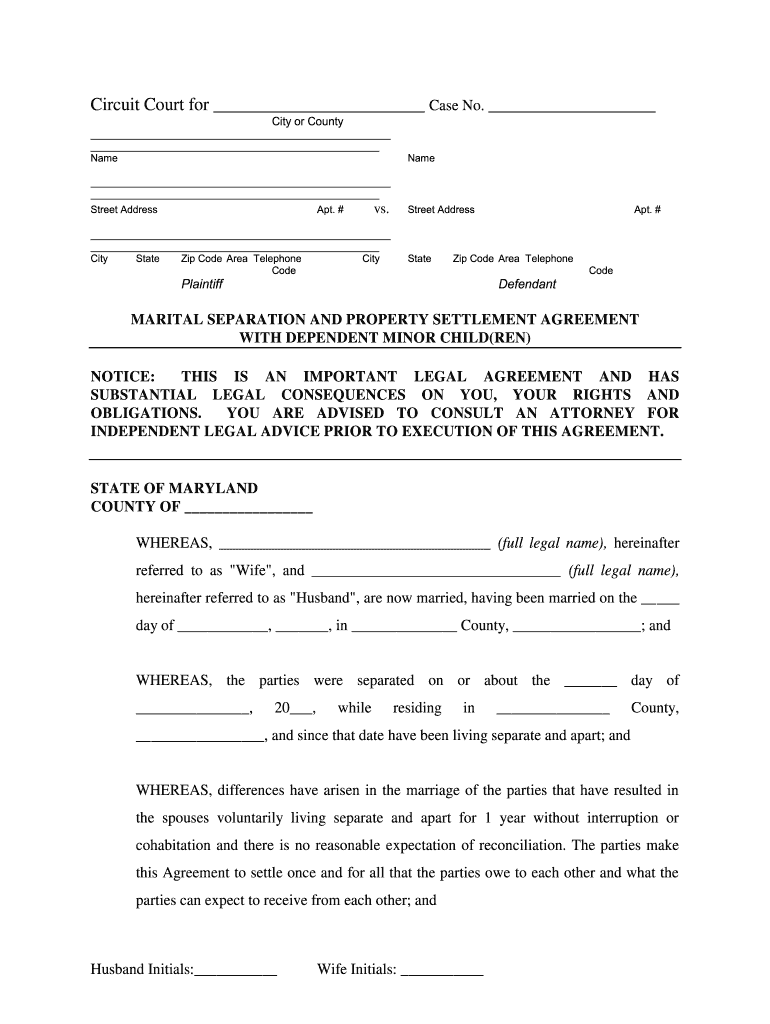
The Maryland Marital Domestic Separation and Property Settlement Agreement is a written contract used by spouses to record terms for separation, assign ownership of assets and debts, and set support or payment obligations. It can address division of bank accounts, real property, retirement interests, and allocation of liabilities. Parties may choose to keep it private or ask a court to incorporate its terms into a divorce decree or judgment. Execution, notarization, and possible court approval affect enforceability and future modification under Maryland family law.

Why a clear separation and property settlement matters

A written settlement clarifies who keeps what, reduces future disputes, documents financial disclosures, and creates enforceable obligations when properly executed and preserved.

Why a clear separation and property settlement matters

Who commonly prepares and signs this agreement

Typical users include the separating spouses, family law counsel, and third‑party neutrals who draft or review settlement terms.

  • Separating spouses negotiating property division outside of immediate litigation, aiming for a written record of agreed terms.
  • Family law attorneys drafting enforceable settlement language and advising on court incorporation and tax consequences.
  • Mediators and financial advisors facilitating valuation, payment schedules, and equitable division of marital assets.

Representative signers and advisors

Self-Represented Spouse

An individual negotiating a separation who prepares or signs the agreement without counsel. They should document full financial disclosure, reserve time to review tax consequences, and consider notarization and witness options to reduce later enforceability disputes.

Family Law Attorney

A Maryland-licensed lawyer who drafts settlement provisions, explains statutory and case-law consequences, prepares QDRO/QMCSO language if needed for retirement accounts, and advises whether to submit the agreement to a circuit court for incorporation in a divorce proceeding.

Core sections typically included in a professional settlement agreement

A complete agreement is organized into identification, financial disclosure, property allocation, debt allocation, support terms, and execution provisions to reduce ambiguity and aid enforcement.

Parties & Date

Clearly identify each spouse with full legal name, address, and the effective date of the agreement so the starting point for obligations is unambiguous.
Financial Disclosure

Attach or list assets, liabilities, incomes, and valuations. Full disclosure supports enforceability and helps prevent later claims of fraud or concealment.

Property Allocation

Specify ownership of real estate, bank accounts, vehicles, and personal property using descriptive detail and account numbers where appropriate.

Debt Allocation

Assign responsibility for mortgages, credit accounts, and loans, and describe payment schedules or indemnity obligations for each party.

Support & Payments

State spousal support, maintenance, or lump-sum payments with amounts, payment method, and termination events or review triggers.

Execution Terms

Include signature blocks, notarization instructions, witness requirements, governing law, amendment method, and statements about incorporation into court orders.

Step-by-step: complete and execute the agreement

Follow a consistent sequence from preparation through filing to reduce omissions and preserve enforceability.

  • 01
    Gather records: Collect bank, title, retirement, and loan documents.
  • 02
    Draft terms: Describe allocation, support, and timelines clearly.
  • 03
    Disclose finances: Exchange written schedules and attach exhibits.
  • 04
    Sign & notarize: Execute in presence of required notary/witnesses.

How to set up a digital signing workflow

Configure document routing, authentication, and notifications so signatures are captured, timestamped, and stored with an audit trail.

Field Configuration
Platform eSignature service with audit trail and PDFs
Authentication Email link plus optional SMS code
Conditional Fields Show spousal support section only when applicable
Template Save as reusable template for similar cases

Where to send, sign, and store the final agreement

Decide whether the agreement remains a private contract or will be filed with the circuit court and route signed copies accordingly.

  • Signatures: Each party signs designated signature blocks.
  • Notarization: Obtain notarization when advised or required.
  • Exchange Copies: Provide each party with a fully executed copy.
  • Court Filing: File or present to court if incorporation is sought.

Digital signing and technical compatibility

Choose a platform that exports tamper-evident PDFs, records an audit trail, and supports required authentication.

  • Integrations: Salesforce, NetSuite, Google Workspace supported
  • File formats: PDF, DOCX, HTML accepted
  • Authentication: Email link, SMS code, or advanced KBA

Common eSignature vendors for executing settlement agreements

Comparison of typical plan and compliance features when selecting an eSignature provider for legal agreements. signNow is listed first per vendor comparison conventions.

signNow DocuSign Adobe Sign PandaDoc HelloSign
Starting Price $8/user/mo $15/user/mo $14/user/mo $19/user/mo $15/user/mo
Free Trial 7-day free trial Varies by vendor Varies by vendor Varies by vendor Varies by vendor
Bulk Send Yes Yes Yes Yes No
Audit Trail Yes Yes Yes Yes Yes
HIPAA Compliant Yes Yes Yes No No
Envelope Cap No cap 100 envelopes/user/year Not specified Not specified Not specified

Security and compliance considerations

Encryption: TLS 1.2/1.3 in transit; AES-256 at rest
HIPAA: HIPAA-compliant; BAA required for PHI
ESIGN & UETA: Compliant with ESIGN and UETA frameworks
21 CFR Part 11: Support for FDA-regulated digital records
SOC 2: SOC 2 Type II attestation available
ISO: ISO 27001 certified controls

Key risks of an incorrect or incomplete agreement

Unenforceable Agreement: Court may decline enforcement
Missing Disclosure: Claims of concealment or fraud
Improper Notarization: Questioned signature authenticity
Unsigned Pages: Incomplete execution record
Ambiguous Terms: Future litigation over interpretation
Tax Consequences: Unanticipated tax liabilities

Common mistakes to avoid when preparing the agreement

  • Failing to exchange full financial disclosure before signing, which can lead to claims of nondisclosure and undermine enforceability.
  • Using vague language for asset descriptions or payment terms instead of precise account numbers, legal descriptions, and dates.
  • Overlooking tax treatment for transfers and support, resulting in unexpected liabilities or reporting errors.
  • Neglecting notarization or witness requirements where local practice or court rules expect an acknowledged document.

Timing and common scheduling considerations

There is no single universal filing deadline for separation agreements; timing depends on negotiation pace and whether you seek court incorporation.

Effective Date:

Set clearly using MM/DD/YYYY format at the top of the document

Review Period:

Allow time for each party's independent review before signing

Financial Disclosure Deadline:

Exchange schedules prior to execution to avoid later challenges

Notarization Deadline:

Complete notarization at execution when recommended or required

Court Filing Window:

If seeking incorporation, follow local court scheduling and filing procedures

Key milestones from negotiation to enforceability

Sequence the major stages so parties know when obligations, filings, and review windows occur during the separation process.

01

Negotiation Completed

Finalize terms and exhibits during settlement discussions.

02

Financial Disclosure

Exchange and attach all schedules and valuations.

03

Execution & Notarization

Signatures and acknowledgements completed in appropriate format.

04

Court Incorporation

Submit to court if you need an enforceable decree.

Practical examples of how the agreement is used

Two common scenarios illustrate typical provisions and downstream steps when parties execute a separation and property settlement agreement.

Uncontested Separation

A couple with limited assets agrees on division and support in writing

  • Agreement specifies equal division of checking accounts and joint debt responsibility
  • They notarize signatures, exchange fully executed copies, and retain originals in case the agreement needs to be presented during later divorce proceedings.

High-Asset Division

Parties negotiate allocations for real estate and retirement accounts with attorney assistance

  • Includes clauses describing QDRO steps for retirement plan transfers
  • The agreement attaches appraisals, names plan administrators, and outlines payment schedules for buyouts with clear default remedies.

Frequently asked questions about validity, eSigning, and disputes

Answers to common questions about enforceability, eSign use, notarization, and updating the agreement after execution.


Need help? Contact support

be ready to get more
Join over 28 million airSlate SignNow users