Establishing secure connection…Loading editor…Preparing document…

Notice of Default in Franchise Agreement

This template is fully customizable. Edit the text, fill out the fields, and send it for signature. Give it a try!
Notice of Default in Franchise Agreement

What a Notice of Default in a Franchise Agreement Is

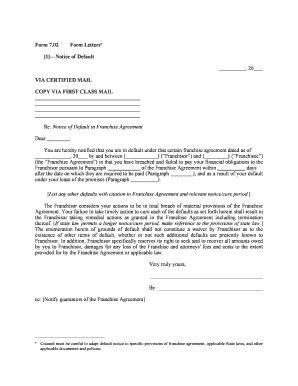
A Notice of Default in a Franchise Agreement is a formal written communication from a franchisor (or franchisee) stating that a specific contractual obligation has not been met and identifying the breach. The notice typically cites the contractual provision breached, describes the facts supporting the breach, and gives the recipient a defined cure period or the franchisor’s intended remedies. It creates a documented record used for dispute resolution, termination proceedings, or litigation and is often a prerequisite to stronger remedies under the agreement.

Why issuing a clear Notice of Default matters

A properly drafted notice preserves contractual rights, starts cure periods, and supports later enforcement or termination. It documents the franchisor’s position and reduces ambiguity that could undermine remedies under the contract or in court.

Why issuing a clear Notice of Default matters

Who prepares and receives this notice

In many cases both in-house counsel and outside counsel collaborate to ensure the notice meets contractual and statutory requirements.

  • Franchisor compliance team — drafts notices, documents breaches, and manages cure timelines.
  • Franchisee representatives — review allegations, coordinate responses, and seek counsel where appropriate.
  • Outside counsel or mediators — review legal sufficiency and advise on enforcement or settlement options.

Core elements to include in a professional notice

A complete Notice of Default should be precise, factual, and tied directly to the agreement language. The following components reduce ambiguity and support enforceability.

Identifying Parties

Full legal names of franchisor and franchisee and the agreement date to remove identity ambiguity and link the notice to the correct contract.
Contract Citation

Explicit reference to the franchise agreement provision(s) alleged to be breached, including section numbers and exact wording where practical.

Description of Breach

Clear, time-sequenced facts describing the default, relevant dates, and evidence (e.g., inspection reports, missed payments).

Cure Period

State the time allowed to cure (e.g., 30 days), the start date for that period, and the consequence if uncured.

Requested Action

Specific remedial actions required (payments, operational changes, deliverables) and any documentation the recipient must provide.

Signature Block

Name, title, date, and method of execution; if sent electronically, note the e-signature method used and signatory authority.

Required data fields at a glance

Franchisee Name: Full legal name
Franchisor Name: Full legal name
Agreement Date: MM/DD/YYYY
Breach Date(s): MM/DD/YYYY
Cure Deadline: MM/DD/YYYY
Notifying Party: Name and title

Step-by-step: preparing and sending the notice

Follow a clear sequence: verify authority to issue the notice, confirm the factual basis, draft precise language tied to contract provisions, select delivery method, and preserve proof of delivery.

  • 01
    Verify authority: Confirm signatory has delegated power under the agreement
  • 02
    Document facts: Gather evidence and dates supporting the breach
  • 03
    Draft notice: Cite contract sections and state cure terms
  • 04
    Deliver and record: Send via required method and retain proof

How to configure an online notice workflow

Set up an e-delivery workflow that preserves audit trails and meets contractual delivery instructions.

Field Configuration
Sender Authentication Use corporate account with role-based access
Signer Authentication Email link + SMS code or higher for sensitive cases
Attachments Attach evidence PDFs; enable read receipts
Audit Trail Capture timestamps, IPs, and delivery status

Where to send and how to file the notice

Deliver the notice according to the contract’s notice clause and retain a copy in your records and the franchise file.

  • Contractual Address: Send to the contact/address listed in the franchise agreement’s notice provision
  • Registered Agent: If the agreement allows service via registered agent, follow that process
  • Electronic Delivery: Use permitted e-mail or e-sign platform methods spelled out in the contract
  • Record Retention: Store signed notice and proof of delivery in the contract repository

Digital delivery: technical considerations

Preserve the original signed file and export a read-only copy with the audit certificate for the franchise file and potential disputes.

  • Authentication: Email + SMS or stronger
  • Audit Trail: Timestamps, IP, action log
  • Document Formats: PDF/A or DOCX recommended

Common timelines and deadlines to watch

Time limits in the franchise agreement and contractual notice provisions control cure periods and escalation rights; calculate deadlines precisely.

Immediate Acknowledgement:

Confirm receipt within 24–72 hours where contract requires

Cure Period:

Often 10–60 days depending on clause

Escalation Deadline:

Deadline for invoking termination or remedies after cure period

Statute of Limitations:

Varies by state; usually 3–6 years for contract claims

Record Retention:

Keep notice and evidence for the term plus recommended retention period

Frequent drafting and delivery mistakes to avoid

  • Using vague language that fails to cite the exact contractual provision and factual basis.
  • Miscomputing the cure period start or end dates, causing procedural defects.
  • Sending to an incorrect address or failing to use the contractually required delivery method.
  • Failing to preserve proof of delivery and the supporting evidence that substantiates the breach.

Risks and consequences of an incorrect or defective notice

Waived Rights: An improper notice can waive contractual remedies or delay enforcement
Invalid Termination: Faulty notice may make a termination unenforceable and expose the sender to counterclaims
Statutory Penalties: Potential state-law damages or costs if notice procedures are statutorily mandated
Increased Litigation Cost: Ambiguous facts invite discovery and extend disputes
Business Disruption: Operational uncertainty for both parties during cure and litigation
Regulatory Exposure: Industry-specific regulators may impose sanctions if obligations relate to regulated conduct

Pricing and feature snapshot for electronic delivery and signing

Compare typical entry-level pricing and core capabilities relevant to sending Notices of Default; signNow appears first per vendor ordering rules.

signNow DocuSign Adobe Sign PandaDoc HelloSign
Starting Price $8/user/mo $15/user/mo $14/user/mo $19/user/mo $15/user/mo
Free Trial 7-day free trial Varies by vendor Varies by vendor Varies by vendor Varies by vendor
Bulk Send Yes Yes Yes Yes No
Audit Trail Yes Yes Yes Yes Yes
HIPAA Compliant Yes Yes Yes No No

Frequently asked questions about Notices of Default

Answers to common procedural and legal questions when preparing or responding to a Notice of Default in a franchise context.


Need help? Contact support

be ready to get more
Join over 28 million airSlate SignNow users