Establishing secure connection…Loading editor…Preparing document…

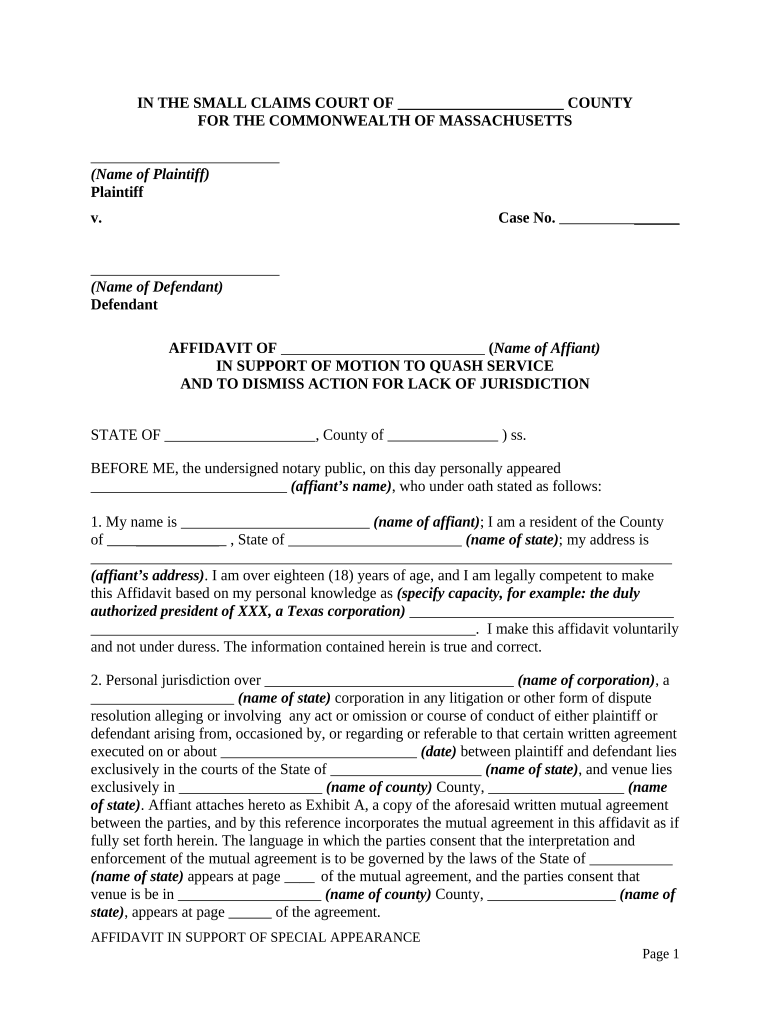
Massachusetts Affidavit

This template is fully customizable. Edit the text, fill out the fields, and send it for signature. Give it a try!
Massachusetts Affidavit

What a Massachusetts Affidavit Is and When It’s Used

A Massachusetts Affidavit is a written sworn statement used in Massachusetts to declare facts under oath for legal, real estate, probate, and administrative purposes. It records the declarant’s assertions, identifies the declarant, and is typically signed, dated, and notarized or witnessed according to Massachusetts rules. Affidavits serve as contemporaneous evidence submitted to courts, government agencies, or counterparties. Where allowed by federal and state law, affidavits may be completed and transmitted electronically in compliance with ESIGN (15 U.S.C. §7001) and UETA as adopted by the Commonwealth.

Why a Properly Prepared Affidavit Matters

Massachusetts Affidavits provide sworn, admissible evidence to support claims, verify identity or facts, and satisfy administrative or contractual requirements. Properly executed affidavits reduce dispute risk, streamline filings, and, where permitted, can be signed and stored electronically under ESIGN and UETA frameworks.

Why a Properly Prepared Affidavit Matters

Who Commonly Prepares and Accepts Affidavits

Common users include attorneys, title companies, government agencies, lenders, landlords, and private individuals preparing sworn statements for legal or administrative matters.

  • Attorneys and courts: prepare affidavits for pleadings, motions, and evidentiary statements.
  • Real estate professionals: title affidavits, possession affidavits, and closing-related sworn statements.
  • Individuals and businesses: identity verification, lost document affidavits, and transaction confirmations.

Typical Signers and Preparers

Civil Attorney

A civil litigation attorney uses affidavits to swear factual statements for motions, discovery responses, and trial exhibits. Affidavits must reference direct knowledge, be dated, and comply with state notary requirements to be admitted or relied upon by courts.

Title Officer

A title officer prepares title affidavits to clear defects, confirm owner occupancy, or document chain-of-title facts. Precision in names, legal descriptions, and notarization prevents closing delays and helps underwriters accept the title for issuance.

Core Parts of a Professional Massachusetts Affidavit

A professional Massachusetts Affidavit combines clear factual statements, signer identification, exhibit references, proper jurat language, notarization, and consistent formatting to maximize legal weight and acceptance.

Caption

Include case or transaction caption at the top, referencing matter title, docket number, or property description to tie the affidavit to the correct file or proceeding.
Declarant ID

Provide full legal name, address, date of birth or other identifying particulars, and relationship to the facts to establish personal knowledge and attribution.

Statement of Facts

Numbered paragraphs presenting only facts within the declarant’s direct knowledge, with precise dates, locations, and references to attached exhibits when applicable.

Jurat

Jurat or sworn statement specifying that the declarant swears or affirms the truth under penalty of perjury, followed by signature and date.

Notary Block

Space for notary acknowledgement or jurat including notary signature, seal, commission expiry, and, if applicable, remote notarization session details and retention notes.

Exhibits

Labelled attachments referenced in the body, each described briefly and authenticated by signature blocks or chain-of-custody statements when necessary.

Required Information and Standard Field Labels

Declarant Name: Full legal name as on ID.
Declarant Address: Street, city, state, ZIP code.
Statement of Facts: Numbered factual paragraphs.
Effective Date: MM/DD/YYYY format date.
Notary Block: Space for jurat or acknowledgement.
Exhibits: Labelled attachments referenced.

Step-by-Step: Fill and Execute a Massachusetts Affidavit

Follow these step-by-step instructions to prepare, verify, and execute a Massachusetts Affidavit correctly for legal or transactional use.

  • 01
    Identify Parties: Enter full legal names and contact details for all declarants.
  • 02
    State Facts: Describe facts in first person, present tense, and include dates.
  • 03
    Attach Evidence: List exhibits and append copies with exhibit labels and references.
  • 04
    Notarize/Sign: Sign before a notary or as required; include dates and initials.

How to Configure an Online Affidavit Workflow

Configure an online affidavit workflow that supports electronic completion, required fields, authentication, and secure storage for auditability and compliance.

Field Configuration
Required Fields Make Full Name, Statement, Date, Notary fields mandatory.
Authentication Use email verification and optional SMS code for signer identity.
Notary/RON Support in-person and RON workflows; retain A/V logs.
Storage Encrypted at rest (AES-256) with access logs and retention settings.

Platform Requirements for Electronic Completion and Submission

Platforms for e-signing must meet authentication, encryption, and audit trail needs for legal acceptance in Massachusetts.

  • File Formats: PDF and PDF/A and DOCX supported.
  • Integrations: Works with Salesforce, NetSuite, Google Workspace.
  • Security: TLS 1.2/1.3; AES-256 at rest.

Where to File and How to Deliver an Affidavit

This flow shows how to prepare, sign, and deliver a Massachusetts Affidavit to recipients or filing authorities.

  • Upload Document: Start with a clear PDF of the affidavit.
  • Assign Signers: Add declarant and witnesses or notary roles.
  • Authenticate Signer: Use email, SMS, or stronger methods per needs.
  • Deliver/Submit: Send copies to courts, title companies, or retain.

Timing Considerations and Typical Submission Windows

Deadlines vary by purpose; provide affidavits promptly to meet court, closing, agency, or filing timelines.

On Request:

Provide affidavit when a payer, lender, or agency requests verification.

Real Estate Closings:

Submit affidavit with closing package to title or escrow agents.

Probate Filings:

File affidavits with probate or registrar when ordered by court.

Agency Deadlines:

Comply with agency-specific submission windows or risk delays.

Electronic Submission:

Confirm recipient accepts e-signed affidavits under ESIGN/UETA.

Key Milestones from Drafting to Archival

Typical processing milestones for a Massachusetts Affidavit cover drafting, notarization, submission, and archival stages to ensure legal and administrative acceptance.

01

Drafting Complete

Declarant finalizes fact statements and attaches exhibits.

02

Notarization/Verification

Affidavit executed before a notary or RON with A/V record.

03

Submission/Distribution

Deliver copies to court, agency, lender, or title company.

04

Record Retention

Store original and certified copies per retention policy.

Common Preparation Mistakes to Avoid

  • Using nicknames, initials, or inconsistent legal names that conflict with government IDs and notarization.
  • Failing to attach or reference supporting exhibits, leaving statements unsupported or unclear for reviewers.
  • Omitting jurat wording or improper notary language, which can render the affidavit inadmissible.
  • Submitting electronic signatures where the recipient or statute explicitly requires a wet signature.

Risks and Consequences of Incorrect Affidavits

Perjury Risk: Criminal penalties for false sworn statements.
Inadmissible Evidence: Poor form or improper notarization may be excluded.
Civil Liability: Exposed to damages for fraudulent statements.
Closing Delays: Title or escrow may withhold closing funds.
Administrative Rejection: Agencies can reject incorrect affidavits.
Tax Withholding: Incorrect TINs can trigger backup withholding.

Real-World Examples of Affidavit Use

Practical examples illustrate how accurate affidavits resolve transactional and title issues while preserving evidentiary value.

Optica Ventures

Optica Ventures streamlined affidavit workflows for investor closing statements and ownership confirmations during fund formation closings.

  • Reduced turnaround time with electronic signatures.
  • By ensuring accurate declarant details and notarization, the firm reduced manual corrections, preserved evidentiary value, and shortened closing cycles. Electronic completion saved administrative hours while maintaining required sworn attestation under Massachusetts procedures.

Martin Properties

Martin Properties used affidavits to document tenant possession and address chain-of-title questions for condominium resales.

  • Affidavits helped avoid protracted title searches.
  • Clear sworn statements attached to the closing package resolved lender questions quickly, reduced escrow holds, and produced a complete record for underwriters and registries. Proper notarization and consistent names were key to acceptance.

Common eSignature Plan Comparison for Affidavit Workflows

Compare common eSignature plans and basic features relevant to executing a Massachusetts Affidavit, with signNow listed first for vendor parity.

signNow DocuSign Adobe Sign PandaDoc HelloSign
Starting Price $8/user/mo $15/user/mo $14/user/mo $19/user/mo $15/user/mo
Free Trial 7-day free trial Varies by plan Varies by plan Varies by plan Varies by plan
Bulk Send Yes (Premium tier) Yes Yes Yes No
Audit Trail Yes Yes Yes Yes Yes
HIPAA Compliant Yes (BAA available) Yes Yes No No
Envelope Cap No cap 100 envelopes/user/year Varies Varies Varies

FAQs: Common Questions About Massachusetts Affidavits

Answers to frequent questions about preparing, executing, and submitting a Massachusetts Affidavit, including electronic signing and notarial concerns.


Need help? Contact support

be ready to get more
Join over 28 million airSlate SignNow users