Definitions
Define capitalized terms (Member, Term, Renewal, Dues, Services) to avoid ambiguity across clauses and schedules.
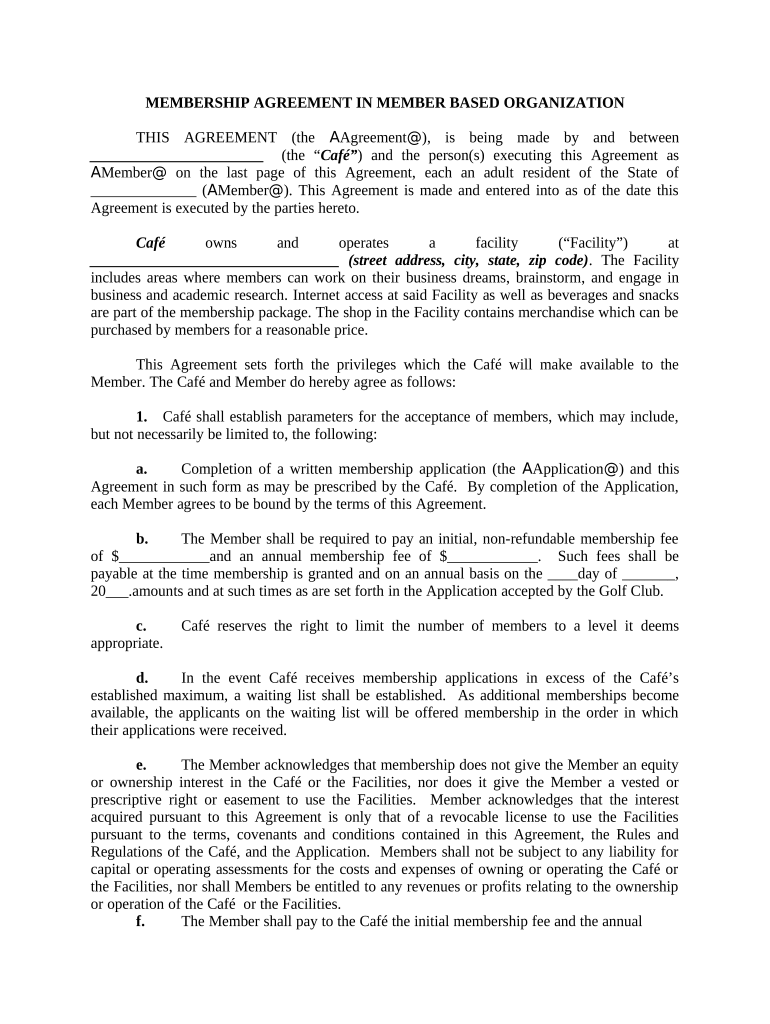
A clear Membership Agreement reduces ambiguity about rights, fees, and termination and supports enforcement in disputes. Electronic execution is valid under the ESIGN Act (15 U.S.C. ch. 96) and state UETA statutes where adopted, provided intent, consent, attribution, and record retention requirements are met.

Organizations and individual members each play distinct roles: organizations prepare and manage the agreement; members review, accept, and perform obligations.
Knowing each party's role helps assign signature authority, set up approval workflows, and ensure required notices and disclosures reach the right recipients.
The organization should be signed by an officer or authorized representative (board chair, CEO, executive director). That signer must have authority under corporate bylaws or governing documents to bind the organization to membership obligations and fee structures.
An individual member or an authorized representative of a member entity signs to accept terms, payment obligations, and consent to data processing. Verify identity and capacity before accepting signatures.
Define capitalized terms (Member, Term, Renewal, Dues, Services) to avoid ambiguity across clauses and schedules.
Describe access levels, voting rights, use of facilities or services, and any restrictions tied to membership classes.
Specify initial fees, recurring dues, payment methods, late fees, refund policy, and tax treatment where applicable.
State effective date, term length, auto-renewal mechanics, notice periods for nonrenewal, and early termination consequences.
List types of member data collected, permitted uses, retention period, and applicable privacy law compliance obligations.
Include governing law, venue, and whether arbitration or mediation is required before litigation.
| Field | Configuration |
|---|---|
| Signature order | Sequential or parallel signing; set default order |
| Authentication | Email link or SMS code; escalate to KBA if required |
| Reminders | Auto-remind signers at set intervals |
| Attachments | Include invoices, policy addenda, or membership cards |
Choose platforms and file formats that preserve layout, support audit trails, and meet any regulatory controls required for member data.
Ensure the chosen platform supports export of signed copies, retention of audit trails, and secure access controls for member records.
| signNow | DocuSign | Adobe Sign | PandaDoc | HelloSign | |
|---|---|---|---|---|---|
| Starting Price | $8/user/mo | $15/user/mo | $14/user/mo | $19/user/mo | $15/user/mo |
| Free Trial | 7-day free trial | Varies by vendor | Varies by vendor | Varies by vendor | Varies by vendor |
| Bulk Send | Yes | Yes | Yes | Yes | Varies |
| Audit Trail | Yes | Yes | Yes | Yes | Yes |
| Envelope Cap | No envelope cap | 100 envelopes/user/year | Varies | Varies | Varies |
Optica adopted standardized templates to reduce onboarding time and ensure consistency across chapters.
A small real estate association moved renewals online to avoid manual paperwork each year.
Specify exact MM/DD/YYYY effective date to determine start of obligations
Require written notice at least 30 days before renewal
State due date (e.g., within 30 days of invoice)
Set a notice window (e.g., 30–60 days) for member-initiated termination
Allow 1–5 business days for administrative activation after signature