Establishing secure connection…Loading editor…Preparing document…

Minnesota Adoption Form

This template is fully customizable. Edit the text, fill out the fields, and send it for signature. Give it a try!
Minnesota Adoption Form

What the Minnesota Adoption Form Covers

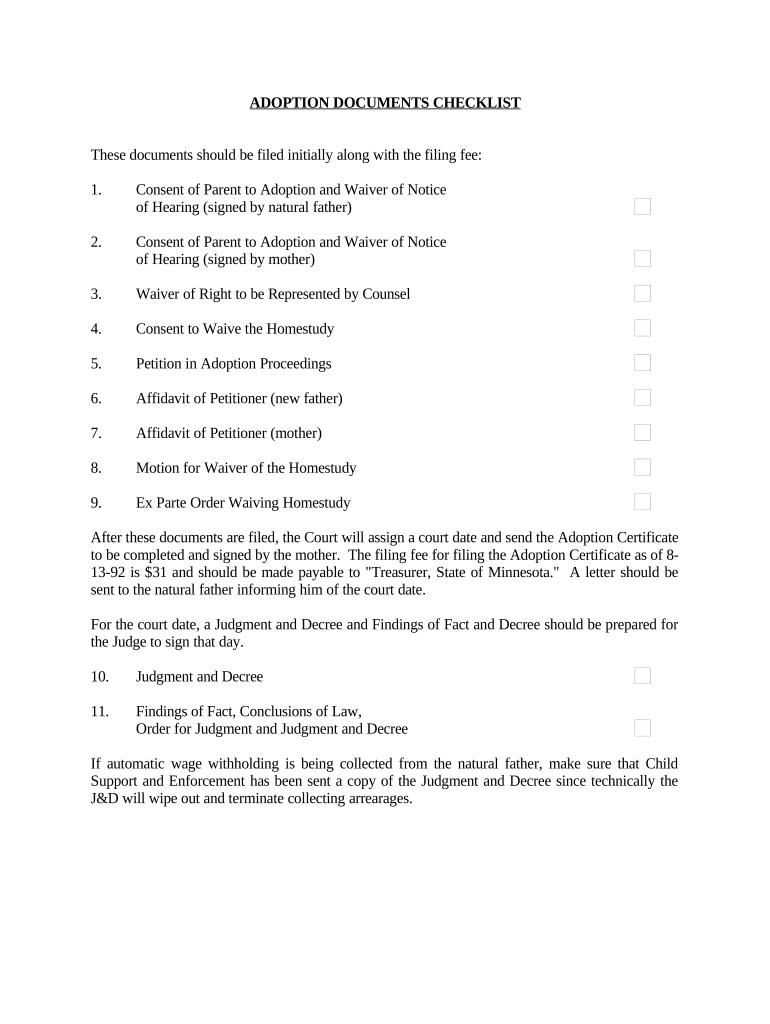
The Minnesota Adoption Form is the set of state and county documents used to initiate and complete an adoption proceeding in Minnesota, including petitions, consent forms, home study reports, and agency affidavits. These documents establish parental consent, background checks, and placement details and are submitted to a Minnesota district court for judicial review and final decree. Certain supporting documents may be completed electronically, but final court orders and adjudicative filings involving adoption are subject to court rules and statutory exceptions to electronic execution under federal ESIGN (15 U.S.C. ch. 96) and state adoption procedures.

Why Accurate Forms Matter for Adoption Proceedings

Using a correct Minnesota Adoption Form ensures legal clarity, documents required for court review, and consistent recordkeeping. Accurate forms streamline home studies, consent verification, and agency coordination while reducing delays in finalization when statutory requirements and supporting evidence are complete.

Why Accurate Forms Matter for Adoption Proceedings

Who Prepares and Files These Documents

Adoptive parents, licensed adoption agencies, attorneys, guardians ad litem, and county social services commonly prepare or file the Minnesota Adoption Form.

  • Prospective adoptive parents preparing petitions and consent materials as primary filers.
  • Licensed child-placing agencies completing home study documentation and placement reports.
  • Attorneys and court-appointed guardians managing filings, objections, and final decree submissions.

Core Sections Included in the Minnesota Adoption Form

A complete Minnesota Adoption Form package combines petition details, consent statements, background checks, home studies, placement reports, and court-required affidavits for judicial review.

Petition

Lists petitioner information, relationship to the child, reasons for adoption, requested legal relief, and the child's current status; forms must match county-specific formatting and provide truthful factual bases for court consideration.
Consent

Written parental or guardian consent must include acknowledgment of rights relinquished, legal counsel information, and clear dated signatures; some consents require notarization or court-supervised relinquishment procedures.

Home Study

Social worker reports assess the adoptive home environment, references, financial stability, criminal background checks, and recommendations; home studies are prepared by licensed evaluators and attached to the petition.

Background Checks

Include state and federal criminal histories, child abuse registry searches, fingerprinting results where required, and any DHS clearances to establish suitability for placement.

Placement Report

Documents describing the adoptive placement date, agency involvement, contact arrangements, visitation history, medical needs, and the child's prior living arrangements, used by courts in best-interest determinations.

Affidavits

Sworn affidavits from social workers, agency representatives, or witnesses verify factual statements, attach supporting exhibits, and provide the record foundation for the court's adoption decree.

Stepwise Process to Prepare and Submit the Form

Follow these sequential steps to prepare, sign, and submit the Minnesota Adoption Form to court and relevant agencies.

  • 01
    Gather Documents: Collect consent, birth certificate, ID, and home study.
  • 02
    Complete Forms: Fill petition, consent, and agency sections completely.
  • 03
    Authenticate: Sign, notarize where required, attach supporting affidavits.
  • 04
    File with Court: Submit to county clerk and serve interested parties.

How to Configure an Online Completion Workflow

Configure online workflows to capture signatures, manage attachments, and route documents to courts, agencies, and counsel.

Field Configuration
Signature Method Email link with verification or RON where accepted.
Attachments Support docs uploaded as PDFs, labeled, and locked.
Routing Sequential or parallel routing to parties and agencies.
Notifications Automated confirmations and reminders for signers and clerks.

Submission Flow from Preparation to Court Decree

Typical submission flow shows who completes each step from preparation through court filing and record retention.

  • Prepare: Draft forms and assemble exhibits.
  • Sign: Parties sign; notary or witness if applicable.
  • File: Deliver to county clerk, pay fees.
  • Court Review: Judge reviews and issues decree.

Technical Considerations for Electronic Completion

Electronic submission options vary by county; verify local e‑filing availability before preparing digital packets.

  • Formats Supported: PDF/A, DOCX, and scanned images.
  • Integrations: Connects with court e-file systems, case management.
  • Authentication: Email, SMS code, or stronger MFA.

Legal Risks from Incorrect or Incomplete Forms

Invalid Consent: May void adoption decree
Delayed Finalization: Court may continue or hold hearing
Perjury Exposure: Criminal penalties for false statements
Loss of Rights: Unintended consequences for improperly executed forms
Confidentiality Breach: Sensitive records exposed without safeguards
Filing Rejection: Clerk returns incomplete or unsigned filings

Common Preparation Errors to Avoid

  • Using incomplete or unsigned consent forms leads to clerk rejection and delays in scheduling hearings.
  • Mismatched names or dates between birth certificates, petitions, and background checks require affidavits and prolong finalization.
  • Failing to verify county-specific e-filing rules or judge preferences can force paper re-filing or in-person appearances.
  • Not notarizing signatures where required or relying on an unsupported e-signature can render documents unacceptable.

Time-Sensitive Items and Typical Scheduling

Key deadlines include filing dates, statutory waiting periods for consent revocation, hearing scheduling, and timeframe for updating background checks.

Filing Date:

Date petition is submitted to county clerk

Consent Period:

Minnesota allows limited revocation window; check state statute

Hearing Notice:

Court issues hearing date; parties must be served per rules

Background Checks:

Must be current within agency-defined period, often 6–12 months

Final Decree:

Judge signs decree after hearing and statutory criteria met

Typical Signers and Their Responsibilities

Prospective Parent — Petitioner

The petitioner completes identifying information, signs consent where required, and provides affidavit of suitability. As the legal party seeking adoption, the petitioner must ensure accuracy of names, dates, and attachments to avoid procedural delays at the county clerk's office.

Home Study Provider — Social Worker

A licensed social worker or agency prepares the home study, attests to references and suitability, and supplies a sworn report. The provider signs under penalty of perjury and must include license number, contact information, and report date for court acceptance.

Practical Examples from Agency and Private Filings

Real-world examples show how forms and processes differ by agency, county, and case complexity below.

Agency Adoption

A licensed agency filed a petition with complete home study and consent forms electronically, but clerk required wet-notarized consents.

  • E-signatures were accepted for reports.
  • The agency re-obtained notarized consent pages in person and resubmitted the packet, adding a sworn affidavit explaining the signature method; the court accepted the corrected filing without further continuance prompt.

Private Placement

A private placement adoption involved parents filing pro se with counsel review of consent documents and a court-ordered home visit.

  • Judge requested additional medical records.
  • After providing the records and an updated home study, the parties received a written finding of best interest and the court entered the final decree; the record included notarized consents.

eSignature Pricing and Feature Comparison for Adoption Workflows

Compare baseline pricing and feature differences among leading eSignature providers for workflows involving the Minnesota Adoption Form.

signNow DocuSign Adobe Sign PandaDoc HelloSign
Starting Price $8/user/mo $15/user/mo $14/user/mo $19/user/mo $15/user/mo
Free Trial 7-day free trial Varies by plan Varies by plan Varies by plan Varies by plan
Bulk Send Yes Yes Yes Yes No
Audit Trail Yes Yes Yes Yes Yes
HIPAA Compliant Yes Yes Yes No No

Frequently Asked Questions about the Minnesota Adoption Form

Answers to frequently asked questions about completing, signing, and filing the Minnesota Adoption Form, including eSigning limits and notarization.


Need help? Contact support

be ready to get more
Join over 28 million airSlate SignNow users