Establishing secure connection…Loading editor…Preparing document…

Minnesota Easement Form

This template is fully customizable. Edit the text, fill out the fields, and send it for signature. Give it a try!
Minnesota Easement Form

What the Minnesota Easement Form Is and when it applies

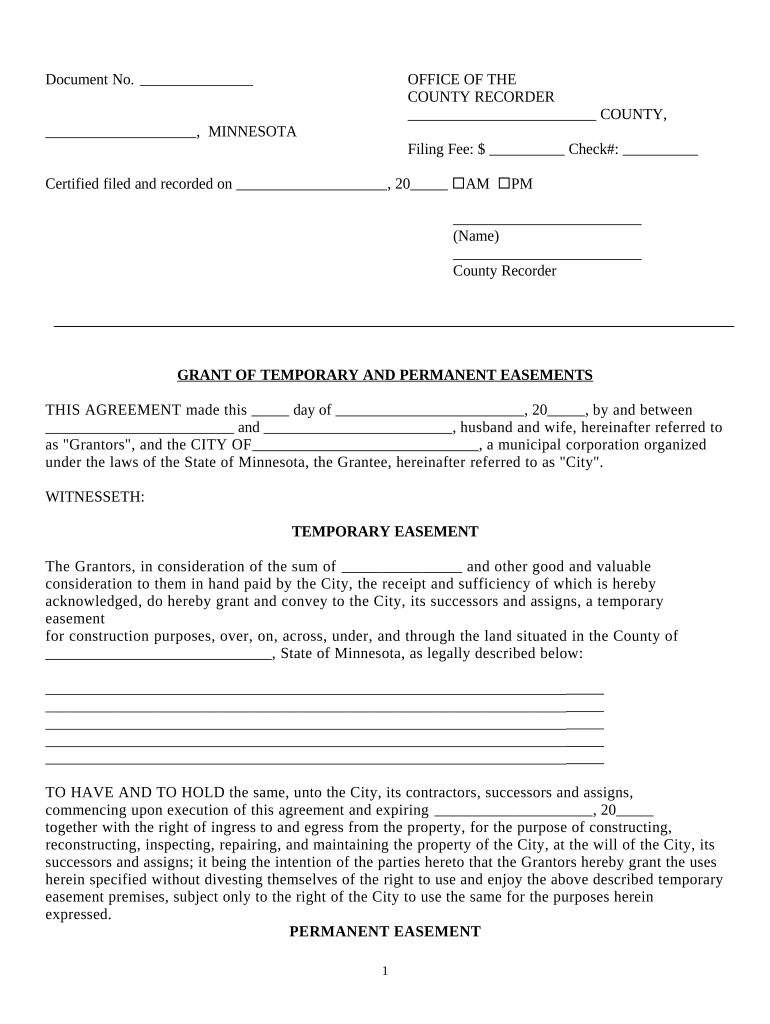
The Minnesota Easement Form documents a property owner’s grant of a limited right to use, cross, or access part of land for a defined purpose, such as utilities, access roads, or drainage. It identifies the grantor and grantee, describes the easement area with a legal description or survey reference, states the permitted uses and any limitations, and specifies duration and consideration. Proper execution, notarization, and county recording are normally required to create public notice and protect priority against later claims.

Why using a clear easement form matters

A professionally prepared Minnesota Easement Form clarifies rights and obligations, reduces future disputes, preserves marketable title through prompt recording, and creates a clear chain of title for buyers, lenders, and public agencies.

Why using a clear easement form matters

Who commonly prepares and signs this form

Typical parties and professionals involved in preparing and executing an easement in Minnesota.

  • Property owners and grantors who convey limited use rights over land to another party.
  • Grantees such as utilities, municipalities, or neighboring landowners receiving access or use rights.
  • Real estate attorneys, title companies, and county recording offices that review, approve, and record the instrument.

Core sections to include in a professional Minnesota Easement Form

A complete easement form combines precise parties, legal descriptions, defined scope, duration terms, consideration, and allocation of maintenance and liability to avoid ambiguity during recording or enforcement.

Granting Clause

A focused statement that the grantor conveys to the grantee a specific easement right; it should precisely describe the interest being created and any limits on its use.
Legal Description

A surveyed legal description or recorded plat reference that unambiguously locates the easement area; attach or reference a survey exhibit whenever possible for clarity.

Scope of Use

Detailed permitted activities (e.g., ingress/egress, utilities, drainage), hours or seasonal limits if any, and prohibited uses to prevent future disputes about acceptable operations.

Term and Termination

State whether the easement is perpetual, for a fixed term, or conditional; include explicit termination events and any reversion language for the grantor.

Consideration

Record the monetary amount or other value exchanged (if any) and whether the easement was granted for nominal consideration, which affects enforceability and tax reporting.

Maintenance and Indemnity

Specify which party maintains improvements, accesses the easement, and indemnifies the other for claims, including insurance requirements and limits on liability.

Required information elements at a glance

Grantor: Full legal name
Grantee: Full legal entity name
Property Description: Survey or parcel ID
Easement Purpose: Specific permitted use
Term: Duration or perpetual
Consideration: Amount or nominal value

Step-by-step: completing a Minnesota Easement Form

A concise sequence helps avoid common delays: collect documents, prepare the draft, confirm legal description, obtain signatures and notary acknowledgement, then record with the county.

  • 01
    Gather documents: Title report, survey, and owner identification.
  • 02
    Draft easement: Include scope, term, and exhibits.
  • 03
    Review and approve: Parties and counsel review language.
  • 04
    Execute and notarize: Sign in presence of notary; prepare for recording.

Where to submit the executed easement

Recording the executed and notarized easement with the appropriate county office creates public notice; follow local county recorder procedures for document format and fees.

  • County Recorder: Primary filing location for establishing public notice.
  • Title Company: Send a copy for title updates and lender notice.
  • Grantee Delivery: Provide executed copies to the grantee for operations.
  • Digital Storage: Store a scanned, dated copy in secure records.

Configuring an online completion workflow

Set the workflow to collect required fields, obtain signer authentication, and record a complete audit trail before distributing final copies to stakeholders.

Field Configuration
Required Fields Make legal name and description mandatory
Signer Authentication Use email plus SMS or KBA where needed
Notifications Auto-notify parties upon completion
Storage Save signed PDF and audit trail

Delivery options and technical requirements for eSigning

Choose a platform that supports PDF, Word, and recorded audit trails, and can produce notarizable documents or integrate with RON providers when required.

  • File formats: PDF, DOCX supported
  • Authentication: Email, SMS, KBA options
  • Integrations: Connects with common systems

Timing considerations and recording priority

Record promptly after execution to ensure priority against later conveyances; workflow timing affects title insurance and lender acceptance.

Execution Date:

Date on which the parties sign the instrument

Notarization:

Complete acknowledgement before recording

Recording:

Record promptly to establish priority

Delivery:

Send copies to grantee and title company

Retention:

Keep executed originals and digital copies

Notarization and authentication: practical step flow

Follow a consistent signer verification and notary workflow so the county recorder accepts the instrument without delay; steps may vary if a remote notarization is used.

01

Identify Signer

Confirm identity using ID credential analysis.

02

Signer Appears

Signer appears physically or via approved RON session.

03

Notary Acknowledgement

Notary completes acknowledgment block on the document.

04

Record Journal

Notary records session details in the journal.

05

Attach Exhibits

Include survey or plat as exhibit for clarity.

06

County Acceptance

Submit per county formatting and margin rules.

07

Receive Recording

Recorder returns recorded document or stamp.

08

Distribute Copies

Provide recorded copies to all parties.

Consequences and legal risks of errors or omissions

Recording Delay: Loss of priority
Incorrect Description: Title exceptions and disputes
Missing Notary: Recorder rejection
Unclear Scope: Litigation risk
Tax Misreporting: IRS penalties possible
Invalid Signatures: Enforceability challenges

Common mistakes to avoid when preparing an easement

  • Using an imprecise or non‑survey description that creates ambiguity about the easement’s physical bounds and invites boundary disputes and title exceptions.
  • Failing to include or attach a survey exhibit when required, which commonly leads recorders or title companies to flag exceptions and delay closings.
  • Neglecting notarization requirements or relying on an improperly executed acknowledgement, resulting in recorder rejection or later attempts to quiet title.
  • Omitting maintenance, access, or indemnity provisions that leave unresolved responsibilities and increase the likelihood of future litigation.

Practical tips for accurate, efficient completion

Follow these recommended practices to reduce rework, recording delays, and title objections when creating or accepting an easement.

Attach a certified survey exhibit
Include a labeled survey or plat showing the easement area and reference it in the body of the easement; a certified exhibit prevents boundary ambiguity and expedites title review and recorder acceptance.
Use precise, narrow language
Describe permitted uses, access hours, equipment limitations, and maintenance obligations in specific terms to limit interpretation disputes and reduce the risk of litigation or title exceptions.
Confirm all names and vesting
Verify the grantor’s and grantee’s legal names match title records and identification to avoid mismatches that cause recording rejections or require corrective instruments later.
Coordinate recording with title/lender
Ask the title company or lender what endorsements or endorsements are required and record the easement in the sequence that preserves lender interests and ensures proper title updates.

Real-world scenarios where a Minnesota Easement Form is used

Two short examples illustrate how different parties use an easement form and the outcomes when executed properly.

Martin Properties example

A developer needed a permanent access easement across a neighboring lot to reach a subdivided parcel

  • The easement specified ingress/egress only and included a surveyed exhibit
  • After recording the easement the developer obtained clear title benefits and lender approval with a single recording event and updated title commitment.

Optica Ventures example

A utility company required an underground conduit easement to run fiber along private property

  • The easement included defined depth and restoration obligations
  • Precise scope and indemnity language minimized disputes and ensured timely permitting and installation.

eSignature vendor comparison for executing and managing easements

Select a provider that supports notarizable PDFs, audit trails, secure storage, and integrations with title or document management systems; below is a high‑level pricing and capability snapshot.

signNow DocuSign Adobe Sign PandaDoc HelloSign
Starting Price $8/user/mo $15/user/mo $14/user/mo $19/user/mo $15/user/mo
Free Trial 7-day free trial Varies Varies Varies Varies
Bulk Send Yes (plan dependent) Varies Varies Varies Varies
Audit Trail Yes Yes Yes Yes Yes
HIPAA Compliant Yes Yes Yes No No
Envelope Cap No cap 100 envelopes/user/year Varies Varies Varies

Frequently asked questions about Minnesota Easement Forms

Answers to common questions about validity, notarization, recording, revocation, and digital signing for easements in Minnesota and comparable jurisdictions.


Need help? Contact support

be ready to get more
Join over 28 million airSlate SignNow users